



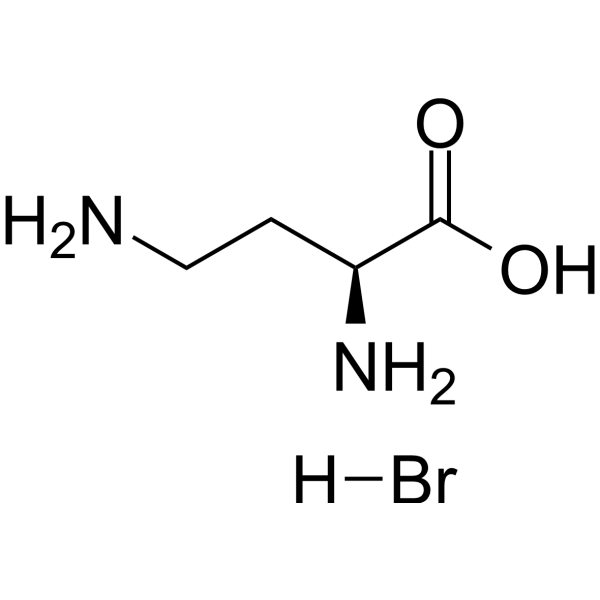
L-DABA hydrobromide
Based on 2 publication(s) in Google Scholar
L-DABA (L-2,4-Diaminobutyric acid) hydrobromide is a week GABA transaminase inhibitor with an IC50 of larger than 500 μM; exhibits antitumor activity in vivo and in vitro.
For research use only. We do not sell to patients.
- Purity : 98.0%
- CAS No.: 73143-97-2
- Formula: C4H11BrN2O2
- Molecular Weight:199.05
-
Storage:
4°C, sealed storage, away from moisture
* In solvent : -80°C, 6 months; -20°C, 1 month (sealed storage, away from moisture)

To place orders, for customer services and technical support, please contact: MedChemExpress USA
Tel: 609-228-6898 E-mail: [email protected] [email protected]


-
 Biological Activity
-
Chemical Information
-
Solvent & Solubility
- Protocols
- Purity & Documentation
- References
-
 Help & FAQs


Publications Citing Use of MedChemExpress (MCE) L-DABA hydrobromide
MoreAll Endogenous Metabolite Isoforms
More

Biological Activity
Description
IC50 & Target
IC50: larger than 500 μM (GABA transaminase)[1]
In Vitro
The tumor cells are irreversibly and totally damaged by incubation with 10 mM L-2,4-Diaminobutyric acid for 24 h at 37°C. The cell-destructive effect by L-DABA hydrobromide is probably due to an osmotic lysis induced by the non-saturated intracellular accumulation of L-DABA hydrobromide. The harmful effect of L-DABA hydrobromide could be abolished by concomitant incubation with L-alanine and L-methionine[1]. Kinetic studies indicates that L-DABA hydrobromide is a non-linear, non-competitive inhibitor of GABA transaminase activity. The L-DABA hydrobromide-induced elevation of GABA levels parallels the inhibition of GABA transaminase activity[2]. L-2,4-Diaminobutyric acid, an amino acid analogue, produceS a cytolytic effect with a human glioma cell line, SKMG-1, and normal human fibroblasts. The concentrations of L-DABA hydrobromide necessary to reduce the cell count to 50% of control following a 24-h incubation at 37°C are 12.5 mM for the human fibroblasts and 20 mM for the glioma cell line[3].
MedChemExpress (MCE) has not independently confirmed the accuracy of these methods. They are for reference only. Further protocols information, click here.
In Vivo


Chemical Information
-
CAS No. 73143-97-2
-
Appearance Solid
-
Molecular Weight 199.05
-
Formula C4H11BrN2O2
-
Color White to off-white
-
SMILES
NCC[C@H](N)C(O)=O.[H]Br
-
Synonyms
L-2,4-Diaminobutyric acid hydrobromide
-
Structure Classification
-
Initial Source
-
Shipping
Room temperature in continental US; may vary elsewhere.
-
Storage
4°C, sealed storage, away from moisture
* In solvent : -80°C, 6 months; -20°C, 1 month (sealed storage, away from moisture)


Publications (2)
-
Journal Impact Factor
-
Most Recent
-
Nature
2025 Jul;643(8070):192-200. PMID: 39695227 -
Ann Bot
Integrated LC/MS-MS approaches reveal toxicity differences across seed layers of Cycas angulata. [Abstract]2026 Jun 17:mcag169. PMID: 42308138


Solvent & Solubility
In Vitro:
H2O : 33.33 mg/mL (167.45 mM; Need ultrasonic)
Please refer to the solubility information to select the appropriate solvent. Once prepared, please aliquot and store the solution to prevent product inactivation from repeated freeze-thaw cycles.
Storage method and period of stock solution: -80°C, 6 months; -20°C, 1 month (sealed storage, away from moisture). When stored at -80°C, please use it within 6 months. When stored at -20°C, please use it within 1 month.
* Note: If you choose water as the stock solution, please dilute it to the working solution, then filter and sterilize it with a 0.22 μm filter before use.
Please refer to the solubility information to select the appropriate solvent. Once prepared, please aliquot and store the solution to prevent product inactivation from repeated freeze-thaw cycles.
Storage method and period of stock solution: -80°C, 6 months; -20°C, 1 month (sealed storage, away from moisture). When stored at -80°C, please use it within 6 months. When stored at -20°C, please use it within 1 month.
* Note: If you choose water as the stock solution, please dilute it to the working solution, then filter and sterilize it with a 0.22 μm filter before use.
Concentration (start) × Volume (start) = Concentration (final) × Volume (final)

Protocols
-
Cell Cytotoxicity Assay
Cytotoxicity assays are usually based on the assessment of cell membrane damage, which can also be indirectly detected by measuring cell viability. Detection methods include MTT assay, CKK-8 assay, LDH assay and ATP assay, etc.
-
Subcutaneous Cell-Line-Derived Xenograft
Subcutaneous cell-line-derived xenograft (CDX) models are established by implanting cultured human cancer cell lines into immunodeficient mice, where the injected cells form localized tumors that can be monitored in vivo as a measure of tumorigenic potential, growth kinetics, and treatment response. These models are widely used in oncology research because they allow reproducible tumor formation and enable comparative assessment of tumor growth between different cell lines or genetic manipulations in a controlled in vivo microenvironment. Subcutaneous implantation of cancer cells in immunodeficient mice is a standard approach for evaluating tumor growth behavior and therapeutic response across multiple cancer types, including prostate, esophageal, pancreatic, and colon cancer models.


Purity & Documentation
-
Data Sheet (280 KB)
-
SDS (394 KB)
- English - EN (394 KB)
- Français - FR (394 KB)
- Deutsch - DE (394 KB)
- Norwegian - NO (394 KB)
- Español - ES (394 KB)
- Swedish - SV (394 KB)
- Italian - IT (394 KB)
- Korean - KR (394 KB)
- Portuguese - PT (394 KB)
-
Handling Instructions (2659 KB)
References
[1]. Ronquist G, et al. Antitumor activity of L-2,4 diaminobuturic acid against mouse fibrosarcoma cells in vitro and in vivo. J Cancer Res Clin Oncol. 1980;96(3):259-68. [Content Brief]
[2]. Beart PM, et al. l-2,4-Diaminobutyric acid and the GABA system. Neurosci Lett. 1977 Jul;5(3-4):193-8. [Content Brief]
[3]. Panasci L, et al. The cytolytic effect of L-2,4 diaminobutyric acid with malignant glioma cells and fibroblasts. Cancer Chemother Pharmacol. 1988;21(2):143-4. [Content Brief]


Complete Stock Solution Preparation Table
Please refer to the solubility information to select the appropriate solvent. Once prepared, please aliquot and store the solution to prevent product inactivation from repeated freeze-thaw cycles.
Storage method and period of stock solution: -80°C, 6 months; -20°C, 1 month (sealed storage, away from moisture). When stored at -80°C, please use it within 6 months. When stored at -20°C, please use it within 1 month.
| Optional Solvent | Concentration Solvent Mass | 1 mg | 5 mg | 10 mg | 25 mg |
|---|---|---|---|---|---|
| H2O | 1 mM | 5.0239 mL | 25.1193 mL | 50.2386 mL | 125.5966 mL |
| 5 mM | 1.0048 mL | 5.0239 mL | 10.0477 mL | 25.1193 mL | |
| 10 mM | 0.5024 mL | 2.5119 mL | 5.0239 mL | 12.5597 mL | |
| 15 mM | 0.3349 mL | 1.6746 mL | 3.3492 mL | 8.3731 mL | |
| 20 mM | 0.2512 mL | 1.2560 mL | 2.5119 mL | 6.2798 mL | |
| 25 mM | 0.2010 mL | 1.0048 mL | 2.0095 mL | 5.0239 mL | |
| 30 mM | 0.1675 mL | 0.8373 mL | 1.6746 mL | 4.1866 mL | |
| 40 mM | 0.1256 mL | 0.6280 mL | 1.2560 mL | 3.1399 mL | |
| 50 mM | 0.1005 mL | 0.5024 mL | 1.0048 mL | 2.5119 mL | |
| 60 mM | 0.0837 mL | 0.4187 mL | 0.8373 mL | 2.0933 mL | |
| 80 mM | 0.0628 mL | 0.3140 mL | 0.6280 mL | 1.5700 mL | |
| 100 mM | 0.0502 mL | 0.2512 mL | 0.5024 mL | 1.2560 mL |
* Note: If you choose water as the stock solution, please dilute it to the working solution, then filter and sterilize it with a 0.22 μm filter before use.


L-DABA hydrobromide Related Classifications
HY-101414A Related Classifications
 Powered by Bioz