



JAK2/TYK2-IN-1
Based on 1 publication(s) in Google Scholar
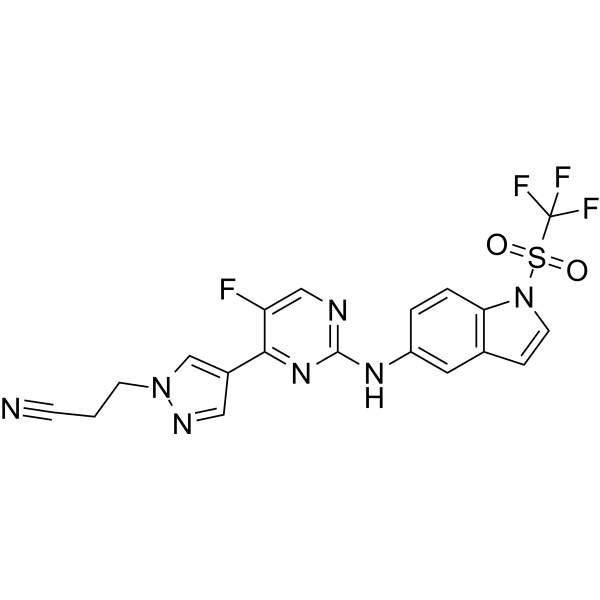
JAK2/TYK2-IN-2 is a potent and selective TYK2 inhibitor with IC50 values of 9 and 157 nM for TYK2 and JAK2, respectively. JAK2/TYK2-IN-2 has anti-inflammatory activity.
Nur für Forschungszwecke. Wir verkaufen nicht an Patienten.
- Reinheit : 99.94%
- CAS. Nr.: 2613434-12-9
- Formel: C19H13F4N7O2S
-
Speicherung:Powder -20°C, 3 years , 4°C, 2 years ; In solvent -80°C, 6 months , -20°C, 1 month

To place orders, for customer services and technical support, please contact: MedChemExpress USA
Tel: 609-228-6898 E-mail: [email protected] [email protected]


-
 Biologische Aktivität
-
Chemical Information
-
Lösungsmittel & Löslichkeit
- Protokoll
- Reinheit & Dokumentation
- Verweise
-
 Help & FAQs


Publications Citing Use of MedChemExpress (MCE) JAK2/TYK2-IN-1
More

Biologische Aktivität
Beschreibung
IC50 & Target
|
Tyk2 9 nM (IC50) |
JAK2 157 nM (IC50) |
In Vitro
JAK2/TYK2-IN-2 (compound 14l; 0-10000 nM) inhibits the phosphorylation of STAT in vitro[1].
MedChemExpress (MCE) has not independently confirmed the accuracy of these methods. They are for reference only.
-
Cell Line:TF-1, H9, TF-1, THP-1 cells
-
Concentration:0-10000 nM
-
Incubation Time:
-
Result:After stimulation with IL-6 and IFN-α at a concentration of 100 to 5000 nM, JAK2/TYK2-IN-2 reduced JAK1/JAK2/TYK2 and JAK1/TYK2-dependent signal transduction in a dose-dependent manner and remarkably reduced IFN-α-induced phosphorylation at 10 000 nM.
In Vivo
JAK2/TYK2-IN-2 (5, 20 mg/kg; oral administration; twice a day for 12 days) leads to a low oral bioavailability[1].Pharmacokinetic Parameters of JAK1/TYK2-IN-2 in Male Sprague-Dawley rats[1]
| PK parameters | iv | PK parameters | p.o. |
| AUC(0-t) (μg/L*h) | 29.00 | AUC(0-t) (μg/L*h) | 13.89 |
| MRT(0-t) (h) | 4.98 | MRT(0-t) (h) | 2.76 |
| t1/2 (h) | 5.95 | t1/2 (h) | 3.64 |
| Cl (L/min/kg) | 1.58 | Cl (L/min/kg) | 20.55 |
| Vss (L/kg) | 985.41 | Vss (L/kg) | 6564.28 |
| Cmax (μg/L) | 48.55 | Cmax (μg/L) | 8.00 |
| Tmax (h) | 1.00 | ||
| F | 11.96% |
MedChemExpress (MCE) has not independently confirmed the accuracy of these methods. They are for reference only.
-
Animal Model:Six-eight week old male C57BL/6 mice, 20-22 g (acute mice colitis model)[1]
-
Dosage:10, 20 mg/kg (dissolved in 5% EtOH, 1% Propylene glycol, 0.5% Tween 80 and 92.5% physiological saline)
-
Administration:Oral administration, twice a day; 6 consecutive days
-
Result:Exhibited anti-inflammatory activity and have a good therapeutic effect on inflammatory bowel disease (IBD) in a dose-dependent manner.


Chemical Information
-
CAS. Nr. 2613434-12-9
-
Appearance Solid
-
Formel C19H13F4N7O2S
-
Color White to off-white
-
SMILES
N#CCCN1N=CC(C2=NC(NC3=CC4=C(N(S(=O)(C(F)(F)F)=O)C=C4)C=C3)=NC=C2F)=C1
-
Versand
Room temperature in continental US; may vary elsewhere.
-
Speicherung
Powder -20°C 3 years 4°C 2 years In solvent -80°C 6 months -20°C 1 month


Publications (1)
-
Journal Impact Factor
-
Most Recent


Lösungsmittel & Löslichkeit
In Vitro:
DMSO : 50 mg/mL (Need ultrasonic; Hygroscopic DMSO has a significant impact on the solubility of product, please use newly opened DMSO)


Reinheit & Dokumentation
-
Data Sheet (274 KB)
-
SDS (252 KB)
- English - EN (252 KB)
- Français - FR (252 KB)
- Deutsch - DE (252 KB)
- Norwegian - NO (252 KB)
- Español - ES (252 KB)
- Swedish - SV (252 KB)
- Italian - IT (252 KB)
- Korean - KR (252 KB)
- Portuguese - PT (252 KB)
-
Handling Instructions (2659 KB)
Verweise

Calculators
Konzentration (Stammlösung) × Volumen (Stammlösung) = Konzentration (Ziellösung) × Volumen (Ziellösung)


JAK2/TYK2-IN-1 Related Classifications
HY-143884 Related Classifications
 Powered by Bioz