



AZ3451
Based on 14 publication(s) in Google Scholar
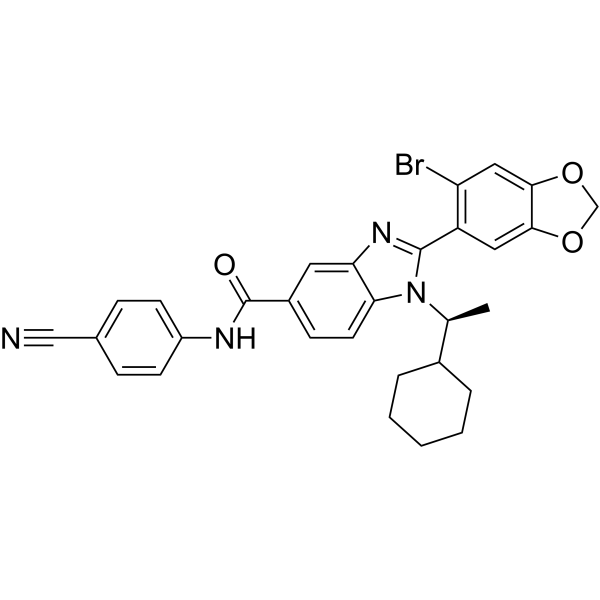
AZ3451 is a potent protease-activated receptor-2 (PAR2) antagonist with IC50 of 23 nM.
For research use only. We do not sell to patients.
- Purity: 99.88%
- CAS No.: 2100284-59-9
- Formula: C30H27BrN4O3
- Molecular Weight:571.46
-
Storage:Powder -20°C, 3 years , 4°C, 2 years ; In solvent -80°C, 2 years , -20°C, 1 year

To place orders, for customer services and technical support, please contact: MedChemExpress USA
Tel: 609-228-6898 E-mail: [email protected] [email protected]


-
 Biological Activity
-
Chemical Information
-
Solvent & Solubility
- Purity & Documentation
- References
-
 Help & FAQs
-

GPCR/G Protein Compound Library
HY-L006
-
Immunology/Inflammation Compound Library
HY-L007
-
Coagulation and Anti-coagulation Compound Library
HY-L136
-
Membrane Protein-targeted Compound Library
HY-L149
-
Membrane Receptor-targeted Compound Library
HY-L150
-
Highly Selective Inhibitors Library
HY-L158
-
Bioactive Compound Library Max
HY-L181
-
MCE Bioactive Compound Library
HY-L001V
-
Bioactive Compound Library
HY-L001
-
High-Throughput Bioactive Compound Library
HY-L205
-
Lactylation Compound Library
HY-L249


Publications Citing Use of MedChemExpress (MCE) AZ3451
More- Cancer Cell. 2024 Oct 14;42(10):1676-1692.e11. [Abstract]
- Nat Commun. 2026 Jan 22;17(1):1946. [Abstract]
- Exp Mol Med. 2024 Dec;56(12):2631-2641. [Abstract]
- Commun Biol. 2026 May 11. [Abstract]
- Mucosal Immunol. 2026 Feb 21:S1933-0219(26)00021-8. [Abstract]
- Function (Oxf). 2024 Sep 10;5(5):zqae030. [Abstract]
- J Dermatol Sci. 2022 Jun;106(3):181-188. [Abstract]
- FASEB J. 2024 Mar 31;38(6):e23566. [Abstract]
- J Cell Physiol. 2025 Apr;240(4):e70025. [Abstract]
- PLoS Negl Trop Dis. 2024 Jan 2;18(1):e0011874. [Abstract]
- Immunol Res. 2026 May 14;74(1):55. [Abstract]
- Res Sq. 2026 May 10.
- New York University. 2025.
- Aging (Albany NY). 2019 Dec 16;11(24):12532-12545. [Abstract]
 Customer Validation & Images

-
WB
-
RT-PCR
-
WB
-
Cell Imaging/Staining
-
Cell Imaging/Staining


Biological Activity
|
PAR2 23 nM (IC50) |
Antagonist AZ3451 binds to a remote allosteric site outside the helical bundle of the protease-activated receptor 2. AZ3451 is highly lipophilic, which coincides with the hydrophobic nature of the binding pocket within the membrane. Antagonist binding prevents structural rearrangements required for receptor activation and signalling[1].
MedChemExpress (MCE) has not independently confirmed the accuracy of these methods. They are for reference only.


Chemical Information
-
CAS No. 2100284-59-9
-
Appearance Solid
-
Molecular Weight 571.46
-
Formula C30H27BrN4O3
-
Color White to light brown
-
SMILES
O=C(C1=CC=C2C(N=C(C3=C(Br)C=C(OCO4)C4=C3)N2[C@H](C5CCCCC5)C)=C1)NC6=CC=C(C#N)C=C6
-
Shipping
Room temperature in continental US; may vary elsewhere.
-
Storage
Powder -20°C 3 years 4°C 2 years In solvent -80°C 2 years -20°C 1 year


Publications (14)
-
Journal Impact Factor
-
Most Recent
-
Cancer Cell
Coagulation factor X promotes resistance to androgen-deprivation therapy in prostate cancer. [Abstract]2024 Oct 14;42(10):1676-1692.e11. PMID: 39303726 -
Nat Commun
Atypical pericapillary Ly6G⁺Nur77⁺ macrophages initiate type-2 immune responses to allergens in the mouse lung. [Abstract]2026 Jan 22;17(1):1946. PMID: 41571657 -
Exp Mol Med
Distribution and impact of p16INK4A+ senescent cells in elderly tissues: a focus on senescent immune cell and epithelial dysfunction. [Abstract]2024 Dec;56(12):2631-2641. PMID: 39617789 -
Commun Biol
2026 May 11. PMID: 42115777 -
Mucosal Immunol
Interaction between airway basal cells, mast cells and type 2 immunity contributes to epithelial barrier dysfunction in allergic rhinitis. [Abstract]2026 Feb 21:S1933-0219(26)00021-8. PMID: 41730474 -
Function (Oxf)
2024 Sep 10;5(5):zqae030. PMID: 38984988 -
J Dermatol Sci
2022 Jun;106(3):181-188. PMID: 35637111 -
FASEB J
The ecotin-like peptidase inhibitor of Trypanosoma cruzi prevents TMPRSS2-PAR2-TLR4 crosstalk downmodulating infection and inflammation. [Abstract]2024 Mar 31;38(6):e23566. PMID: 38526868 -
J Cell Physiol
The Thromboxane Levels in Ovarian Follicular Fluid Are Inversely Correlated With Oocyte Maturation: Implications of PAR-2/-3 Cooperation and Thromboxane Participation in Follicle Development. [Abstract]2025 Apr;240(4):e70025. PMID: 40170403 -
PLoS Negl Trop Dis
A novel trypsin of Trichinella spiralis mediates larval invasion of gut epithelium via binding to PAR2 and activating ERK1/2 pathway. [Abstract]2024 Jan 2;18(1):e0011874. PMID: 38166153 -
Immunol Res
Crosstalk between the monocytes and coagulation factor VⅡa aggravates the inflammation in patients with CAD. [Abstract]2026 May 14;74(1):55. PMID: 42128959 -
-
-
Aging (Albany NY)
Protease-activated receptor 2 (PAR-2) antagonist AZ3451 as a novel therapeutic agent for osteoarthritis. [Abstract]2019 Dec 16;11(24):12532-12545. PMID: 31841119
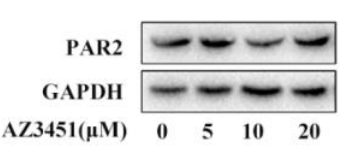
AZ3451 purchased from MedChemExpress. Usage Cited in: Aging (Albany NY). 2019 Dec 16;11(24):12532-12545. [Abstract]
AZ3451 (0-20 μM) can effectively inhibit PAR2 expression in chondrocytes.
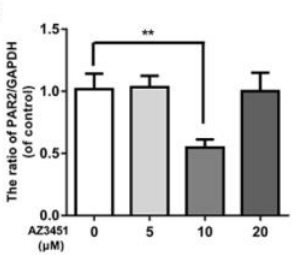
AZ3451 purchased from MedChemExpress. Usage Cited in: Aging (Albany NY). 2019 Dec 16;11(24):12532-12545. [Abstract]
AZ3451 (0-20 μM) can effectively inhibit PAR2 expression in chondrocytes.
AZ3451 purchased from MedChemExpress. Usage Cited in: Aging (Albany NY). 2019 Dec 16;11(24):12532-12545. [Abstract]
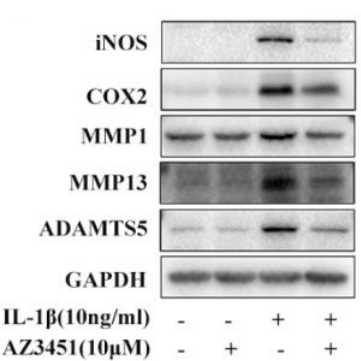
IL-1β increased the inflammatory cytokines and catabolic genes expression, including iNOS, COX2, MMP1, MMP13 and ADAMTS5, while treatment with AZ3451 (10 μM) alleviated this process.
AZ3451 purchased from MedChemExpress. Usage Cited in: Aging (Albany NY). 2019 Dec 16;11(24):12532-12545. [Abstract]
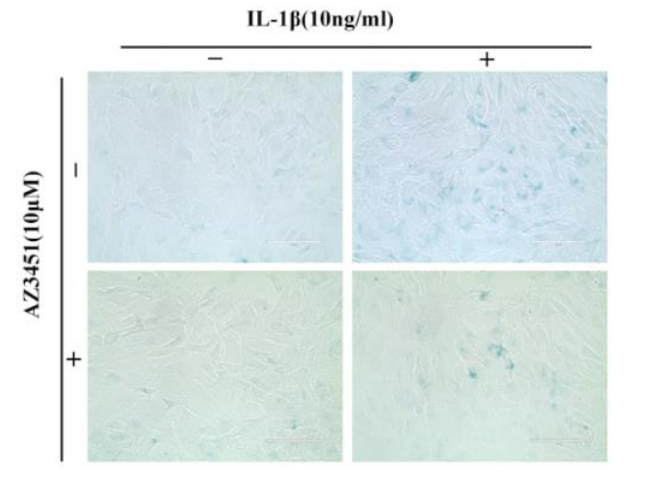
The IL-1β-treated chondrocytes exerted higher SA-β-gal activity and p16INK4a protein expression compared with the control group, while PAR2 antagonist AZ3451 (10 μM) significantly prevented this process.
AZ3451 purchased from MedChemExpress. Usage Cited in: Aging (Albany NY). 2019 Dec 16;11(24):12532-12545. [Abstract]
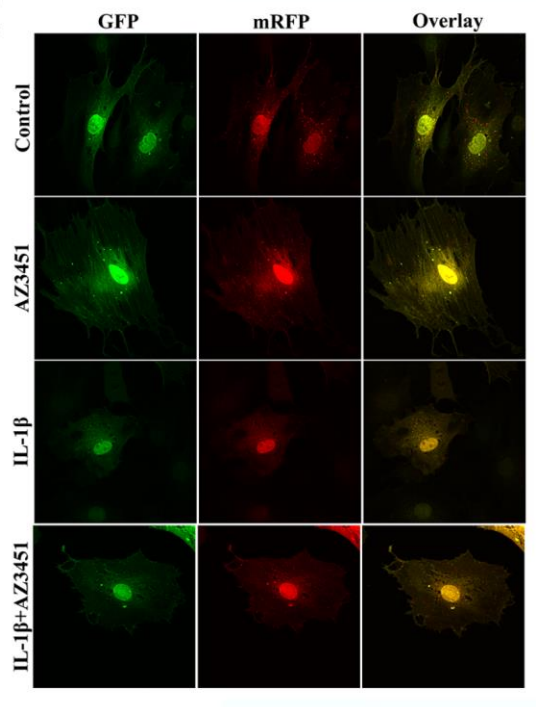
After infection with the GFP-RFP-LC3 adenovirus, there was fewer red puncta under IL-1β stimulation in chondrocytes; However, AZ3451 treatment cells presented more red puncta. These results demonstrated that AZ3451 could enhance autophagosome conversion to autophagolysosomes and thus promoting autophagy flux and autophagy level.
AZ3451 purchased from MedChemExpress. Usage Cited in: Aging (Albany NY). 2019 Dec 16;11(24):12532-12545. [Abstract]
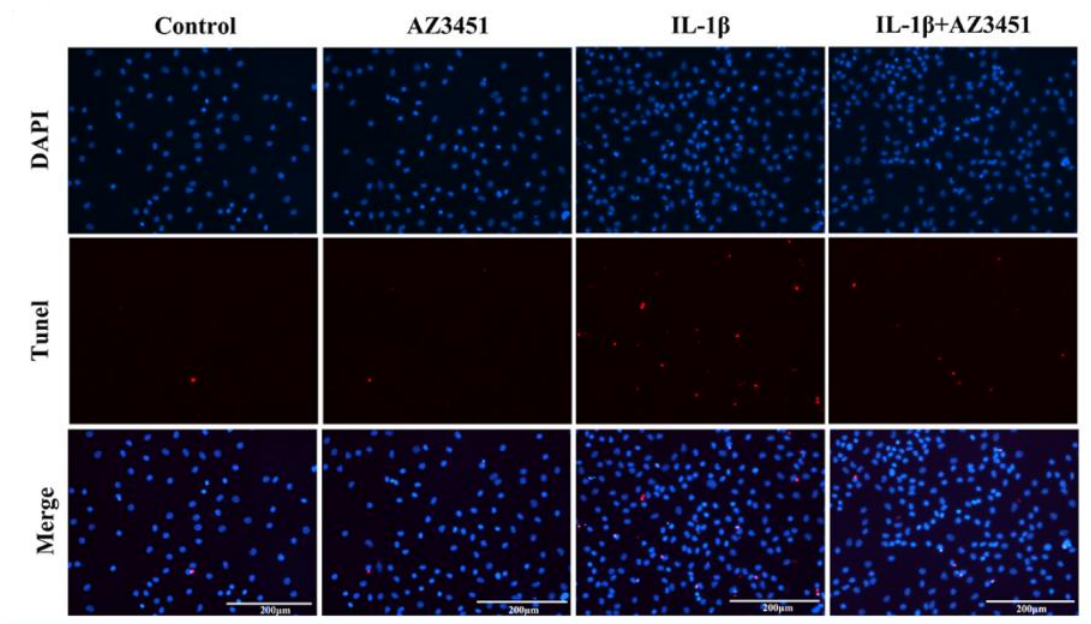
AZ3451 treatment downregulated the IL-1β-induced increasing levels of TUNEL positive cells.
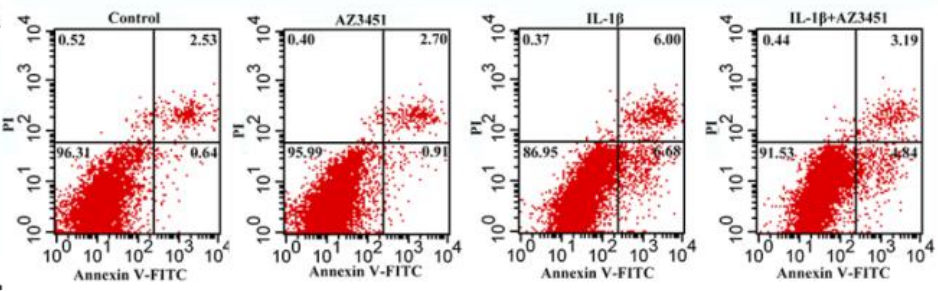
AZ3451 purchased from MedChemExpress. Usage Cited in: Aging (Albany NY). 2019 Dec 16;11(24):12532-12545. [Abstract]
AZ3451 treatment caused a marked decrease of apoptotic chondrocytes induced by IL-1β.


Solvent & Solubility
DMSO : 100 mg/mL (174.99 mM; Need ultrasonic; Hygroscopic DMSO has a significant impact on the solubility of product, please use newly opened DMSO)
Please refer to the solubility information to select the appropriate solvent. Once prepared, please aliquot and store the solution to prevent product inactivation from repeated freeze-thaw cycles.
Storage method and period of stock solution: -80°C, 2 years; -20°C, 1 year. When stored at -80°C, please use it within 2 years. When stored at -20°C, please use it within 1 year.
Please refer to the solubility information to select the appropriate solvent. Once prepared, please aliquot and store the solution to prevent product inactivation from repeated freeze-thaw cycles.
Storage method and period of stock solution: -80°C, 2 years; -20°C, 1 year. When stored at -80°C, please use it within 2 years. When stored at -20°C, please use it within 1 year.
Concentration (start) × Volume (start) = Concentration (final) × Volume (final)
Select the appropriate dissolution method based on your experimental animal and administration route.
- For the following dissolution methods, please ensure to first prepare a clear stock solution using an In Vitro approach and then sequentially add co-solvents:
- To ensure reliable experimental results, the clarified stock solution can be appropriately stored based on storage conditions. As for the working solution for In Vivo experiments, it is recommended to prepare freshly and use it on the same day.
- The percentages shown for the solvents indicate their volumetric ratio in the final prepared solution. If precipitation or phase separation occurs during preparation, heat and/or sonication can be used to aid dissolution.
Add each solvent one by one: 10% DMSO 40% PEG300 5% Tween-80 45% Saline
Solubility: ≥ 2.08 mg/mL (3.64 mM); Clear solution
This protocol yields a clear solution of ≥ 2.08 mg/mL (saturation unknown).
Taking 1 mL working solution as an example, add 100 μL DMSO stock solution (20.8 mg/mL) to 400 μL PEG300, and mix evenly; then add 50 μL Tween-80 and mix evenly; then add 450 μL Saline to adjust the volume to 1 mL.
Preparation of Saline: Dissolve 0.9 g sodium chloride in ddH₂O and dilute to 100 mL to obtain a clear Saline solution.
Please enter the basic information of animal experiments:
-
-
-
-
Recommended: Prepare an additional quantity of animals to account for potential losses during experiments.
Please enter your animal formula composition:
-
%DMSO +
Recommended: Keep the proportion of DMSO in working solution below 2% if your animal is weak.
-
%+
-
+%Tween-80 + +
-
%Saline +
The co-solvents required include: DMSO, . All of co-solvents are available by MedChemExpress (MCE). , Tween 80. All of co-solvents are available by MedChemExpress (MCE).
Working solution concentration: 0.22 mg/mL
Method for preparing stock solution: mg drug dissolved in μL DMSO. Stock solution concentration: mg/mL.
1. Take μL DMSO stock solution;
2. Add μL .
μL , mix evenly;
3. Then add μL Tween 80, mix evenly;
4. Then add μL
Please ensure that the stock solution in the first step is dissolved to a clear state, and add co-solvents in sequence. You can use ultrasonic heating (ultrasonic cleaner, recommended frequency 20-40 kHz), vortexing, etc. to assist dissolution.


Purity & Documentation
-
Data Sheet (273 KB)
-
SDS (396 KB)
- English - EN (396 KB)
- Français - FR (396 KB)
- Deutsch - DE (396 KB)
- Norwegian - NO (396 KB)
- Español - ES (396 KB)
- Swedish - SV (396 KB)
- Italian - IT (396 KB)
- Korean - KR (396 KB)
- Portuguese - PT (396 KB)
-
Handling Instructions (2659 KB)
References


Complete Stock Solution Preparation Table
Please refer to the solubility information to select the appropriate solvent. Once prepared, please aliquot and store the solution to prevent product inactivation from repeated freeze-thaw cycles.
Storage method and period of stock solution: -80°C, 2 years; -20°C, 1 year. When stored at -80°C, please use it within 2 years. When stored at -20°C, please use it within 1 year.
| Optional Solvent | Concentration Solvent Mass | 1 mg | 5 mg | 10 mg | 25 mg |
|---|---|---|---|---|---|
| DMSO | 1 mM | 1.7499 mL | 8.7495 mL | 17.4990 mL | 43.7476 mL |
| 5 mM | 0.3500 mL | 1.7499 mL | 3.4998 mL | 8.7495 mL | |
| 10 mM | 0.1750 mL | 0.8750 mL | 1.7499 mL | 4.3748 mL | |
| 15 mM | 0.1167 mL | 0.5833 mL | 1.1666 mL | 2.9165 mL | |
| 20 mM | 0.0875 mL | 0.4375 mL | 0.8750 mL | 2.1874 mL | |
| 25 mM | 0.0700 mL | 0.3500 mL | 0.7000 mL | 1.7499 mL | |
| 30 mM | 0.0583 mL | 0.2917 mL | 0.5833 mL | 1.4583 mL | |
| 40 mM | 0.0437 mL | 0.2187 mL | 0.4375 mL | 1.0937 mL | |
| 50 mM | 0.0350 mL | 0.1750 mL | 0.3500 mL | 0.8750 mL | |
| 60 mM | 0.0292 mL | 0.1458 mL | 0.2917 mL | 0.7291 mL | |
| 80 mM | 0.0219 mL | 0.1094 mL | 0.2187 mL | 0.5468 mL | |
| 100 mM | 0.0175 mL | 0.0875 mL | 0.1750 mL | 0.4375 mL |


AZ3451 Related Classifications
HY-112558 Related Classifications
 Powered by Bioz