



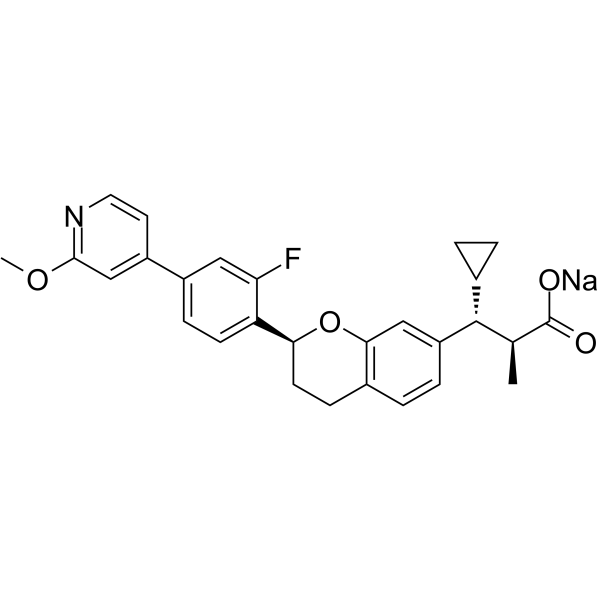
AP5 sodium
Based on 2 publication(s) in Google Scholar
AP5 sodium is a potent, orall active, and selective GPR40 receptor agonist with a positive allosteric modulation of endogenous ligand (AgoPAM). AP5 sodium demonstrates rat and human inositol monophosphate (IP1) EC50 values of 0.49 nM and 0.8 nM against the GPR40 receptor, respectively. AP5 sodium has the potential for type II diabetes research.
For research use only. We do not sell to patients.
- CAS No.: 1623143-67-8
- Formula: C28H27FNNaO4
- Molecular Weight:483.51
-
Storage:
Please store the product under the recommended conditions in the Certificate of Analysis.

To place orders, for customer services and technical support, please contact: MedChemExpress USA
Tel: 609-228-6898 E-mail: [email protected] [email protected]


-
 Biological Activity
-
Chemical Information
- Protocols
- Purity & Documentation
- References
-
 Help & FAQs


Publications Citing Use of MedChemExpress (MCE) AP5 sodium
More

Biological Activity
Description


Chemical Information
-
CAS No. 1623143-67-8
-
Molecular Weight 483.51
-
Formula C28H27FNNaO4
-
SMILES
FC1=CC(C2=CC(OC)=NC=C2)=CC=C1[C@@H]3CCC(C=CC([C@H](C4CC4)[C@H](C)C(O[Na])=O)=C5)=C5O3
-
Shipping
Room temperature in continental US; may vary elsewhere.
-
Storage
Please store the product under the recommended conditions in the Certificate of Analysis.


Publications (2)
-
Journal Impact Factor
-
Most Recent
-
Nat Neurosci
Emergence of consciousness from anesthesia through ubiquitin degradation of KCC2 in the ventral posteromedial nucleus of the thalamus. [Abstract]2023 May;26(5):751-764. PMID: 36973513 -
Nat Commun
2024 May 15;15(1):4122. PMID: 38750027


Purity & Documentation
References

Calculators
Concentration (start) × Volume (start) = Concentration (final) × Volume (final)


AP5 sodium Related Classifications
HY-112603A Related Classifications
 Powered by Bioz