



Echinulin

Based on 1 Customer Validation
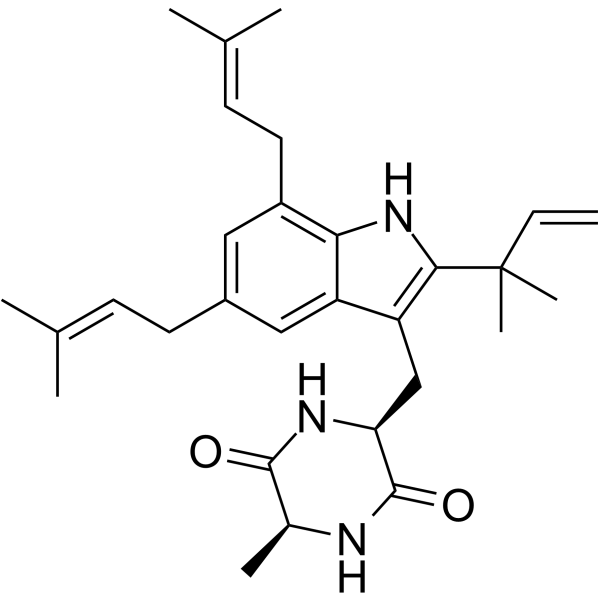
Echinulin (Echinuline) is a cyclic dipeptide carrying a triprenylated indole moiety. Echinulin contributes to the activation of T cell subsets, which leads to NF-κB activation.Echinulin exerts its immune roles by the NF-κB pathway.Echinulin has the potential to serve as a immunotherapeutic agent.
商品は「研究用試薬」です。人や動物の医療用・臨床診断用・食品用の製品ではありません。
研究用途以外に使用した場合、当社は一切の責任を負いかねます。
- 純度 : 98.63%
- CAS 番号: 1859-87-6
- 分子式: C29H39N3O2
- 分子量:461.64
-
保管条件:Powder -20°C, 3 years ; In solvent -80°C, 6 months , -20°C, 1 month

To place orders, for customer services and technical support, please contact: MedChemExpress USA
Tel: 609-228-6898 E-mail: [email protected] [email protected]


-
 生物活性
生物活性
-
化学情報
- プロトコル
- 純度とドキュメンテーション
- 参考文献
-
 Help & FAQs




生物活性
製品説明
IC50 & Target
[1]|
NF-κB |
Cellular Effect
|
Cell Line

|
Type | Value | Description | References |
|---|---|---|---|---|
| B16-4A5 | IC50 |
68 μM
Compound: 2
|
Inhibition of melanogenesis in theophylline-stimulated mouse B16-4A5 cells assessed as reduction in melanin level incubated for 72 hrs
Inhibition of melanogenesis in theophylline-stimulated mouse B16-4A5 cells assessed as reduction in melanin level incubated for 72 hrs
|
[PMID: 27641468] |
| BV-2 | IC50 |
>50 μM
Compound: 26
|
Inhibition of iNOS-mediated NO production in LPS-induced mouse BV2 cells
Inhibition of iNOS-mediated NO production in LPS-induced mouse BV2 cells
|
[PMID: 18926710] |
| MDCK | CC50 |
>200 μM
Compound: 22
|
Cytotoxicity against MDCK cells assessed as cell growth after 40 hrs by CellTiter-Glo assay
Cytotoxicity against MDCK cells assessed as cell growth after 40 hrs by CellTiter-Glo assay
|
[PMID: 25681711] |


化学情報
-
CAS 番号 1859-87-6
-
性状 Solid
-
分子量 461.64
-
分子式 C29H39N3O2
-
Color White to off-white
-
SMILES
C/C(C)=C\CC1=C2C(C(C[C@H]3C(N[C@H](C(N3)=O)C)=O)=C(C(C)(C)C=C)N2)=CC(C/C=C(C)\C)=C1
-
別名
Echinuline
-
Structure Classification
-
Initial Source
Aspergillus chevalieri
-
輸送条件
Room temperature in continental US; may vary elsewhere.
-
保管条件
Powder -20°C 3 years In solvent -80°C 6 months -20°C 1 month


純度とドキュメンテーション
-
データシート (270 KB)
-
SDS (393 KB)
- English - EN (393 KB)
- Français - FR (393 KB)
- Deutsch - DE (393 KB)
- Norwegian - NO (393 KB)
- Español - ES (393 KB)
- Swedish - SV (393 KB)
- Italian - IT (393 KB)
- Korean - KR (393 KB)
- Portuguese - PT (393 KB)
-
取扱説明書 (2659 KB)
参考文献

Calculators
濃度 (開始) × 体積 (開始) = 濃度 (終了) × 体積 (終了)


Echinulin 関連分類
HY-N3796 関連分類
 Powered by Bioz