



Cerebellin
Cerebellin is a neuromodulatory hexadecapeptide that serves as a marker for Purkinje cell maturation. Cerebellin stimulates norepinephrine release via the adenylate cyclase/PKA-dependent signaling pathway. Cerebellin reduces insulin secretion from pancreatic islets under high-glucose conditions. Cerebellin also regulates synaptic structure formation and controls catecholamine secretion in peripheral tissues. Cerebellin can be used in neurological research.
연구목적의 판매만을 진행합니다. 환자를 대상으로 한 판매는 하지 않습니다.
- CAS No.: 94071-26-8
- 화학식: C69H113N23O23
- 분자량:1632.78
-
보관:
Please store the product under the recommended conditions in the Certificate of Analysis.

To place orders, for customer services and technical support, please contact: MedChemExpress USA
Tel: 609-228-6898 E-mail: [email protected] [email protected]


-
 Biological Activity
-
Chemical Information
-
용액&용해도
- Protocol
- 순도&문서
- References
-
 Help & FAQs




Biological Activity
제품 설명
In Vitro
Cerebellin (1-100 nM; 10-30 min) potently stimulates the production of norepinephrine and cyclic adenosine monophosphate in rat adrenal medullary tissues via an adenylate cyclase/PKA-dependent pathway[1].
Cerebellin (1-100 nM; 90 min) inhibits glucose-stimulated insulin secretion from isolated rat islets[2].
Cerebellin (100 nM-1 μM; 1 hour) inhibits glucose/Exendin-4 (HY-13443)-stimulated insulin secretion in INS-1 cells[2].
Cerebellin (10 nM-1 μM; 5 min) reduces Forskolin (HY-15371)-induced cAMP accumulation in INS-1 cells in a concentration-dependent manner[2].
Cerebellin (100 nM) irreversibly reduces the intracellular free calcium concentration in INS-1 cells[2].
MedChemExpress (MCE) has not independently confirmed the accuracy of these methods. They are for reference only.
In Vivo
Cerebellin (0.5-1.5 nmol/100 g body weight; subcutaneous injection; single bolus) acts as an insulin inhibitor in healthy female Wistar rats[2].
MedChemExpress (MCE) has not independently confirmed the accuracy of these methods. They are for reference only.
-
Animal Model:Wistar (female, 8-12 weeks, 180-190 g)[2]
-
Dosage:0.5 nmol/100 g body weight; 1.5 nmol/100 g body weight
-
Administration:s.c.; single bolus
-
Result:Significantly reduced plasma insulin concentration at both 60 and 120 minutes post-injection at 0.5 nmol/100 g body weight.
Significantly reduced plasma insulin concentration at 120 minutes post-injection at 1.5 nmol/100 g body weight.
Caused a moderate significant increase in plasma glucagon at 60 minutes post-injection at 1.5 nmol/100 g body weight.
Caused a moderate significant decrease in blood glucose at 60 minutes post-injection at 1.5 nmol/100 g body weight.


Chemical Information
-
CAS No. 94071-26-8
-
분자량 1632.78
-
화학식 C69H113N23O23
-
Sequence
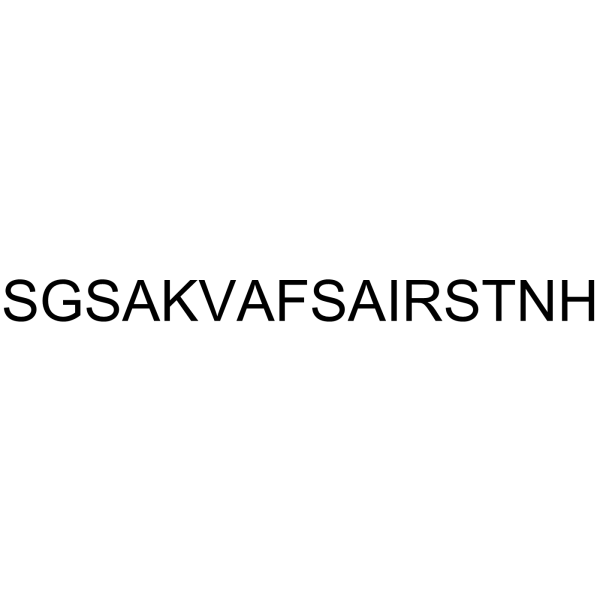
Ser-Gly-Ser-Ala-Lys-Val-Ala-Phe-Ser-Ala-Ile-Arg-Ser-Thr-Asn-His
-
Sequence Shortening
SGSAKVAFSAIRSTNH
-
선적
Room temperature in continental US; may vary elsewhere.
-
보관
Please store the product under the recommended conditions in the Certificate of Analysis.


용액&용해도
In Vitro
H2O
Peptide Solubility and Storage Guidelines:
1. Calculate the length of the peptide.
2. Calculate the overall charge of the entire peptide according to the following table:
| Contents | Assign value | |
|---|---|---|
| Acidic amino acid | Asp (D), Glu (E), and the C-terminal -COOH. | -1 |
| Basic amino acid | Arg (R), Lys (K), His (H), and the N-terminal -NH2 | +1 |
| Neutral amino acid | Gly (G), Ala (A), Leu (L), Ile (I), Val (V), Cys (C), Met (M), Thr (T), Ser (S), Phe (F), Tyr (Y), Trp (W), Pro (P), Asn (N), Gln (Q) | 0 |
3. Recommended solution:
| Overall charge of peptide | Details |
|---|---|
| Negative (<0) |
1. Try to dissolve the peptide in water first. 2. If water fails, add NH4OH (<50 μL). 3. If the peptide still does not dissolve, add DMSO (50-100 μL) to solubilize the peptide. |
| Positive (>0) |
1. Try to dissolve the peptide in water first. 2. If water fails, try dissolving the peptide in a 10%-30% acetic acid solution. 3. If the peptide still does not dissolve, try dissolving the peptide in a small amount of DMSO. |
| Zero (=0) |
1. Try to dissolve the peptide in organic solvent (acetonitrile, methanol, etc.) first. 2. For very hydrophobic peptides, try dissolving the peptide in a small amount of DMSO, and then dilute the solution with water to the desired concentration. |


순도&문서
References
[1]. Albertin G, et al. Cerebellin stimulates the secretory activity of the rat adrenal gland: in vitro and in vivo studies. Neuropeptides. 2000;34(1):7-11. [Content Brief]
[2]. Strowski MZ, et al. Insulinostatic activity of cerebellin--evidence from in vivo and in vitro studies in rats. Regul Pept. 2009;157(1-3):19-24. [Content Brief]
[3]. Slemmon JR, et al. Cerebellin: a quantifiable marker for Purkinje cell maturation. Proc Natl Acad Sci U S A. 1985;82(20):7145-7148. [Content Brief]
[4]. Mugnaini E, et al. The neuropeptide cerebellin is a marker for two similar neuronal circuits in rat brain. Proc Natl Acad Sci U S A. 1987;84(23):8692-8696. [Content Brief]

Calculators
Concentration (start) × Volume (start) = Concentration (final) × Volume (final)


Cerebellin Related Classifications
HY-P1544 Related Classifications
 Powered by Bioz
Keywords
- Cerebellin
- 94071-26-8
- Endogenous Metabolite
- Adenylate Cyclase
- PKA
- Calcium Channel
- rat insulinoma cells
- rat adrenomedullary tissue
- precerebellin (Cbln1)
- cerebellar Purkinje cells
- corticosterone
- norepinephrine
- rat brain
- dorsal cochlear nucleus cartwheel cells
- adenylate cyclase/PKA-dependent signaling pathway
- aldosterone
- Inhibitor
- inhibitor
- inhibit