



LY3104607
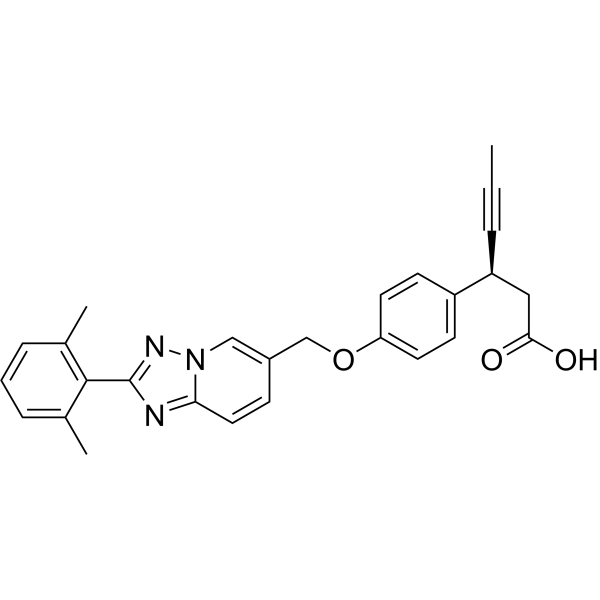
LY3104607 is a potent and selective G protein-coupled receptor 40 (GPR40) agonist. LY3104607 can be used in research of diabetes.
연구목적의 판매만을 진행합니다. 환자를 대상으로 한 판매는 하지 않습니다.
- CAS No.: 1795232-22-2
- 화학식: C27H25N3O3
- 분자량:439.51
-
보관:
Please store the product under the recommended conditions in the Certificate of Analysis.

To place orders, for customer services and technical support, please contact: MedChemExpress USA
Tel: 609-228-6898 E-mail: [email protected] [email protected]


-
 Biological Activity
-
Chemical Information
- Protocol
- 순도&문서
- References
-
 Help & FAQs




Biological Activity
제품 설명
Cellular Effect
|
Cell Line

|
Type | Value | Description | References |
|---|---|---|---|---|
| HEK293 | EC50 |
108 nM
Compound: 4; LY3104607
|
Agonist activity at human PK-tagged GPR40 expressed in HEK293 cells assessed as EA-tagged beta-arrestin recruitment after 90 mins in presence of 1 % heat inactivated FBS by beta-galactosidase reporter gene assay
Agonist activity at human PK-tagged GPR40 expressed in HEK293 cells assessed as EA-tagged beta-arrestin recruitment after 90 mins in presence of 1 % heat inactivated FBS by beta-galactosidase reporter gene assay
|
[PMID: 29236497] |
| HEK293 | EC50 |
11 nM
Compound: 4; LY3104607
|
Agonist activity at human GPR40 receptor expressed in HEK293 cells assessed as increase in intracellular calcium flux after 2.5 hrs measured over 3 mins by calcium 4 dye-based FLIPR assay
Agonist activity at human GPR40 receptor expressed in HEK293 cells assessed as increase in intracellular calcium flux after 2.5 hrs measured over 3 mins by calcium 4 dye-based FLIPR assay
|
[PMID: 29236497] |
| HEK293 | EC50 |
119 nM
Compound: 6
|
Agonist activity at human GPR40 expressed in HEK293 cells assessed as increase in intracellular Ca2+ flux by calcium-4 dye based FLIPR assay
Agonist activity at human GPR40 expressed in HEK293 cells assessed as increase in intracellular Ca2+ flux by calcium-4 dye based FLIPR assay
|
[PMID: 27825762] |


Chemical Information
-
CAS No. 1795232-22-2
-
분자량 439.51
-
화학식 C27H25N3O3
-
SMILES
CC(C=CC=C1C)=C1C2=NN3C(C=CC(COC4=CC=C([C@@H](C#CC)CC(O)=O)C=C4)=C3)=N2
-
선적
Room temperature in continental US; may vary elsewhere.
-
보관
Please store the product under the recommended conditions in the Certificate of Analysis.

Protocol
-
Research Protocol for Metabolic Diseases
AMP-activated protein kinase, AMPK, is a conserved cellular energy sensor that responds to reduced cellular energy status and coordinates metabolism by increasing ATP-generating catabolic pathways while suppressing ATP-consuming anabolic processes. In metabolic disease research, the AMPK pathway is experimentally relevant because it regulates hepatic lipid synthesis, fatty acid oxidation, glucose production, skeletal-muscle glucose disposal, mTORC1-linked biosynthesis, autophagy, mitochondrial homeostasis, and whole-body energy balance. The central pathway logic is that energy stress, metformin, exercise-like stimulation, or direct AMPK activators increase AMPKα Thr172 phosphorylation and downstream substrate phosphorylation, including ACC and RAPTOR. Phosphorylation of ACC suppresses lipogenesis and supports fatty acid oxidation, whereas phosphorylation of RAPTOR suppresses mTORC1 signaling and links cellular energy status to growth and protein synthesis control. The pathway is linked


순도&문서
References

Calculators
Concentration (start) × Volume (start) = Concentration (final) × Volume (final)


LY3104607 Related Classifications
HY-111116 Related Classifications
 Powered by Bioz