



PROTAC — Target Selection and Design
2022-07-08
Protein degradation targeting chimera (PROTAC) is an emerging technology that can specifically degrade target proteins via the ubiquitin-proteasome pathway. The design and development of PROTAC molecules have evolved from peptide derivatives to small molecules with improved solubility and membrane permeability. While PROTAC molecules do not follow “Lipinski’s rule of five” for their large molecular weight and complex structures, the unique structure provides opportunities for further modifications to optimize DMPK properties. We introduced some special designs of PROTAC in the first article of this PROTAC series. Here, we will discuss the conventional approaches for the rational design of PROTAC molecules.
A PROTAC molecule consists of three components: a target protein binding ligand, an E3 ligase ligand, and a linker connecting these two moieties.
The target protein is usually selected first when designing new PROTAC molecules. The following three factors need to be considered for the selection of target proteins.
1. Specificity: A non-specific target protein could induce PROTAC off-target toxicity. Tissue specificity may also be important.
2. PROTACability: The proteins can be effectively degraded using the conventional PROTAC technology.
3. Availability of ligands or crystal structure of targets: The availability of ligands for the target protein and/or crystal structure of the protein can facilitate the rational design of new PROTAC molecules. For example, the estrogen receptor degrader ARV-471 and the androgen receptor degrader ARV-766, two clinical candidates being tested in phase II trials, are derived from previously well characterized ligands Tamoxifen and (+)-JQ-1 , respectively.
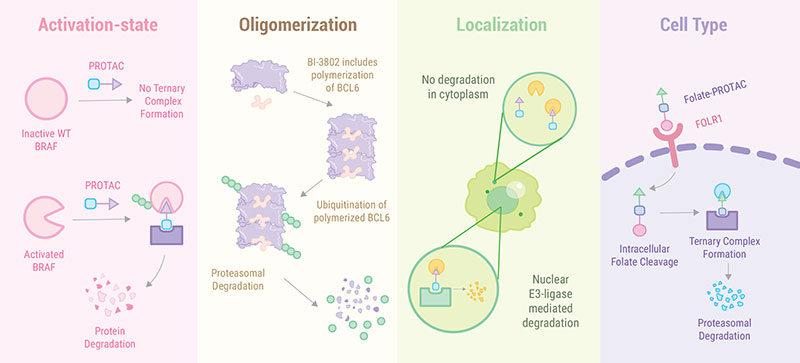
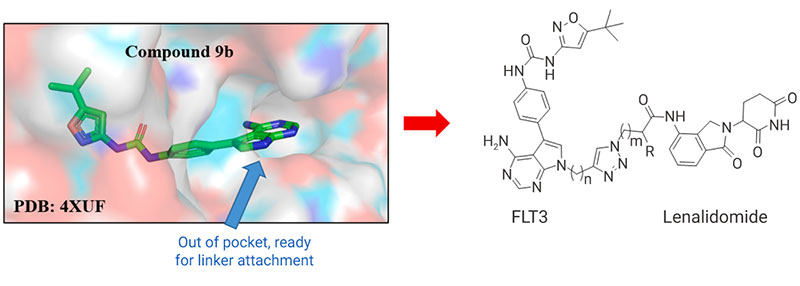
Upon meeting the above three criteria, a conventional design of new PROTAC molecules can be initiated. The structure-activity relationship information of a known ligand of the target protein serves as guidance for structure modifications on locations where ligand-target protein binding sites are not interfered. The crystal structure of the target protein can also be used for virtual screening, narrowing down the scope of subsequent high-throughput screening, and improving efficiency of new PROTAC development.
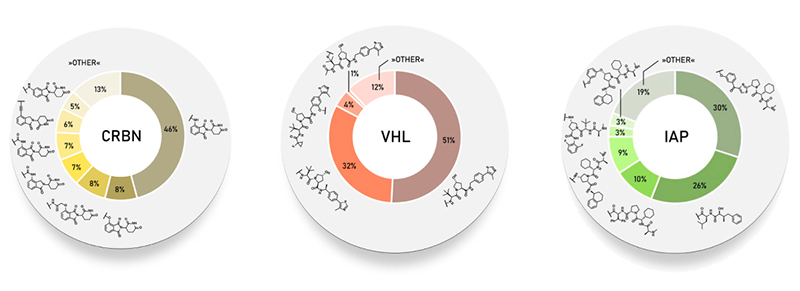
CRBN and VHL ligands are still the most frequently used E3 ligase binding motifs. It is essential to first determine the abundance of different E3 ligases in cells in order to select the best E3 ligase ligand. Although those commercially available CRBN and VHL ligand molecules are commonly used for practical reasons, other E3 ligands have been screened to support the design of new PROTAC molecules.
| E3 ligand type | Common Structure | Feature | PROTACs |
|---|---|---|---|
| CRBN ligand | Domine derivatives | Mostly used; Small molecular weight; Good druggability | ARV-471 ARV-110 |
| VHL ligand | Endogenous ligand peptide-like compounds | Second choice;Modest molecular weight;Good druggability | ARV-766 LC-2 |
| IAP ligand | Endogenous ligand peptide-like compounds | IAP itself promotes cancer in cancer cells; The ligand itself can promote the dimerization and degradation of IAP | SNIPER-1 SNIPER-020 |
| MDM2 ligand | Nutlin derivatives | E3 ligand for the first PROTAC molecule; Its overexpression in cancer cells inhibits the inhibitory effect of p53 | A1874 PROTAC ERRα Degrader-1 |
In addition, other degradation systems such as the RNase dependent RIBOTAC, the lysosome dependent ATTEC and LYTAC, and the autophagy dependent AUTAC have also been reported,[6] expanding the arsenal of targeted protein degradation.
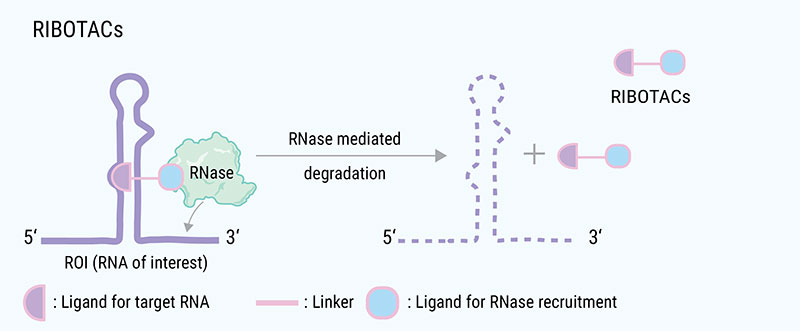
RIBOTAC contains RNA binding modules, ribonuclease (RNase) recruitment modules, and a linker; RIBOTAC binds to target RNA, and recruits RNase near the target RNA thereby promotes its degradation.
PEG chain is often selected as the connecting linker in PROTAC design for its flexibility to fit in the binding pocket. On the other hand, the resulted high entropy from the flexible PEG chain could undermine degradation efficacy. Currently there are no general rules to select the linker length at the beginning of PROTAC design.
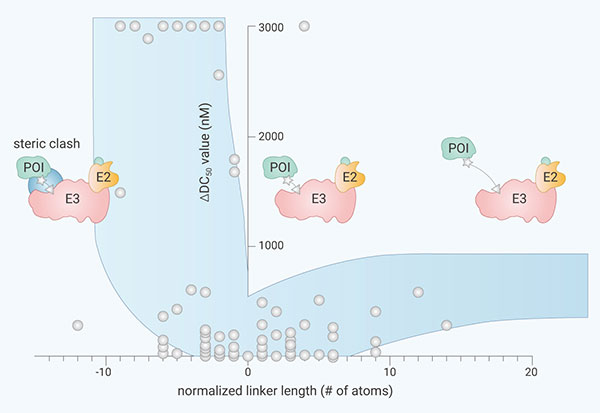
The length of most linkers ranges from 10 to 20 atoms. In a recent report,[8] the relationship between normalized degradation activity and linker length was analyzed and showed as an L-shape pattern. The entropic effect due to long linker length diminishes degradation potency, while the steric clash caused by short linker length also leads to a sharp drop in degradation potency. Therefore, a slightly longer linker is usually selected in the early stage of PROTAC design followed by continuous optimization of linker length. Not only the interaction between PROTAC molecule and the binding pocket of the target protein is affected by the length of linker, the global physiochemical properties of PROTAC molecule is also impacted by linker length and structural composition.
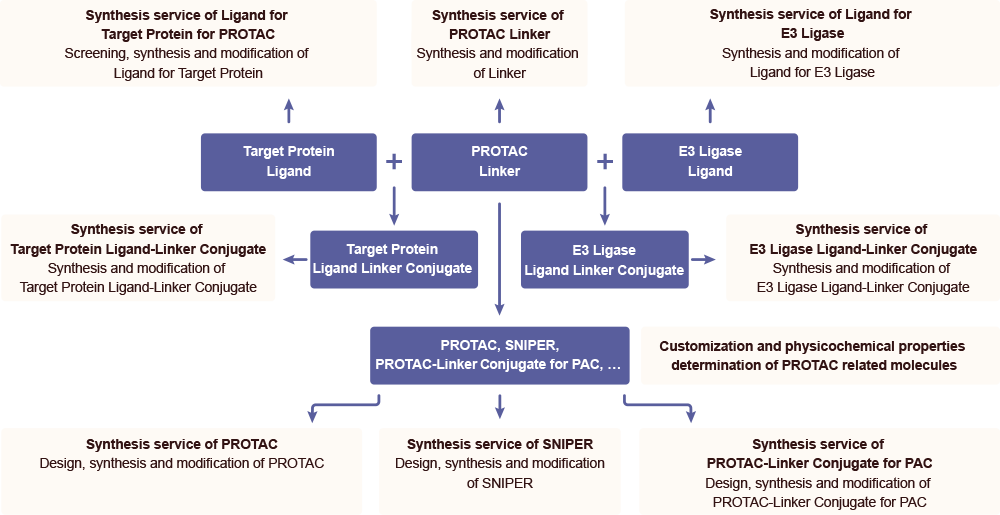
Development of a new PROTAC is a trial-and-error and reiterative design-synthesis-evaluation process. The selection of each part of PROTAC, connecting site, membrane permeability, and other factors will all be taken into account during optimization.
MCE provides a comprehensive collection of PROTAC molecules. We also offer consultant services on PROTAC design and synthesis for our clients. With our experienced and dedicated teams of scientists, MCE ensure our clients’ success by providing high-quality services on PROTAC molecule development and preparation.
- Quick delivery
Delivered for using at the earliest time, reducing the intermediate procedures
- Price concessions
High cost performance and competitive prices
- Product reports
Provide real and reliable experimental data related to PROTACs
- In strict confidence
Sign a confidentiality agreement
with MCE for absolute security - Professional consultation
Professional technicians will answer and solve your doubts in time
- Abundant species
3,000+ PROTAC products for
worldwide customers - Speciallized capacity
Professional synthesis ability and
rich experience - Cutting-edge technology
Continuous technological innovation
for design and synthesis service
Inquiries about synthetic scheme and price about PROTAC molecule design and synthesis will be evaluated in a timely manner. For further information, please email [email protected] or contact MCE sales team directly.
[2] Chen Y, Yuan X, Tang M, Shi M, Yang T, Liu K, Deng D, Chen L. Degrading FLT3-ITD protein by proteolysis targeting chimera (PROTAC). Bioorg Chem. 2022 Feb;119:105508.
[3] Jin J, Wu Y, Chen J, Shen Y, Zhang L, Zhang H, Chen L, Yuan H, Chen H, Zhang W, Luan X. The peptide PROTAC modality: a novel strategy for targeted protein ubiquitination. Theranostics. 2020 Aug 8;10(22):10141-10153.
[4] Liu J, Chen H, Kaniskan HÜ, Xie L, Chen X, Jin J, Wei W. TF-PROTACs Enable Targeted Degradation of Transcription Factors. J Am Chem Soc. 2021 Jun 16;143(23):8902-8910.
[5] Fischer F, Alves Avelar LA, Murray L, Kurz T. Designing HDAC-PROTACs: lessons learned so far. Future Med Chem. 2022 Jan;14(3):143-166.
[6] Zhong Y, Chi F, Wu H, Liu Y, Xie Z, Huang W, Shi W, Qian H. Emerging targeted protein degradation tools for innovative drug discovery: From classical PROTACs to the novel and beyond. Eur J Med Chem. 2022 Jan 20;231:114142.
[7] Dey SK , Jaffrey SR. RIBOTACs: Small Molecules Target RNA for Degradation[J]. Cell Chem Biol. 2019 Aug 15, 26(8):1047-1049.
[8] Bemis TA, La Clair JJ, Burkart MD. Unraveling the Role of Linker Design in Proteolysis Targeting Chimeras. J Med Chem. 2021 Jun 24;64(12):8042-8052.
 LinkedIn
 Researchgate
 Instagram
 X
X Facebook
 WhatsApp
 Reddit
 Mail
Mail