



STZ Induced Diabetes Models
2024-06-13
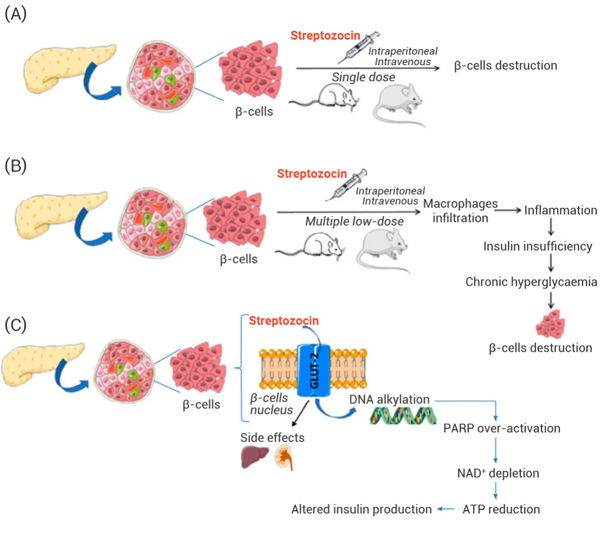
Streptozotocin (STZ) , a natural product of Streptomyces achromogenes, is a cytotoxic glucose analogue that is selectively transported to islet beta cells by GLUT2 (Figure 1)[1]. Its chemical structure has two parts; a glucopyranosyl group (Affinity to pancreatic tissue) and a nitrosourea group (Alkylation activity)[2]. In clinical studies, STZ is often used to treat NETs. In the experimental field, STZ is often used as a diabetic agent.

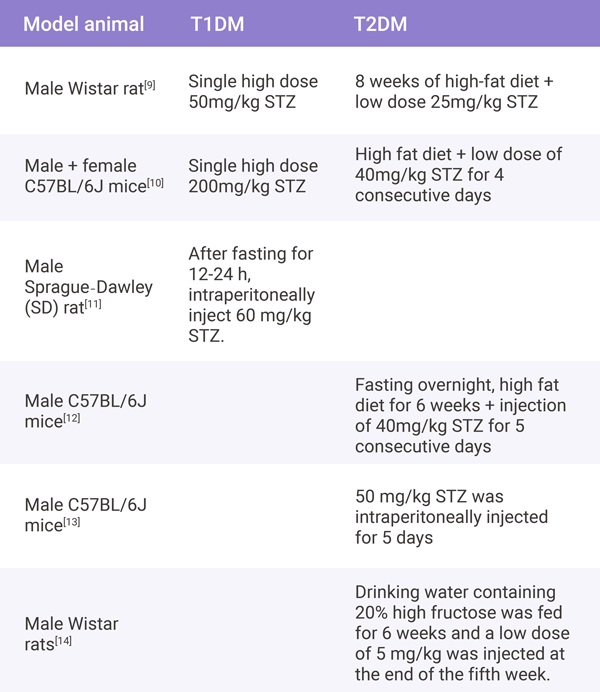
Inducing diabetes in animals by administering chemicals such as STZ and Alloxan (ALX) is one of the ways to obtain experimental models of diabetes. Depending on the dose and mode of administration, STZ and ALX can induce both Type 1 diabetes mellitus (T1DM) and Type 2 diabetes mellitus (T2DM). STZ is mainly transported to pancreatic beta cells by Glucose transporter 2 (GLUT-2), which causes toxicity mainly through DNA alkylation. A single high-dose injection has a high success rate of modeling, while low-dose injection may only cause islet inflammation[4].
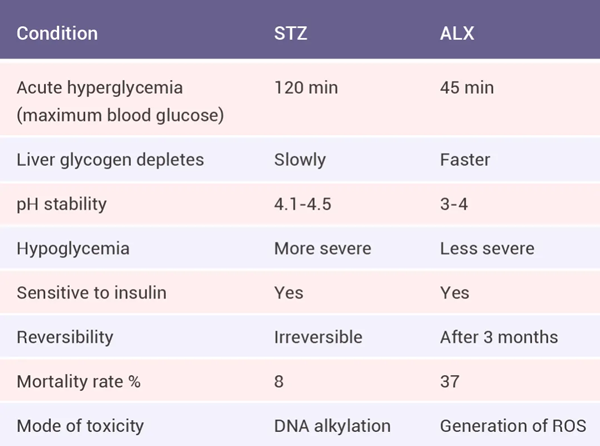
Alx-induced diabetes is due to ROS-mediated beta cell toxicity and has been successfully applied in multiple animal species rabbits, mice, rats, monkeys, cats, and dogs[5]. However, compared with STZ, hyperglycemia caused by ALX is unstable and reversible, and the model developed by ALX may be more suitable for short-term observation. Therefore, STZ is the most widely used diabetes inducing drug at present (Table 2).
How to use STZ?
Solution: Prepared 0.1mol/L citric acid buffer[8]
1. Weigh 2.1g citric acid (MW:210.14, HY-N1428 ) and add it to double-distilled water to 100mL, dissolve;
2. Sodium citrate (MW:294.10, HY-B1610 ) 2.94g Add double-distilled water to 100mL, dissolve.
3. Take 28mL A and add it to 22mL B (mix at a ratio of 1.32:1), dilute it with double-distilled water to 100mL, measure pH value, adjust pH to 4.5, and filter impurities with 0.22µm or 0.45µm filter membrane.
4. Use a mixed working solution to dissolve STZ. Prepare it for immediate use. Prepare and store at 4°C. Try to complete the injection within 30 minutes.
Precautions
① It is recommended to prepare and use it immediately: STZ is unstable to water and light. It can be stored in a sealed, dry and dark place at -20°C for 3 years. The solution state is unstable. The α configuration of the product in water will transform into the β configuration and reach equilibrium in half an hour at room temperature. When using it for the first time, it can be packed in a dry and light-proof environment according to the estimated single dosage, and stored dry and frozen.
② It is recommended to use male rats: the sensitivity of different individuals to the β-cytotoxicity of streptomycin varies greatly, and the female may have a poor modeling rate. Mice are less sensitive to STZ and may require a larger dose.
③ Fasting without water before injection increases the sensitivity of pancreatic beta cells to STZ. STZ injections in model animals generally require rapid injections.
Question! So with the above modeling methods, how do we evaluate whether the model is successful?
• General assessment indicators[9][11][12]: Weight loss; Fasting blood glucose ≥16.67 mmol/L or blood glucose exceeding 250 mg/dl for 3 consecutive days were measured.
• Other indicators: Occurrence of polydipsia, polyphagia and polyuria[15]; Plasma insulin and C-peptide concentrations were significantly reduced[9]. Plasma cholesterol and low density fat levels (LDL) were significantly increased[14].
Persistent hyperglycemia and insulin resistance can lead to a series of complications such as diabetic retinopathy, diabetic kidney disease (DKD), heart disease and peripheral neuropathy. Therefore, STZ is also widely used in the study of diabetes-related complications.
Diabetic kidney disease (DKD)
Macrophages infiltrating into kidneys is a significant event.This infiltration can cause renal injury.It also contributes to fibrosis related to diabetes. Jin et al studied the effect of macrophage CUL4B on the kidney of diabetic mice induced by high fat diet and STZ. CUL4B can enhance macrophage migration and adhesion.This happens through the suppression of miR-194-5p. As a result, ITGA9 is upregulated. When CUL4B is depleted in macrophages, it has a positive effect. It effectively diminishes renal injury and fibrosis induced by diabetes[14].

Diabetic cardiomyopathy (DCM)
Patients with diabetes (type I and type II) develop DCM due to left ventricular diastolic and systolic dysfunction. Due to high blood sugar, excess reactive oxygen species (ROS) are produced in the heart muscle, leading to apoptosis of diabetic heart cells. STZ-based T1DM and T2DM mouse models affected left ventricular diastolic and systolic function differently. Compared with T2DM mice, T1DM mice showed exaggerated apoptotic cardiomyocyte (CM) death, reactive hypertrophy, and fibrosis, along with increased cardiac oxidative stress, CM cell DNA damage, and senescence[10].

Diabetic osteoporosis (DOP)
Although osteoporosis is typically associated with senescence and estrogen deficiency, diabetes, especially type 1 diabetes mellitus (T1DM), due to metabolic disorders such as calcium and phosphorus, also contributes to or exacerbates bone loss in patients with osteoporosis[17]. STZ, STZ combined with high-fat diet and STZ combined with ovariectomy can effectively induce DOP in rats[18].

In addition, the STZ-induced diabetes model can also be used to study complications such as diabetic cardiac autonomic neuropathy (DCAN) and brain lesions through invasive biomarker, histological pattern and cardiac nerve density assessment[9][19].
| Product Name | Description |
|---|---|
| Streptozotocin | An antibiotic that methylates DNA. It can induce disease models such as diabetes, diabetic osteoporosis and diabetic nephropathy. |
| Alloxan hydrate | A proteasome inhibitor. Alloxan hydrate causes diabetes in experimental animals by destroying the insulin-producing B cells of the pancreas. |
| Fructose | Fructose is a simple ketone monosaccharide found in many plants and can be used to model diabetes. |
| Doxorubicin hydrochloride | A cytotoxic anthracycline antibiotic that can be used to induce animal heart disease models and nephritis models. |
| Resiquimod | An agonist of Toll-like receptors 7 and 8 (TLR7/TLR8) for use in inducing models of cardiac disease. |
| Cyproheptadine | A potent orally active 5-HT2A receptor antagonist. Can be used to induce diabetes models. |
[2] Capdevila J, et al. Neuroendocrinology. 2022;112(12):1155-1167.
[3] Nakai, K., et al. Sci Rep 13, 8705 (2023).
[4] Vieira R, et al. Journal of Clinical Medicine. 2019; 8(9):1332.
[5] Ighodaro OM, et al. Medicina (Kaunas). 2017;53(6):365-374.
[6] Lenzen S. 2008;51(2):216-226.
[7] Dhuria RS, et al. Adv Biomed Res. 2015;4:117.
[8] CN 101804211B
[9] Akinlade OM, et al. Afr Health Sci. 2021;21(2):719-727.
[10] Marino F, et al. Int J Mol Sci. 2023;24(2):1132.
[11] Shi S, et al. Exp Mol Med. 2023;55(5):898-909.
[12] You S, et al. Cardiovasc Diabetol. 2023;22(1):107.
[13] Sunilkumar S, et al. Diabetes. 2022;71(11):2412-2425.
[14] Udumula MP, et al. Sci Rep. 2021;11(1):12924.
[15] Zhang XT, et al. Cell Cycle. 2020;19(23):3329-3347.
[16] Jin S, et al. Cell Rep. 2023;42(6):112550.
[17] Wongdee K, et al. World J Diabetes. 2011;2(3):41-48.
[18] Ma R, et al. Evid Based Complement Alternat Med. 2016;2016:3218313.
[19] Yang H, et al. Mol Med Rep. 2013;7(2):431-440.
 LinkedIn
 Researchgate
 Instagram
 X
X Facebook
 WhatsApp
 Reddit
 Mail
Mail