



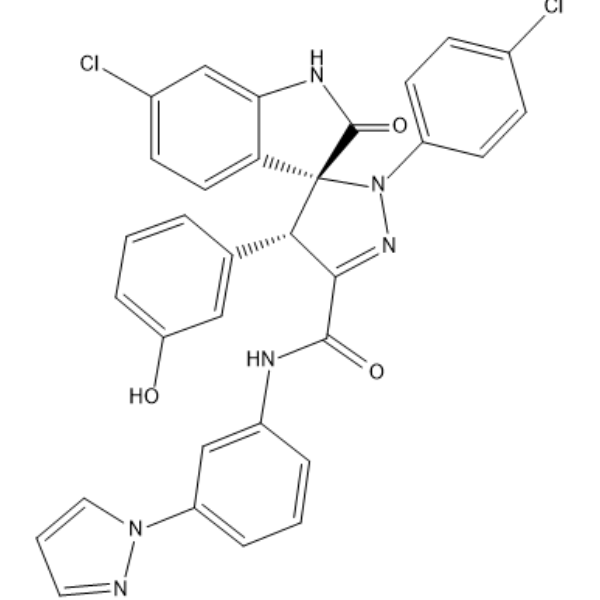
MDM2/4-p53-IN-1
MDM2/4-p53-IN-1 is a potent MDM2-p53 and MDM4-p53 inhibitor with IC50 values of 35.9, 57.4 nM, respectively. MDM2/4-p53-IN-1 shows antiproliferative activity.
For research use only. We do not sell to patients.
- CAS No.: 3037300-57-2
- Formula: C32H22Cl2N6O3
- Molecular Weight:609.46
-
Storage:
Please store the product under the recommended conditions in the Certificate of Analysis.

To place orders, for customer services and technical support, please contact: MedChemExpress USA
Tel: 609-228-6898 E-mail: [email protected] [email protected]


-
 Biological Activity
-
Chemical Information
- Protocols
- Purity & Documentation
- References
-
 Help & FAQs




Biological Activity
Description
IC50 & Target
IC50: 35.9 nM (MDM2-p53); 57.4 nM (MDM4-p53)[1]
In Vitro
MDM2/4-p53-IN-1 (compound 3f) (0-100 μM; 48-96 h) shows antiproliferative activity with IC50 values of 20.9, 14.7, 11.5, 12.4 μM for HCT116, SJSA-1, LNCaP, MCF-7 cells, respectively[1].
MedChemExpress (MCE) has not independently confirmed the accuracy of these methods. They are for reference only. Further protocols information, click here.
-
Cell Line:HCT116, SJSA-1, LNCaP, MCF-7 cells
-
Concentration:0-100 µM
-
Incubation Time:48 h (HCT116), 72 h (MCF7), 96 h (SJSA-1, LNCaP)
-
Result:Showed antiproliferative activity with IC50 values of 20.9, 14.7, 11.5, 12.4 µM for HCT116, SJSA-1, LNCaP, MCF-7 cells, respectively.


Chemical Information
-
CAS No. 3037300-57-2
-
Molecular Weight 609.46
-
Formula C32H22Cl2N6O3
-
SMILES
O=C1NC2=CC(Cl)=CC=C2[C@@]13N(N=C(C(NC4=CC(N5N=CC=C5)=CC=C4)=O)[C@@H]3C6=CC(O)=CC=C6)C7=CC=C(C=C7)Cl
-
Shipping
Room temperature in continental US; may vary elsewhere.
-
Storage
Please store the product under the recommended conditions in the Certificate of Analysis.

Protocols
-
Cell Cytotoxicity Assay
Cytotoxicity assays are usually based on the assessment of cell membrane damage, which can also be indirectly detected by measuring cell viability. Detection methods include MTT assay, CKK-8 assay, LDH assay and ATP assay, etc.
-
Cell Viability Determination by MTT Colorimetric Assay
The following protocol uses the MTT colorimetric assay as a classic literature-established method for assessing cell viability/metabolic activity in cultured mammalian cells. MTT[3-(4,5-dimethylthiazol-2-yl)-2,5-diphenyltetrazolium bromide] is reduced by metabolically active cells to a colored formazan product; the amount of formazan is quantified spectrophotometrically and provides an indirect measure of metabolically active viable cells. Importantly, MTT reduction reflects cellular oxidoreductase/metabolic activity rather than an absolute direct count of living cells, so changes in cellular metabolism can alter the signal independently of cell number.


Purity & Documentation
References

Calculators
Concentration (start) × Volume (start) = Concentration (final) × Volume (final)


MDM2/4-p53-IN-1 Related Classifications
HY-151169 Related Classifications
 Powered by Bioz