



ML243
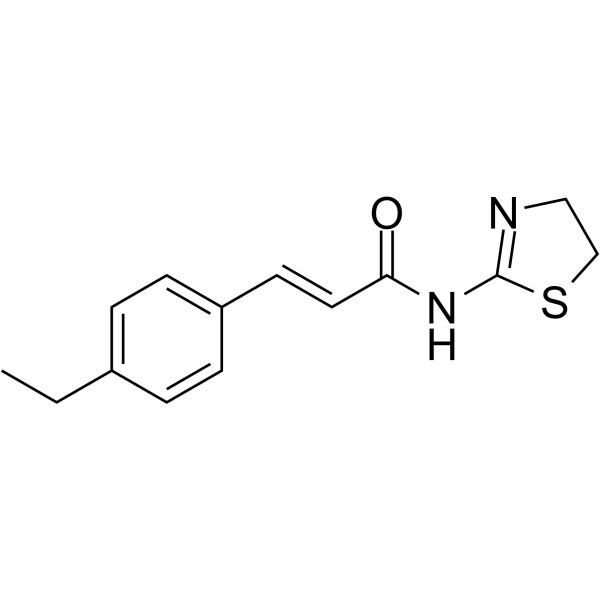
ML243 is a selective small-molecule inhibitor of breast cancer stem cells. ML243 has 32-fold greater selective inhibition in the breast CSC-like cell line HMLE_shECad than the control cell line HMLE_shGFP. ML243 may target the Wnt pathway at the protein level without altering RNA expression levels.
For research use only. We do not sell to patients.
- CAS No.: 1426576-80-8
- Formula: C14H16N2OS
- Molecular Weight:260.35
-
Storage:
Please store the product under the recommended conditions in the Certificate of Analysis.

To place orders, for customer services and technical support, please contact: MedChemExpress USA
Tel: 609-228-6898 E-mail: [email protected] [email protected]


-
 Biological Activity
-
Chemical Information
- Protocols
- Purity & Documentation
- References
-
 Help & FAQs




Biological Activity
Description
IC50 & Target
Breast CSCs[1]
Cellular Effect
|
Cell Line

|
Type | Value | Description | References |
|---|---|---|---|---|
| HMLE | EC50 |
2 μM
Compound: 19d, ML243
|
Cytotoxicity against human CSC-like HMLE cells expressing shRNA and epithelial cadherin after 70 to 74 hrs by Cell Titer Glo assay
Cytotoxicity against human CSC-like HMLE cells expressing shRNA and epithelial cadherin after 70 to 74 hrs by Cell Titer Glo assay
|
[PMID: 23403082] |
| HMLE | EC50 |
63.98 μM
Compound: 19d, ML243
|
Cytotoxicity against human HMLE cells expressing shRNA and GFP after 70 to 74 hrs by Cell Titer Glo assay
Cytotoxicity against human HMLE cells expressing shRNA and GFP after 70 to 74 hrs by Cell Titer Glo assay
|
[PMID: 23403082] |


Chemical Information
-
CAS No. 1426576-80-8
-
Molecular Weight 260.35
-
Formula C14H16N2OS
-
SMILES
CCC1=CC=C(/C=C/C(NC2=NCCS2)=O)C=C1
-
Shipping
Room temperature in continental US; may vary elsewhere.
-
Storage
Please store the product under the recommended conditions in the Certificate of Analysis.

Protocols
-
RT-PCR
Reverse transcription technology uses RNA as a template to synthesize DNA. RT-PCR is simple, specific and sensitive, and can be used to detect gene expression levels and expression differences in cells; detect RNA virus content; clone cDNA sequences of specific genes.
-
Western Blot
Western blotting (WB) is a commonly used experimental method in molecular biology, biochemistry, and immunogenetics for identifying and quantifying target proteins. It combines gel electrophoresis with immunoassay, enabling researchers to analyze protein expression, post-translational modifications, and molecular weight.
-
RNA extraction experimental
By lysing cells, releasing RNA, and removing impurities such as proteins and DNA, high-purity RNA products are finally obtained. The commonly used traditional method is the guanidine isothiocyanate/phenol/chloroform method (Trizol), which is suitable for a variety of animal materials including animal tissues, microorganisms, cultured cells, etc., and most plant materials.
-
Protocol for Northern Blot
Northern blot detects a defined RNA species by separating denatured RNA by size, transferring RNA to a membrane, hybridizing with a complementary labeled DNA or RNA probe, and detecting probe-bound RNA by autoradiography, phosphorimaging, or validated nonradioactive detection. The readout is both RNA size and abundance: band migration estimates transcript length or RNA-processing state, while band intensity reflects relative target RNA amount after normalization to total RNA, rRNA, or another validated loading control. In cancer cells, primary neurons, mouse tumor samples, intestinal organoids, inflammatory macrophages, or drug-screening studies, Northern blot is most appropriate when transcript size, isoform pattern, RNA processing, or small-RNA detection is important; qPCR or RNA-seq can complement it when higher sensitivity or global profiling is needed.
-
Breast Cancer Modeling
Breast cancer is a heterogeneous cancer, and it has been distinguished into four subtypes: luminal A, luminal B, HER2-positive and basal-like. Molecular mutations, epigenetic alterations, hormone exposure and immune microenvironment are related to the progression of breast cancer.
-
Real Time qPCR (Q-PCR)
Real-time quantitative PCR (qPCR) quantifies an amplifiable nucleic-acid target by monitoring fluorescence during PCR cycling rather than measuring product only after amplification. The increase in fluorescence tracks accumulation of PCR product, and the quantification cycle (Cq; historically also Ct/CP) is related to the initial amount of target: samples containing more starting target generally reach the defined fluorescence threshold in fewer cycles.


Purity & Documentation
References

Calculators
Concentration (start) × Volume (start) = Concentration (final) × Volume (final)


ML243 Related Classifications
HY-19972 Related Classifications
 Powered by Bioz