



ML267
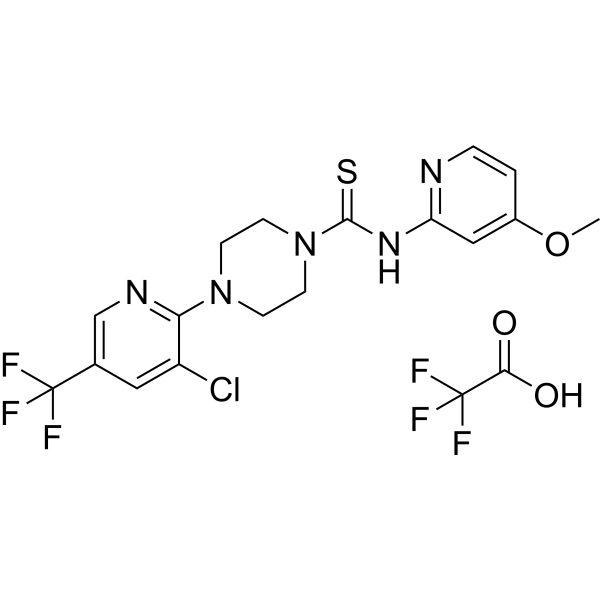
ML267 is a blood-brain barrier permeable Antibacterial agent and bacterial phosphopantetheinyl transferase (PPTase) inhibitor, with an IC50 of 0.29 μM against Bacillus subtilis Sfp-PPTase and an IC50 of 8.1 μM against bacterial AcpS-PPTase. ML267 attenuates bacterial secondary metabolism, activity, and the production of Sfp-PPTase-dependent metabolites. ML267 inhibits the growth of Gram-positive bacteria, including Methicillin (HY-121544)-resistant Staphylococcus aureus. ML267 is applicable to research related to bacterial infections, including methicillin-resistant Staphylococcus aureus infections.
For research use only. We do not sell to patients.
- CAS No.: 1542213-67-1
- Formula: C19H18ClF6N5O3S
- Molecular Weight:545.89
-
Storage:
Please store the product under the recommended conditions in the Certificate of Analysis.

To place orders, for customer services and technical support, please contact: MedChemExpress USA
Tel: 609-228-6898 E-mail: [email protected] [email protected]


-
 Biological Activity
-
Chemical Information
- Protocols
- Purity & Documentation
- References
-
 Help & FAQs




Biological Activity
Description
In Vitro
ML267 (3.6 nM-114 μM; 15 min pre-incubation, 30 min reaction) potently inhibits bacterial Sfp-PPTase with an IC50 of 0.290 μM and shows no activity against human PPTase at concentrations up to 114 μM[1].
ML267 (free base) (up to 8.1 μM; 15 min pre-incubation, 60 min reaction) inhibits bacterial AcpS-PPTase with an IC50 of 8.1 μM[1].
ML267 (0.4-100 μg/mL; 16-20 h, 4 h resazurin) exhibits bactericidal activity against Gram-positive bacterial strains including methicillin-resistant Staphylococcus aureus, with MICs ranging from 1.7 to 6.3 μg/mL, and no activity against Gram-negative bacteria or fungi[1].
ML267 (free base) (0.53-1.1 μg/mL; 28 h) dose-dependently attenuates Sfp-PPTase-dependent surfactin production in Bacillus subtilis OKB105 by 33-41% at sublethal concentrations, with minimal impact on bacterial growth[1].
ML267 potently inhibits bacterial Sfp-type PPTase (IC50 = 0.29 μM) and AcpS-type PPTase (IC50 = 8.1 μM), with no activity against the human PPTase ortholog[2].
ML267 (0.156-40 μM; 6 h) inhibits the growth of Bacillus subtilis ATCC 21332 with a MIC of 5.0 μM[2].
ML267 (15 min with enzyme, 30 min with substrate) potently inhibits Sfp phosphopantetheinyl transferase with an IC50 of 290 nM in a qHTS assay[3].
ML267 (48 h) exhibits no significant cytotoxicity against HepG2 human hepatocarcinoma cells, with an IC50 greater than 57 μM[3].
MedChemExpress (MCE) has not independently confirmed the accuracy of these methods. They are for reference only. Further protocols information, click here.
-
Cell Line:HepG2 human hepatocarcinoma cells
-
Concentration:serial dilutions
-
Incubation Time:48 h
-
Result:Showed no significant cytotoxicity against HepG2 cells, with an IC50 greater than 57 μM.
In Vivo
ML267 (3-30 mg/kg; i.v., i.p.; single dose) achieves favorable systemic exposure and crosses the blood-brain barrier in healthy CD1 mice with no acute toxicity at tested doses[1].
ML267 (3-30 mg/kg; i.v., i.p.; single dose) exhibits favorable in vivo pharmacokinetic properties in male CD-1 mice, with 98.5% bioavailability after intraperitoneal administration at 30 mg/kg and a plasma-to-brain ratio of 2.1, and a half-life of 2.4 hours after intravenous administration at 3 mg/kg[3].
MedChemExpress (MCE) has not independently confirmed the accuracy of these methods. They are for reference only.
-
Animal Model:CD1 (male, 6−8 weeks of age)[1]
-
Dosage:3 mg/kg (i.v.); 30 mg/kg (i.p.)
-
Administration:i.v.; single dose; i.p.; single dose
-
Result:Had a half-life (T1/2) of 2.4 h, maximum concentration (Cmax) of 4114 ng/mL, area under the curve (AUCinf) of 6983 h·ng/mL, volume of distribution (Vd) of 1.5 L/kg, mean residence time (MRT) of 3.4 h, clearance of 7.2 mL/min/kg, and plasma-to-brain ratio (P/B) of 2.5 following i.v. administration.
Had a half-life (T1/2) of 2.0 h, maximum concentration (Cmax) of 17633 ng/mL, area under the curve (AUCinf) of 68860 h·ng/mL, and plasma-to-brain ratio (P/B) of 2.1 following i.p. administration.
Noted no adverse clinical observations over 24 hours.


Chemical Information
-
CAS No. 1542213-67-1
-
Molecular Weight 545.89
-
Formula C19H18ClF6N5O3S
-
SMILES
S=C(N1CCN(C2=NC=C(C(F)(F)F)C=C2Cl)CC1)NC3=NC=CC(OC)=C3.O=C(O)C(F)(F)F
-
Shipping
Room temperature in continental US; may vary elsewhere.
-
Storage
Please store the product under the recommended conditions in the Certificate of Analysis.

Protocols
-
Research Protocol for Infectious Diseases
Infectious-disease experiments test how pathogens interact with host barriers, innate immune receptors, inflammatory signaling, pathogen replication, and tissue injury; pattern-recognition receptors such as TLRs, RIG-I-like receptors, NOD-like receptors, and inflammasomes detect microbial molecules and activate NF-κB, interferon, and cytokine responses. The central hypothesis is that infection severity reflects the balance between pathogen burden and host response: protective inflammation restricts pathogen growth, whereas excessive or mislocalized inflammation contributes to tissue damage and disease phenotype. Unresolved questions include which host pathways are protective versus pathogenic, why some infection models fail to translate to human disease, and which combined readouts best predict clinically relevant infection outcomes.
-
Gram Staining of Tissue Sections
Gram staining of tissue sections is a histochemical technique used to differentiate Gram-positive and Gram-negative bacteria within histological specimens based on differences in bacterial cell wall structure and dye retention, adapted from classical bacteriological Gram staining into tissue-compatible “histological Gram stain” variants. In tissue applications, modifications of the Brown-Hopps and Brown-Brenn methods are commonly used to improve differentiation of microorganisms embedded within host connective tissue and to reduce overstaining or loss of Gram-negative signal, which are known limitations of earlier approaches. The principle relies on crystal violet-iodine complex retention in Gram-positive organisms and subsequent decolorization and counterstaining steps that allow contrast visualization of Gram-negative organisms against tissue background.


Purity & Documentation
References
[1]. Foley TL, et al. 4-(3-Chloro-5-(trifluoromethyl)pyridin-2-yl)-N-(4-methoxypyridin-2-yl)piperazine-1-carbothioamide (ML267), a potent inhibitor of bacterial phosphopantetheinyl transferase that attenuates secondary metabolism and thwarts bacterial growth. J Med Chem. 2014 Feb 13;57(3):1063-78. [Content Brief]
[2]. Konno S, et al. A Chemoproteomics Approach to Investigate Phosphopantetheine Transferase Activity at the Cellular Level. Chembiochem. 2017;18(18):1855-1862. [Content Brief]

Calculators
Concentration (start) × Volume (start) = Concentration (final) × Volume (final)


ML267 Related Classifications
HY-137502 Related Classifications
 Powered by Bioz
Keywords
- ML267
- 1542213-67-1
- ML 267
- ML-267
- Bacterial
- Escherichia coli BW25113
- nonribosomal peptide synthetases
- AcpS-PPTase
- phosphopantetheinyl transferase
- Bacillus subtilis Sfp-PPTase
- Candida albicans
- Gram-positive bacteria
- CD1 mice
- HepG2 human hepatocarcinoma cells
- methicillin-resistant Staphylococcus aureus
- Inhibitor
- inhibitor
- inhibit