



Moexiprilat
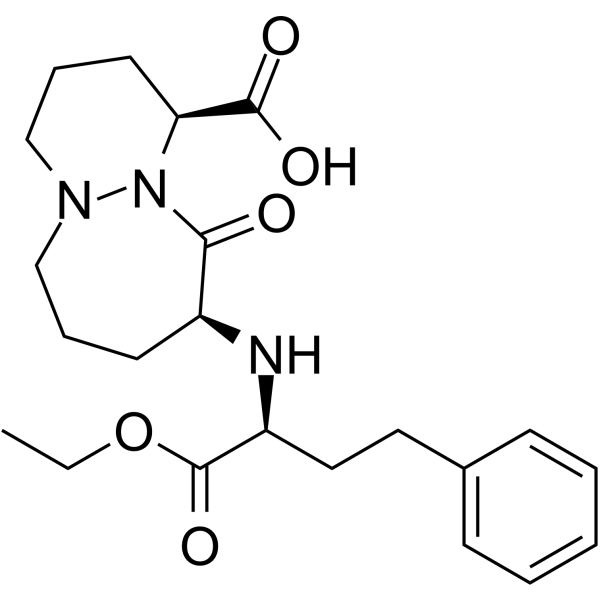
Moexiprilat is an inhibitor of angiotensin-converting enzyme (ACE; IC50=2.1 nM) and an active metabolite of the prodrug Moexipril (HY-117281). It is formed from moexipril in vivo by side chain ester hydrolysis. Moexiprilat (10 nM) prevents the estrone- or angiotensin II-stimulated proliferation of primary neonatal rat cardiac fibroblasts. It reduces mean arterial blood pressure and increases the levels of atrial natriuretic peptide, a marker of hypertension, in ovariectomized mice when administered at a dose of 50 mg/kg per day.
Nur für Forschungszwecke. Wir verkaufen nicht an Patienten.
- CAS. Nr.: 103775-14-0
- Formel: C25H30N2O7
- Molecular Weight:470.51
-
Speicherung:
Please store the product under the recommended conditions in the Certificate of Analysis.


To place orders, for customer services and technical support, please contact: MedChemExpress USA
Tel: 609-228-6898 E-mail: [email protected] [email protected]


-
 Biologische Aktivität
-
Chemical Information
- Protokoll
- Reinheit & Dokumentation
- Verweise
-
 Help & FAQs




Biologische Aktivität
Beschreibung


Chemical Information
-
CAS. Nr. 103775-14-0
-
Molecular Weight 470.51
-
Formel C25H30N2O7
-
SMILES
O=C([C@H]1N(C([C@@H](N[C@H](C(O)=O)CCC2=CC=CC=C2)C)=O)CC3=C(C=C(OC)C(OC)=C3)C1)O
-
Synonyms
RS 10029
-
Versand
Room temperature in continental US; may vary elsewhere.
-
Speicherung
Please store the product under the recommended conditions in the Certificate of Analysis.

Protokoll
-
Research Protocol for Cardiovascular Diseases
Cardiovascular disease can be modeled as maladaptive cardiac remodeling, where ischemic injury or pressure overload activates inflammatory signaling, fibroblast activation, extracellular-matrix deposition, cardiomyocyte hypertrophy, vascular remodeling, and progressive ventricular dysfunction. The TGF-β/SMAD axis is a central profibrotic pathway after myocardial injury and pressure overload, while innate immune and cytokine pathways regulate leukocyte recruitment, scar formation, and adverse remodeling. Key unresolved questions include which inflammatory signals are reparative versus harmful, when fibrosis is protective versus maladaptive, and whether pathway inhibition improves function without weakening necessary infarct healing or compensatory remodeling.
-
Cell Viability Determination by MTT Colorimetric Assay
The following protocol uses the MTT colorimetric assay as a classic literature-established method for assessing cell viability/metabolic activity in cultured mammalian cells. MTT[3-(4,5-dimethylthiazol-2-yl)-2,5-diphenyltetrazolium bromide] is reduced by metabolically active cells to a colored formazan product; the amount of formazan is quantified spectrophotometrically and provides an indirect measure of metabolically active viable cells. Importantly, MTT reduction reflects cellular oxidoreductase/metabolic activity rather than an absolute direct count of living cells, so changes in cellular metabolism can alter the signal independently of cell number.


Reinheit & Dokumentation
Verweise

Calculators
Konzentration (Stammlösung) × Volumen (Stammlösung) = Konzentration (Ziellösung) × Volumen (Ziellösung)


Moexiprilat Related Classifications
HY-A0114 Related Classifications
 Powered by Bioz