



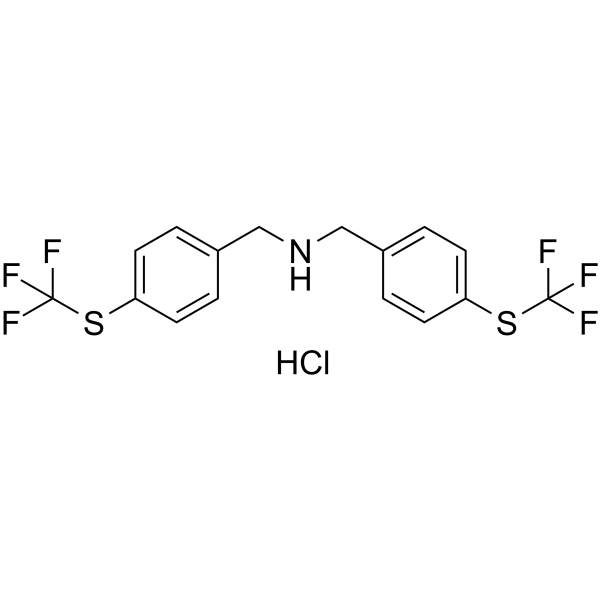
MY33-3 hydrochloride

Based on 1 Customer Validation
MY33-3 hydrochloride is a potent and selective inhibitor of receptor protein tyrosine phosphatase (RPTP)β/ζ, with an IC50 of ~0.1 μM. MY33-3 hydrochloride also inhibits PTP-1B (IC50 ~0.7 μM). MY33-3 hydrochloride can reduce ethanol consumption and alleviate Sevoflurane-induced neuroinflammation and cognitive dysfunction.
For research use only. We do not sell to patients.
- Purity : 99.32%
- CAS No.: 2204280-42-0
- Formula: C16H14ClF6NS2
- Molecular Weight:433.86
-
Storage:
4°C, sealed storage, away from moisture
* In solvent : -80°C, 6 months; -20°C, 1 month (sealed storage, away from moisture)

To place orders, for customer services and technical support, please contact: MedChemExpress USA
Tel: 609-228-6898 E-mail: [email protected] [email protected]


-
 Biological Activity
-
Chemical Information
-
Solvent & Solubility
- Protocols
- Purity & Documentation
- References
-
 Help & FAQs




Biological Activity
Description
In Vitro
MY33-3 hydrochloride (1 μM; pretreated for 5 min) blocks Ethanol-induced activation of TrkA and ALK in SH-SY5Y cells[1].
MY33-3 hydrochloride (0.1-10 μM; 24 h) limits LPS-induced nitrites production and iNos increases in BV2 microglial cells[2].
MedChemExpress (MCE) has not independently confirmed the accuracy of these methods. They are for reference only. Further protocols information, click here.
In Vivo
MY33-3 hydrochloride (i.p.) reverses the Sevoflurane-induced decrease in the discrimination index and impaired motor learning ability[3].
MedChemExpress (MCE) has not independently confirmed the accuracy of these methods. They are for reference only.


Chemical Information
-
CAS No. 2204280-42-0
-
Appearance Solid
-
Molecular Weight 433.86
-
Formula C16H14ClF6NS2
-
Color White to light yellow
-
SMILES
FC(F)(SC1=CC=C(CNCC2=CC=C(C=C2)SC(F)(F)F)C=C1)F.Cl
-
Shipping
Room temperature in continental US; may vary elsewhere.
-
Storage
4°C, sealed storage, away from moisture
* In solvent : -80°C, 6 months; -20°C, 1 month (sealed storage, away from moisture)


Solvent & Solubility
In Vitro:
DMSO : 50 mg/mL (115.24 mM; ultrasonic and warming and heat to 60°C; Hygroscopic DMSO has a significant impact on the solubility of product, please use newly opened DMSO)
Please refer to the solubility information to select the appropriate solvent. Once prepared, please aliquot and store the solution to prevent product inactivation from repeated freeze-thaw cycles.
Storage method and period of stock solution: -80°C, 6 months; -20°C, 1 month (sealed storage, away from moisture). When stored at -80°C, please use it within 6 months. When stored at -20°C, please use it within 1 month.
Please refer to the solubility information to select the appropriate solvent. Once prepared, please aliquot and store the solution to prevent product inactivation from repeated freeze-thaw cycles.
Storage method and period of stock solution: -80°C, 6 months; -20°C, 1 month (sealed storage, away from moisture). When stored at -80°C, please use it within 6 months. When stored at -20°C, please use it within 1 month.
Concentration (start) × Volume (start) = Concentration (final) × Volume (final)

Protocols
-
Cell Cytotoxicity Assay
Cytotoxicity assays are usually based on the assessment of cell membrane damage, which can also be indirectly detected by measuring cell viability. Detection methods include MTT assay, CKK-8 assay, LDH assay and ATP assay, etc.
-
Research Protocol for Neurological Diseases
PINK1/Parkin-mediated mitophagy pathway is a mitochondrial quality-control signaling axis in which mitochondrial depolarization stabilizes PINK1 on damaged mitochondria, activates Parkin recruitment and E3 ubiquitin ligase activity, promotes ubiquitination of outer mitochondrial membrane proteins, recruits selective autophagy adaptors, and drives lysosomal degradation of damaged mitochondria. In neurological disease research, this pathway is experimentally important because neurons, especially dopaminergic neurons, are highly dependent on mitochondrial integrity, and defective mitochondrial turnover can lead to mitochondrial dysfunction, oxidative stress, impaired neuronal survival, α-synuclein accumulation, and neuroinflammatory damage-associated signals. The genetic disease link is strongest in Parkinson’s disease because mutations in PRKN/parkin cause autosomal recessive juvenile parkinsonism, mutations in PINK1 cause hereditary early-onset Parkinson’s disease, and Drosophila studie


Purity & Documentation
-
Data Sheet (270 KB)
-
SDS (393 KB)
- English - EN (393 KB)
- Français - FR (393 KB)
- Deutsch - DE (393 KB)
- Norwegian - NO (393 KB)
- Español - ES (393 KB)
- Swedish - SV (393 KB)
- Italian - IT (393 KB)
- Korean - KR (393 KB)
- Portuguese - PT (393 KB)
-
Handling Instructions (2659 KB)
References
[1]. Fernández-Calle R, et, al. Pharmacological inhibition of Receptor Protein Tyrosine Phosphatase β/ζ (PTPRZ1) modulates behavioral responses to ethanol. Neuropharmacology. 2018 Jul 15;137:86-95. [Content Brief]
[2]. Fernández-Calle R, et, al. Role of RPTPβ/ζ in neuroinflammation and microglia-neuron communication. Sci Rep. 2020 Nov 20;10(1):20259. [Content Brief]
[3]. Mao S, et, al. Pleiotrophin Potentiates Sevoflurane Anesthesia-induced Learning Deficits in Mice. J Mol Neurosci. 2022 Jan;72(1):48-55. [Content Brief]


Complete Stock Solution Preparation Table
Please refer to the solubility information to select the appropriate solvent. Once prepared, please aliquot and store the solution to prevent product inactivation from repeated freeze-thaw cycles.
Storage method and period of stock solution: -80°C, 6 months; -20°C, 1 month (sealed storage, away from moisture). When stored at -80°C, please use it within 6 months. When stored at -20°C, please use it within 1 month.
| Optional Solvent | Concentration Solvent Mass | 1 mg | 5 mg | 10 mg | 25 mg |
|---|---|---|---|---|---|
| DMSO | 1 mM | 2.3049 mL | 11.5245 mL | 23.0489 mL | 57.6223 mL |
| 5 mM | 0.4610 mL | 2.3049 mL | 4.6098 mL | 11.5245 mL | |
| 10 mM | 0.2305 mL | 1.1524 mL | 2.3049 mL | 5.7622 mL | |
| 15 mM | 0.1537 mL | 0.7683 mL | 1.5366 mL | 3.8415 mL | |
| 20 mM | 0.1152 mL | 0.5762 mL | 1.1524 mL | 2.8811 mL | |
| 25 mM | 0.0922 mL | 0.4610 mL | 0.9220 mL | 2.3049 mL | |
| 30 mM | 0.0768 mL | 0.3841 mL | 0.7683 mL | 1.9207 mL | |
| 40 mM | 0.0576 mL | 0.2881 mL | 0.5762 mL | 1.4406 mL | |
| 50 mM | 0.0461 mL | 0.2305 mL | 0.4610 mL | 1.1524 mL | |
| 60 mM | 0.0384 mL | 0.1921 mL | 0.3841 mL | 0.9604 mL | |
| 80 mM | 0.0288 mL | 0.1441 mL | 0.2881 mL | 0.7203 mL | |
| 100 mM | 0.0230 mL | 0.1152 mL | 0.2305 mL | 0.5762 mL |


MY33-3 hydrochloride Related Classifications
HY-123966A Related Classifications
 Powered by Bioz