



MY33-3

Based on 1 Customer Validation
MY33-3 is a potent and selective inhibitor of receptor protein tyrosine phosphatase (RPTP)β/ζ, with an IC50 of ~0.1 μM. MY33-3 also inhibits PTP-1B (IC50 ~0.7 μM). MY33-3 can reduce ethanol consumption and alleviate Sevoflurane-induced neuroinflammation and cognitive dysfunction.
Nos produits utilisent uniquement pour la recherche. Nous ne vendons pas aux patients.
- Pureté : 99.53%
- CAS No.: 2204280-41-9
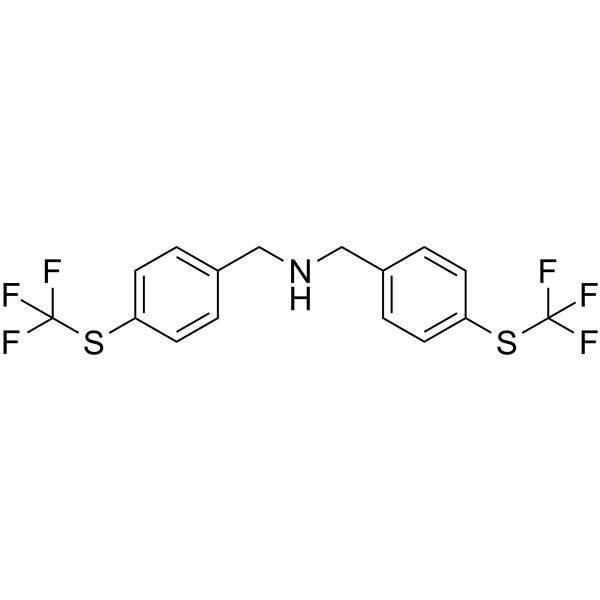
- Formule: C16H13F6NS2
- Masse moléculaire:397.40
-
Stockage:
4°C, sealed storage, away from moisture
* In solvent : -80°C, 6 months; -20°C, 1 month (sealed storage, away from moisture)

To place orders, for customer services and technical support, please contact: MedChemExpress USA
Tel: 609-228-6898 E-mail: [email protected] [email protected]


-
 Activité biologique
-
Chemical Information
-
Solvant et solubilité
- Protocole
- Pureté et documentation
- Références
-
 Help & FAQs




Activité biologique
Description
IC50 & Target
IC50: 0.1 μM (RPTPβ/ζ), 0.7 μM (PTP-1B)[1]
In Vitro
MY33-3 (1 μM; pretreated for 5 min) blocks Ethanol-induced activation of TrkA and ALK in SH-SY5Y cells[1].
MY33-3 (0.1-10 μM; 24 h) limits LPS-induced nitrites production and iNos increases in BV2 microglial cells[2].
MedChemExpress (MCE) has not independently confirmed the accuracy of these methods. They are for reference only.
-
Cell Line:SH-SY5Y cells
-
Concentration:1 μM
-
Incubation Time:Pretreated for 5 min and co-treated for 15 min
-
Result:Decreased the Ethanol-induced activation of TrkA and ALK.
None of the treatments significantly changed total TrkA or total ALK protein levels.
In Vivo
MY33-3 (i.p.) reverses the Sevoflurane-induced decrease in the discrimination index and impaired motor learning ability[3].
MedChemExpress (MCE) has not independently confirmed the accuracy of these methods. They are for reference only.
-
Animal Model:Male C57BL/6J mice (8-10 weeks of age) are received two-bottle drinking in the dark (DID) procedure using 20% ethanol[1]
-
Dosage:60 mg/kg
-
Administration:P.o. 1 hour before the drinking session in the DID test on days 3 and 4
-
Result:Reduced ethanol consumption when comparing day 2 with day 3.
Showed a reduced preference for the ethanol solution.
Not affected total fluid consumption.


Chemical Information
-
CAS No. 2204280-41-9
-
Appearance Solid
-
Masse moléculaire 397.40
-
Formule C16H13F6NS2
-
Color Off-white to light yellow
-
SMILES
FC(SC1=CC=C(CNCC2=CC=C(SC(F)(F)F)C=C2)C=C1)(F)F
-
Livraison
Room temperature in continental US; may vary elsewhere.
-
Stockage
4°C, sealed storage, away from moisture
* In solvent : -80°C, 6 months; -20°C, 1 month (sealed storage, away from moisture)


Solvant et solubilité
In Vitro:
DMSO : 10 mg/mL (25.16 mM; ultrasonic and warming and heat to 60°C; Hygroscopic DMSO has a significant impact on the solubility of product, please use newly opened DMSO)
Please refer to the solubility information to select the appropriate solvent. Once prepared, please aliquot and store the solution to prevent product inactivation from repeated freeze-thaw cycles.
Storage method and period of stock solution: -80°C, 6 months; -20°C, 1 month (sealed storage, away from moisture). When stored at -80°C, please use it within 6 months. When stored at -20°C, please use it within 1 month.
Please refer to the solubility information to select the appropriate solvent. Once prepared, please aliquot and store the solution to prevent product inactivation from repeated freeze-thaw cycles.
Storage method and period of stock solution: -80°C, 6 months; -20°C, 1 month (sealed storage, away from moisture). When stored at -80°C, please use it within 6 months. When stored at -20°C, please use it within 1 month.
Concentration (start) × Volume (start) = Concentration (final) × Volume (final)


Pureté et documentation
-
Fiche technique (271 KB)
-
SDS (252 KB)
- English - EN (252 KB)
- Français - FR (252 KB)
- Deutsch - DE (252 KB)
- Norwegian - NO (252 KB)
- Español - ES (252 KB)
- Swedish - SV (252 KB)
- Italian - IT (252 KB)
- Korean - KR (252 KB)
- Portuguese - PT (252 KB)
-
Instruction de manipulation (2659 KB)
Références
[1]. Fernández-Calle R, et, al. Pharmacological inhibition of Receptor Protein Tyrosine Phosphatase β/ζ (PTPRZ1) modulates behavioral responses to ethanol. Neuropharmacology. 2018 Jul 15;137:86-95. [Content Brief]
[2]. Fernández-Calle R, et, al. Role of RPTPβ/ζ in neuroinflammation and microglia-neuron communication. Sci Rep. 2020 Nov 20;10(1):20259. [Content Brief]
[3]. Mao S, et, al. Pleiotrophin Potentiates Sevoflurane Anesthesia-induced Learning Deficits in Mice. J Mol Neurosci. 2022 Jan;72(1):48-55. [Content Brief]


Complete Stock Solution Preparation Table
Please refer to the solubility information to select the appropriate solvent. Once prepared, please aliquot and store the solution to prevent product inactivation from repeated freeze-thaw cycles.
Storage method and period of stock solution: -80°C, 6 months; -20°C, 1 month (sealed storage, away from moisture). When stored at -80°C, please use it within 6 months. When stored at -20°C, please use it within 1 month.
| Optional Solvent | Concentration Solvent Mass | 1 mg | 5 mg | 10 mg | 25 mg |
|---|---|---|---|---|---|
| DMSO | 1 mM | 2.5164 mL | 12.5818 mL | 25.1636 mL | 62.9089 mL |
| 5 mM | 0.5033 mL | 2.5164 mL | 5.0327 mL | 12.5818 mL | |
| 10 mM | 0.2516 mL | 1.2582 mL | 2.5164 mL | 6.2909 mL | |
| 15 mM | 0.1678 mL | 0.8388 mL | 1.6776 mL | 4.1939 mL | |
| 20 mM | 0.1258 mL | 0.6291 mL | 1.2582 mL | 3.1454 mL | |
| 25 mM | 0.1007 mL | 0.5033 mL | 1.0065 mL | 2.5164 mL |


MY33-3 Related Classifications
HY-123966 Related Classifications
 Powered by Bioz