



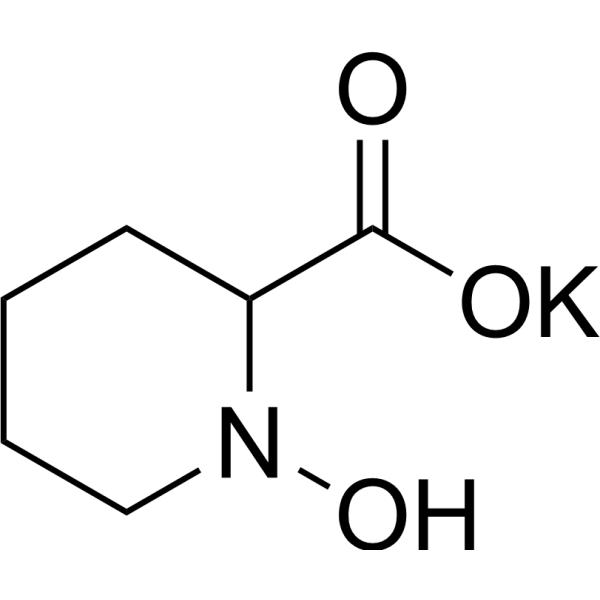
N-Hydroxypipecolic acid potassium
Based on 6 publication(s) in Google Scholar
N-Hydroxypipecolic acid potassium (1-Hydroxy-2-piperidinecarboxylic acid potassium), a plant metabolite and a systemic acquired resistance (SAR) regulator, orchestrates SAR establishment in concert with the immune signal salicylic acid. N-Hydroxypipecolic acid potassium accumulates systemically in the plant foliage in response to pathogen attack. N-Hydroxypipecolic acid potassium induces SAR to bacterial and oomycete infection.
For research use only. We do not sell to patients.
- CAS No.: 2253632-01-6
- Formula: C6H10KNO3
- Molecular Weight:183.25
-
Storage:
Please store the product under the recommended conditions in the Certificate of Analysis.

To place orders, for customer services and technical support, please contact: MedChemExpress USA
Tel: 609-228-6898 E-mail: [email protected] [email protected]


-
 Biological Activity
-
Chemical Information
- Protocols
- Purity & Documentation
- References
-
 Help & FAQs


Publications Citing Use of MedChemExpress (MCE) N-Hydroxypipecolic acid potassium
More

Biological Activity
Description
In Vitro
The mode of action of N-Hydroxypipecolic acid potassium in SAR involves direct induction of SAR gene expression, signal amplification, priming for enhanced defense activation and positive interplay with salicylic acid signaling to ensure elevated plant immunity. Flavin-dependent-monooxygenase1 (FMO1) functions downstream of Pip by hydroxylating Pip to generate N-Hydroxypipecolic acid potassium[1][3].
MedChemExpress (MCE) has not independently confirmed the accuracy of these methods. They are for reference only. Further protocols information, click here.
Clinical Trial
| NCT Number | Sponsor | Condition | Start Date |
Phase

|
|---|---|---|---|---|
| NCT01329991 | Plexxikon| | 2011-05 | PHASE1 |


Chemical Information
-
CAS No. 2253632-01-6
-
Molecular Weight 183.25
-
Formula C6H10KNO3
-
SMILES
O=C(C1N(O)CCCC1)O[K]
-
Synonyms
1-Hydroxy-2-piperidinecarboxylic acid potassium; NHP potassium
-
Structure Classification
-
Initial Source
-
Shipping
Room temperature in continental US; may vary elsewhere.
-
Storage
Please store the product under the recommended conditions in the Certificate of Analysis.


Publications (6)
-
Journal Impact Factor
-
Most Recent
-
Nat Plants
A root-based N-hydroxypipecolic acid standby circuit to direct immunity and growth of Arabidopsis shoots. [Abstract]2025 Aug;11(8):1658-1669. PMID: 40696005 -
Sci China Life Sci
Promotion of Arabidopsis immune responses by a rhizosphere fungus via supply of pipecolic acid to plants and selective augment of phytoalexins. [Abstract]2023 May;66(5):1119-1133. PMID: 36449213 -
Plant Physiol
2025 Oct 23:kiaf536. PMID: 41131670 -
Plant J
Warm temperature suppresses plant systemic acquired resistance by intercepting N-hydroxypipecolic acid biosynthesis. [Abstract]2025 Aug;123(3):e70374. PMID: 40758777 -
Int J Mol Sci
Local Application of Acibenzolar- S-Methyl Treatment Induces Antiviral Responses in Distal Leaves of Arabidopsis thaliana. [Abstract]2024 Feb 2;25(3):1808. PMID: 38339085 -
Life
UGT76B1 and 41 Additional Arabidopsis UDP-Glycosyltransferases Show No Detectable In Vitro Glycosylation Activity Toward N-Hydroxypipecolic Acid. [Abstract]2026 Jun 12;16(6):992. PMID: 42355518

Protocols
-
Research Protocol for Infectious Diseases
Infectious-disease experiments test how pathogens interact with host barriers, innate immune receptors, inflammatory signaling, pathogen replication, and tissue injury; pattern-recognition receptors such as TLRs, RIG-I-like receptors, NOD-like receptors, and inflammasomes detect microbial molecules and activate NF-κB, interferon, and cytokine responses. The central hypothesis is that infection severity reflects the balance between pathogen burden and host response: protective inflammation restricts pathogen growth, whereas excessive or mislocalized inflammation contributes to tissue damage and disease phenotype. Unresolved questions include which host pathways are protective versus pathogenic, why some infection models fail to translate to human disease, and which combined readouts best predict clinically relevant infection outcomes.


Purity & Documentation
References
[1]. Shan L, et al. Pipped at the Post: Pipecolic Acid Derivative Identified as SAR Regulator. Cell. 2018 Apr 5;173(2):286-287. [Content Brief]
[2]. Ádám AL, et al. Signals of Systemic Immunity in Plants: Progress and Open Questions. Int J Mol Sci. 2018 Apr 10;19(4). pii: E1146. [Content Brief]
[3]. Hartmann M, et al. N-hydroxypipecolic acid and salicylic acid: a metabolic duo for systemic acquired resistance. Curr Opin Plant Biol. 2019 Aug;50:44-57. [Content Brief]

Calculators
Concentration (start) × Volume (start) = Concentration (final) × Volume (final)


N-Hydroxypipecolic acid potassium Related Classifications
HY-N7378A Related Classifications
 Powered by Bioz