



P32/98
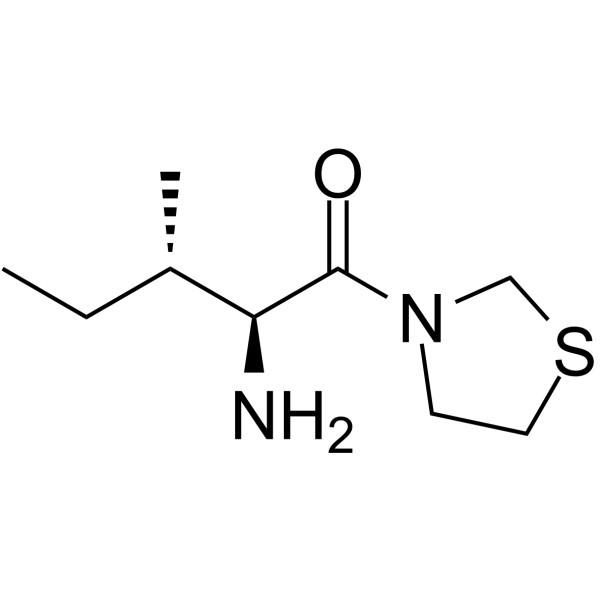
P32/98 a potent inhibitor of dipeptidyl peptidase IV with a Ki value of 130 nM. P32/98 improves glucose tolerance, insulin sensitivity and β-cell responsiveness in fatty Zucker rat model.
For research use only. We do not sell to patients.
- CAS No.: 136259-20-6
- Formula: C9H18N2OS
- Molecular Weight:202.32
-
Storage:
Please store the product under the recommended conditions in the Certificate of Analysis.

To place orders, for customer services and technical support, please contact: MedChemExpress USA
Tel: 609-228-6898 E-mail: [email protected] [email protected]


-
 Biological Activity
-
Chemical Information
- Protocols
- Purity & Documentation
- References
-
 Help & FAQs




Biological Activity
Description
IC50 & Target
DPP4[1]
In Vitro
GLP-1 acts function of stimulation of glucose dependent insulin secretion and induction of satiety feelings, and DPPIV is the major renal catabolic pathway for GLP-1 in vivo[2].
P32/98 hemifumarate, together with 200 pM GLP-1, (10 μM; 3 h) shows no significant inhibition of sodium re-absorption in porcine proximal tubular cells[2].
P32/98 (10 μM; 96 h) does not influence the mRNA expression of GLP-1R, DPPIV, Na+/H+ exchanger isoform 3 (NHE3), sodium-dependent glucose transporter slc5a1, slc5a2 (SGLT1, 2)[2].
MedChemExpress (MCE) has not independently confirmed the accuracy of these methods. They are for reference only. Further protocols information, click here.
-
Cell Line:Porcine proximal tubular cells
-
Concentration:10 μM
-
Incubation Time:96 hours
-
Result:Showed no toxic.
In Vivo
MedChemExpress (MCE) has not independently confirmed the accuracy of these methods. They are for reference only.
-
Animal Model:Zucker diabetic fatty rat[2]
-
Dosage:25 mg/kg
-
Administration:Oral gavage; once daily
-
Result:Significantly improved the glucose tolerance in Zucker diabetic fatty rats.


Chemical Information
-
CAS No. 136259-20-6
-
Molecular Weight 202.32
-
Formula C9H18N2OS
-
SMILES
CC[C@H](C)[C@H](N)C(N1CSCC1)=O
-
Shipping
Room temperature in continental US; may vary elsewhere.
-
Storage
Please store the product under the recommended conditions in the Certificate of Analysis.

Protocols
-
Research Protocol for Endocrine Diseases
Endocrine diseases often arise from disrupted hormone production, hormone signaling, or target-tissue responsiveness; for diabetes-focused endocrine disease models, insulin signaling regulates glucose uptake, hepatic glucose output, lipid metabolism, and β-cell compensation. Type 2 diabetes develops through interacting defects in insulin resistance, β-cell dysfunction, adipose inflammation, hepatic glucose overproduction, altered incretin signaling, and ectopic lipid metabolism. A major unresolved question is whether endocrine dysfunction is driven primarily by target-tissue insulin resistance, intrinsic β-cell failure, immune/inflammatory stress, or combined multi-organ failure that differs by disease stage.
-
How to Select a Suitable Non-Mouse Animal Model
Selecting a suitable non-mouse animal model is a structured decision based on the research question, required anatomy or physiology, disease mechanism, endpoint feasibility, translational relevance, and ethical justification. Non-mouse models are preferred when mice cannot reproduce key human-relevant features, such as organ size, surgical anatomy, cardiovascular physiology, neuroanatomy, immune features, pharmacology, toxicology, or long-term clinical procedures. Candidate species may include rats, rabbits, guinea pigs, ferrets, zebrafish, pigs, sheep, goats, dogs, cats, horses, and non-human primates, but each species must be justified by its specific scientific advantage rather than convenience or tradition. Unresolved questions include how to quantify translational superiority across species, how to balance increased biological relevance against higher ethical burden, and when human-derived systems or new approach methodologies should replace animal use.
-
How to Choose the Right Model Animal
Choosing the right model animal is a validity-driven decision in which the species, strain, sex, age, genetic background, disease-induction method, outcome measures, and welfare burden must match the scientific question rather than laboratory tradition or convenience. A model should be selected by judging face validity, construct validity, and predictive validity: whether it resembles the human phenotype, whether it reproduces relevant mechanisms, and whether results are likely to predict human biology or treatment response. Animal studies often fail to translate because of species differences, weak disease resemblance, poor experimental design, inadequate reporting, publication bias, and underuse of randomization, blinding, and sample-size justification. Unresolved questions include how to rank competing models objectively, how much human-disease complexity must be reproduced for a given objective, and when non-animal systems such as organoids, ex vivo tissue, or computational models


Purity & Documentation
References
[1]. Augstein P, et al. Efficacy of the dipeptidyl peptidase IV inhibitor isoleucine thiazolidide (P32/98) in fatty Zucker rats with incipient and manifest impaired glucose tolerance. Diabetes Obes Metab. 2008;10(10):850-861. [Content Brief]
[2]. Schlatter P, et al. Glucagon-like peptide 1 receptor expression in primary porcine proximal tubular cells. Regul Pept. 2007 Jun 7;141(1-3):120-8. [Content Brief]
[3]. Wargent E, et al. Improvement of glucose tolerance in Zucker diabetic fatty rats by long-term treatment with the dipeptidyl peptidase inhibitor P32/98: comparison with and combination with rosiglitazone. Diabetes Obes Metab. 2005;7(2):170-181. [Content Brief]

Calculators
Concentration (start) × Volume (start) = Concentration (final) × Volume (final)


P32/98 Related Classifications
HY-129736A Related Classifications
 Powered by Bioz