



NLRP3/AIM2-IN-1
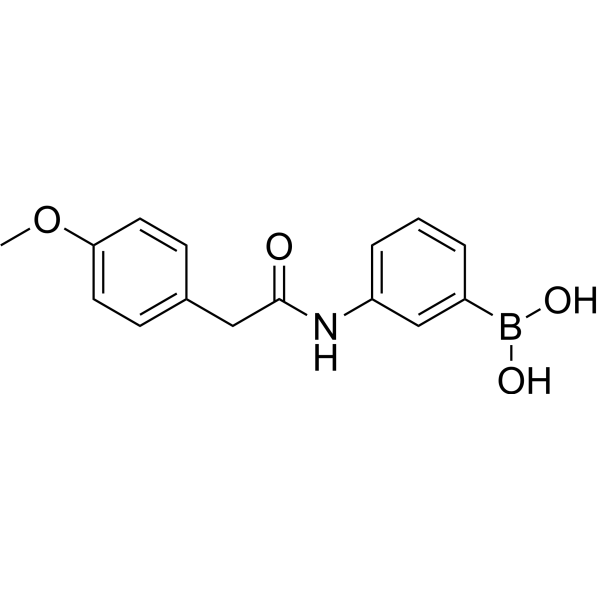
NLRP3/AIM2-IN-1 is an NLRP3/AIM2 inhibitor with an IC50 of 3.136 μM against NLRP3-dependent pyroptosis. NLRP3/AIM2-IN-1 inhibits IL-1β secretion triggered by NLRP3 inflammasome activation. NLRP3/AIM2-IN-1 exhibits moderate anti-pyroptotic activity. NLRP3/AIM2-IN-1 does not inhibit NLRC4 inflammasome activation. NLRP3/AIM2-IN-1 can be used for studying inflammasome-mediated inflammatory diseases.
Nos produits utilisent uniquement pour la recherche. Nous ne vendons pas aux patients.
- CAS No.: 3033386-91-0
- Formule: C15H16BNO4
- Masse moléculaire:285.10
-
Stockage:
Please store the product under the recommended conditions in the Certificate of Analysis.

To place orders, for customer services and technical support, please contact: MedChemExpress USA
Tel: 609-228-6898 E-mail: [email protected] [email protected]


-
 Activité biologique
-
Chemical Information
- Protocole
- Pureté et documentation
- Références
-
 Help & FAQs




Activité biologique
Description
IC50 & Target
[1]|
NLRP3 3.136 μM (IC50) |
Cellular Effect
|
Cell Line

|
Type | Value | Description | References |
|---|---|---|---|---|
| THP-1 | IC50 |
3.136 μM
|
Inhibition of nigericin-induced NLRP3-dependent pyroptosis in PMA-differentiated human THP-1 macrophages assessed as improvement of cell viability via MTT assay, following 4 h LPS priming, 30 min pre-incubation with NLRP3/AIM2-IN-1, and 3 h nigericin stimulation.
Inhibition of nigericin-induced NLRP3-dependent pyroptosis in PMA-differentiated human THP-1 macrophages assessed as improvement of cell viability via MTT assay, following 4 h LPS priming, 30 min pre-incubation with NLRP3/AIM2-IN-1, and 3 h nigericin stimulation.
|
35183871 |
In Vitro
NLRP3/AIM2-IN-1 (compound 1) (0.4-100 μM; 30 min pre-incubation before 3 h nigericin stimulation) moderately inhibits Nigericin (HY-127019)-induced NLRP3-dependent pyroptosis in human THP-1 macrophages with an IC50 of 3.136 μM[1].
NLRP3/AIM2-IN-1 (0.4-100 μM; 30 min pre-incubation before 30 min nigericin stimulation) dose-dependently inhibits NLRP3-dependent IL-1β secretion in human THP-1 macrophages, but does not achieve full inhibition even at 100 μM[1].
MedChemExpress (MCE) has not independently confirmed the accuracy of these methods. They are for reference only. Further protocols information, click here.
-
Cell Line:PMA-differentiated human THP-1 macrophages
-
Concentration:0.4-100 μM
-
Incubation Time:30 min
-
Result:Exhibited moderate dose-dependent improvement of cell viability in Nigericin-induced pyroptosis.
Reached a half-maximal inhibitory concentration (IC50) of 3.136 μM for pyroptosis inhibition.
Failed to completely protect cells from pyroptosis even at the highest tested concentration of 100 μM.
-
Cell Line:PMA-differentiated human THP-1 macrophages
-
Concentration:0.4-100 μM
-
Incubation Time:30 min
-
Result:Showed dose-dependent inhibition of IL-1β secretion triggered by LPS and Nigericin.
Failed to completely block IL-1β release even at 100 μM.


Chemical Information
-
CAS No. 3033386-91-0
-
Masse moléculaire 285.10
-
Formule C15H16BNO4
-
SMILES
COC1=CC=C(C=C1)CC(NC2=CC=CC(B(O)O)=C2)=O
-
Livraison
Room temperature in continental US; may vary elsewhere.
-
Stockage
Please store the product under the recommended conditions in the Certificate of Analysis.

Protocole
-
Pyroptosis Solutions
Pyroptosis is a lytic inflammatory cell-death pathway executed by gasdermin pores, most classically through inflammasome-mediated activation of caspase-1, cleavage of gasdermin D, membrane pore formation, LDH release, and secretion of IL-1β and IL-18. The canonical pathway is commonly modeled by priming cells with an inflammatory signal such as LPS to induce pro-IL-1β and inflammasome components, followed by an activation signal such as ATP or nigericin to activate NLRP3, ASC speck formation, caspase-1 cleavage, GSDMD cleavage, cytokine release, and pyroptotic membrane rupture. The non-canonical pathway is triggered when cytosolic LPS activates mouse caspase-11 or human caspase-4/5, leading to GSDMD cleavage and pyroptosis, and this can secondarily activate NLRP3-dependent IL-1β release. Pyroptosis is linked to inflammatory injury, infection, cancer, liver disease, ocular disease, placental inflammation, and other disease phenotypes, but unresolved questions include which gasdermin fam


Pureté et documentation
Références

Calculators
Concentration (start) × Volume (start) = Concentration (final) × Volume (final)


NLRP3/AIM2-IN-1 Related Classifications
HY-144220 Related Classifications
 Powered by Bioz