



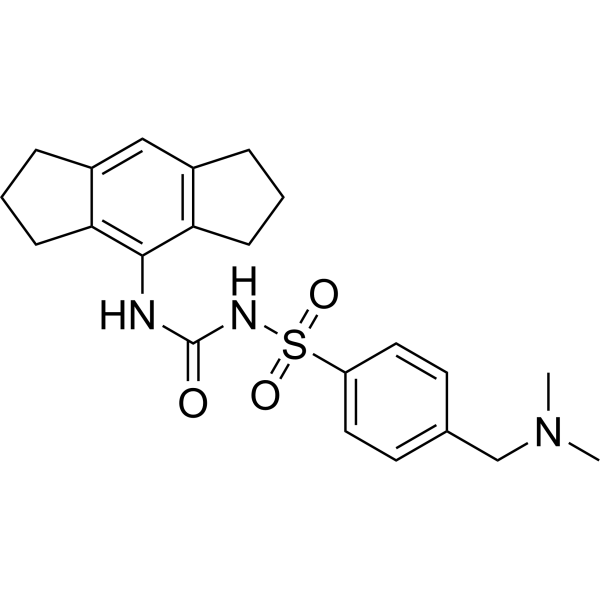
NLRP3-IN-20
NLRP3-IN-20 (compound 11) is an orally available inhibitor of the NLRP3 inflammasome with an IC50 of 25 nM for IL-1β secretion. NLRP3-IN-20 has excellent pharmacokinetic properties and demonstrated significant efficacy in models of non-alcoholic steatohepatitis, fatal septic shock, and colitis.
For research use only. We do not sell to patients.
- CAS No.: 2428478-22-0
- Formula: C22H27N3O3S
- Molecular Weight:413.53
-
Storage:
Please store the product under the recommended conditions in the Certificate of Analysis.

To place orders, for customer services and technical support, please contact: MedChemExpress USA
Tel: 609-228-6898 E-mail: [email protected] [email protected]


-
 Biological Activity
-
Chemical Information
- Protocols
- Purity & Documentation
- References
-
 Help & FAQs




Biological Activity
Description
IC50 & Target
NLRP3[1]
In Vivo
Pharmacokinetic Analysis in Mouse[1]
| Route | Dose (mg/kg) | T1/2 (h) | Tmax (h) | Cmax (ng/mL) | AUC0-inf (ng·h/mL) | MRT0-inf (h) | Vz (mL/kg) | Cl (mL/h/kg) | F (%) |
| i.v. | 5 | 4.01 | 0.083 | 22567 | 130240/ | 5.30 | 226 | 38.8 | |
| p.o. | 10 | 3.50 | 0.667 | 33867 | 221955 | 4.79 | / | / | 85.21 |
MedChemExpress (MCE) has not independently confirmed the accuracy of these methods. They are for reference only.


Chemical Information
-
CAS No. 2428478-22-0
-
Molecular Weight 413.53
-
Formula C22H27N3O3S
-
SMILES
O=S(C1=CC=C(CN(C)C)C=C1)(NC(NC2=C3CCCC3=CC4=C2CCC4)=O)=O
-
Shipping
Room temperature in continental US; may vary elsewhere.
-
Storage
Please store the product under the recommended conditions in the Certificate of Analysis.

Protocols
-
DSS-Induced Colitis
Dextran sulfate sodium (DSS)-induced colitis is generated by administering DSS in mouse drinking water, producing epithelial injury, barrier disruption, weight loss, diarrhea, fecal blood, colon shortening, histologic mucosal damage, and inflammatory mediator changes; the model is mainly used to study acute or chronic intestinal inflammation resembling selected features of ulcerative colitis. DSS injury is interpreted through clinical and tissue readouts rather than a single molecular endpoint: daily body weight, stool consistency, and bleeding are combined into a disease activity index, while colon length, histology, cytokines, myeloperoxidase activity, intestinal permeability, and tight-junction markers provide complementary measures of inflammation and barrier damage.
-
TNBS-Induced Colitis
TNBS-induced colitis is produced by intrarectal delivery of 2,4,6-trinitrobenzene sulfonic acid in ethanol, where ethanol disrupts the mucosal barrier and TNBS haptenates colonic proteins, generating immune-mediated colonic inflammation with weight loss, diarrhea, ulceration, transmural injury, inflammatory-cell infiltration, and cytokine responses. The model is used as an experimental intestinal inflammation model with Crohn’s disease–like features, especially when Th1-type responses, IL-12–dependent inflammation, chronic relapsing inflammation, or fibrosis-related endpoints are studied.
-
Pyroptosis Solutions
Pyroptosis is a lytic inflammatory cell-death pathway executed by gasdermin pores, most classically through inflammasome-mediated activation of caspase-1, cleavage of gasdermin D, membrane pore formation, LDH release, and secretion of IL-1β and IL-18. The canonical pathway is commonly modeled by priming cells with an inflammatory signal such as LPS to induce pro-IL-1β and inflammasome components, followed by an activation signal such as ATP or nigericin to activate NLRP3, ASC speck formation, caspase-1 cleavage, GSDMD cleavage, cytokine release, and pyroptotic membrane rupture. The non-canonical pathway is triggered when cytosolic LPS activates mouse caspase-11 or human caspase-4/5, leading to GSDMD cleavage and pyroptosis, and this can secondarily activate NLRP3-dependent IL-1β release. Pyroptosis is linked to inflammatory injury, infection, cancer, liver disease, ocular disease, placental inflammation, and other disease phenotypes, but unresolved questions include which gasdermin fam


Purity & Documentation
References

Calculators
Concentration (start) × Volume (start) = Concentration (final) × Volume (final)


NLRP3-IN-20 Related Classifications
HY-156121 Related Classifications
 Powered by Bioz