



Coixol
Based on 2 publication(s) in Google Scholar
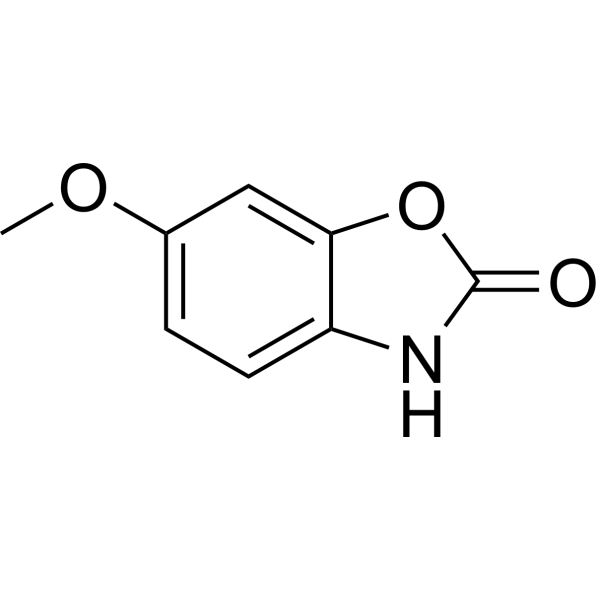
Coixol (6-Methoxy-2-benzoxazolinone; 6-MBOA) is a potent and orally active anti-inflammatory agent. Coixol decreases the iNOS protein expression. Coixol inhibits the production of TNF-α, IL-6, and IL-1β. Coixol improves glucose tolerance and plasma insulin. Coixol decreases the blood glucose level.
For research use only. We do not sell to patients.
- Purity : 98.56%
- CAS No.: 532-91-2
- Formula: C8H7NO3
- Molecular Weight:165.15
-
Storage:Powder -20°C, 3 years , 4°C, 2 years ; In solvent -80°C, 2 years , -20°C, 1 year

To place orders, for customer services and technical support, please contact: MedChemExpress USA
Tel: 609-228-6898 E-mail: [email protected] [email protected]


-
 Biological Activity
-
Chemical Information
-
Solvent & Solubility
- Protocols
- Purity & Documentation
- References
-
 Help & FAQs



Publications Citing Use of MedChemExpress (MCE) Coixol
More

Biological Activity
Description
Cellular Effect
|
Cell Line

|
Type | Value | Description | References |
|---|---|---|---|---|
| RAW264.7 | IC50 |
>100 μM
Compound: 1; 2a
|
Cytotoxicity against mouse RAW264.7 cells incubated for 24 hrs by MTT assay
Cytotoxicity against mouse RAW264.7 cells incubated for 24 hrs by MTT assay
|
[PMID: 37561816] |
| RAW264.7 | IC50 |
31.2 μM
Compound: 1; 2a
|
Inhibition of TNF-alpha production in LPS-induced mouse RAW264.7 cells pretreated for 1 hr followed by LPS stimulation and measured after 24 hrs by ELISA
Inhibition of TNF-alpha production in LPS-induced mouse RAW264.7 cells pretreated for 1 hr followed by LPS stimulation and measured after 24 hrs by ELISA
|
[PMID: 37561816] |
| RAW264.7 | IC50 |
48.9 μM
Compound: 1; 2a
|
Inhibition of IL-6 production in LPS-induced mouse RAW264.7 cells pretreated for 1 hr followed by LPS stimulation and measured after 24 hrs by ELISA
Inhibition of IL-6 production in LPS-induced mouse RAW264.7 cells pretreated for 1 hr followed by LPS stimulation and measured after 24 hrs by ELISA
|
[PMID: 37561816] |
| RAW264.7 | IC50 |
66.4 μM
Compound: 1; 2a
|
Inhibition of IL-1beta production in LPS-induced mouse RAW264.7 cells pretreated for 1 hr followed by LPS stimulation and measured after 24 hrs by ELISA
Inhibition of IL-1beta production in LPS-induced mouse RAW264.7 cells pretreated for 1 hr followed by LPS stimulation and measured after 24 hrs by ELISA
|
[PMID: 37561816] |
In Vitro
Coixol (5, 10, 20 µM, 2+24 h) decreases the iNOS protein expression in LPS-induced RAW264.7 Cells[2].
Coixol (0.03, 0.1, 0.3, 1, 3, 10, 30, 100 μM; 1+24 h) inhibits the production of TNF-α, IL-6, and IL-1β with IC50s of 31.2, 48.9, 66.4 µM, respectively[2].
MedChemExpress (MCE) has not independently confirmed the accuracy of these methods. They are for reference only.
-
Cell Line:RAW264.7 cells
-
Concentration:5, 10, 20 µM
-
Incubation Time:2 h and then stimulated with or without LPS (0.5 μg/mL) for 24 h
-
Result:Decreased the iNOS protein expression in a dose dependent manner.
In Vivo
Coixol (25, 50 mg/kg, p.o.; daily for 15 day) decreases the blood glucose levels in a dose- and time-dependent manner in type 2 diabetic rats[3].
MedChemExpress (MCE) has not independently confirmed the accuracy of these methods. They are for reference only.
-
Animal Model:9–12 weeks, Sprague Dawley (SD) male rats[3]
-
Dosage:25, 50 mg/kg
-
Administration:P.o.
-
Result:Decreased the blood glucose levels significantly, improved glucose tolerance.


Chemical Information
-
CAS No. 532-91-2
-
Appearance Solid
-
Molecular Weight 165.15
-
Formula C8H7NO3
-
Color Light brown to brown
-
SMILES
O=C1OC2=CC(OC)=CC=C2N1
-
Synonyms
6-Methoxy-2-benzoxazolinone; 6-MBOA
-
Structure Classification
-
Initial Source
-
Shipping
Room temperature in continental US; may vary elsewhere.
-
Storage
Powder -20°C 3 years 4°C 2 years In solvent -80°C 2 years -20°C 1 year


Publications (2)
-
Journal Impact Factor
-
Most Recent


Solvent & Solubility
In Vitro:
DMSO : 100 mg/mL (605.51 mM; Need ultrasonic; Hygroscopic DMSO has a significant impact on the solubility of product, please use newly opened DMSO)
Please refer to the solubility information to select the appropriate solvent. Once prepared, please aliquot and store the solution to prevent product inactivation from repeated freeze-thaw cycles.
Storage method and period of stock solution: -80°C, 2 years; -20°C, 1 year. When stored at -80°C, please use it within 2 years. When stored at -20°C, please use it within 1 year.
Please refer to the solubility information to select the appropriate solvent. Once prepared, please aliquot and store the solution to prevent product inactivation from repeated freeze-thaw cycles.
Storage method and period of stock solution: -80°C, 2 years; -20°C, 1 year. When stored at -80°C, please use it within 2 years. When stored at -20°C, please use it within 1 year.
Concentration (start) × Volume (start) = Concentration (final) × Volume (final)
In Vivo:
Select the appropriate dissolution method based on your experimental animal and administration route.
- For the following dissolution methods, please ensure to first prepare a clear stock solution using an In Vitro approach and then sequentially add co-solvents:
- To ensure reliable experimental results, the clarified stock solution can be appropriately stored based on storage conditions. As for the working solution for In Vivo experiments, it is recommended to prepare freshly and use it on the same day.
- The percentages shown for the solvents indicate their volumetric ratio in the final prepared solution. If precipitation or phase separation occurs during preparation, heat and/or sonication can be used to aid dissolution.
Add each solvent one by one: 10% DMSO 40% PEG300 5% Tween-80 45% Saline
Solubility: ≥ 2.5 mg/mL (15.14 mM); Clear solution
This protocol yields a clear solution of ≥ 2.5 mg/mL (saturation unknown).
Taking 1 mL working solution as an example, add 100 μL DMSO stock solution (25.0 mg/mL) to 400 μL PEG300, and mix evenly; then add 50 μL Tween-80 and mix evenly; then add 450 μL Saline to adjust the volume to 1 mL.
Preparation of Saline: Dissolve 0.9 g sodium chloride in ddH₂O and dilute to 100 mL to obtain a clear Saline solution.
Add each solvent one by one: 10% DMSO 90% (20% SBE-β-CD in Saline)
Solubility: ≥ 2.5 mg/mL (15.14 mM); Clear solution
This protocol yields a clear solution of ≥ 2.5 mg/mL (saturation unknown).
Taking 1 mL working solution as an example, add 100 μL DMSO stock solution (25.0 mg/mL) to 900 μL 20% SBE-β-CD in Saline, and mix evenly.
Preparation of 20% SBE-β-CD in Saline (4°C, storage for one week): 2 g SBE-β-CD powder is dissolved in 10 mL Saline, completely dissolve until clear.
In Vivo Dissolution Calculator
Please enter the basic information of animal experiments:
-
-
-
-
Recommended: Prepare an additional quantity of animals to account for potential losses during experiments.
Please enter your animal formula composition:
-
%DMSO +
Recommended: Keep the proportion of DMSO in working solution below 2% if your animal is weak.
-
%+
-
+%Tween-80 + +
-
%Saline +
The co-solvents required include: DMSO, . All of co-solvents are available by MedChemExpress (MCE). , Tween 80. All of co-solvents are available by MedChemExpress (MCE).
Working solution concentration: 0.22 mg/mL
Method for preparing stock solution: mg drug dissolved in μL DMSO. Stock solution concentration: mg/mL.
1. Take μL DMSO stock solution;
2. Add μL .
μL , mix evenly;
3. Then add μL Tween 80, mix evenly;
4. Then add μL
Please ensure that the stock solution in the first step is dissolved to a clear state, and add co-solvents in sequence. You can use ultrasonic heating (ultrasonic cleaner, recommended frequency 20-40 kHz), vortexing, etc. to assist dissolution.


Purity & Documentation
-
Data Sheet (275 KB)
-
SDS (393 KB)
- English - EN (393 KB)
- Français - FR (393 KB)
- Deutsch - DE (393 KB)
- Norwegian - NO (393 KB)
- Español - ES (393 KB)
- Swedish - SV (393 KB)
- Italian - IT (393 KB)
- Korean - KR (393 KB)
- Portuguese - PT (393 KB)
-
Handling Instructions (2659 KB)
References
[1]. Yusheng Hu, et al. Coixol Suppresses NF-κB, MAPK Pathways and NLRP3 Inflammasome Activation in Lipopolysaccharide-Induced RAW 264.7 Cells. Molecules [Content Brief]
[2]. Cui E, et al. Discovery of Coixol Derivatives as Potent Anti-inflammatory Agents. J Nat Prod. 2023 Aug 25;86(8):1950-1959. [Content Brief]
[3]. Hameed A, et al. Coixol amplifies glucose-stimulated insulin secretion via cAMP mediated signaling pathway. Eur J Pharmacol. 2019 Sep 5;858:172514. [Content Brief]


Complete Stock Solution Preparation Table
Please refer to the solubility information to select the appropriate solvent. Once prepared, please aliquot and store the solution to prevent product inactivation from repeated freeze-thaw cycles.
Storage method and period of stock solution: -80°C, 2 years; -20°C, 1 year. When stored at -80°C, please use it within 2 years. When stored at -20°C, please use it within 1 year.
| Optional Solvent | Concentration Solvent Mass | 1 mg | 5 mg | 10 mg | 25 mg |
|---|---|---|---|---|---|
| DMSO | 1 mM | 6.0551 mL | 30.2755 mL | 60.5510 mL | 151.3775 mL |
| 5 mM | 1.2110 mL | 6.0551 mL | 12.1102 mL | 30.2755 mL | |
| 10 mM | 0.6055 mL | 3.0276 mL | 6.0551 mL | 15.1378 mL | |
| 15 mM | 0.4037 mL | 2.0184 mL | 4.0367 mL | 10.0918 mL | |
| 20 mM | 0.3028 mL | 1.5138 mL | 3.0276 mL | 7.5689 mL | |
| 25 mM | 0.2422 mL | 1.2110 mL | 2.4220 mL | 6.0551 mL | |
| 30 mM | 0.2018 mL | 1.0092 mL | 2.0184 mL | 5.0459 mL | |
| 40 mM | 0.1514 mL | 0.7569 mL | 1.5138 mL | 3.7844 mL | |
| 50 mM | 0.1211 mL | 0.6055 mL | 1.2110 mL | 3.0276 mL | |
| 60 mM | 0.1009 mL | 0.5046 mL | 1.0092 mL | 2.5230 mL | |
| 80 mM | 0.0757 mL | 0.3784 mL | 0.7569 mL | 1.8922 mL | |
| 100 mM | 0.0606 mL | 0.3028 mL | 0.6055 mL | 1.5138 mL |


Coixol Related Classifications
HY-N0936 Related Classifications
 Powered by Bioz