



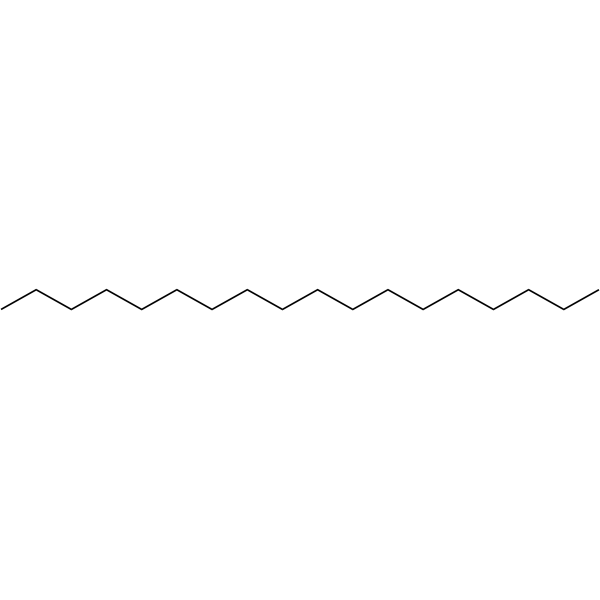
Octadecane

Based on 1 Customer Validation
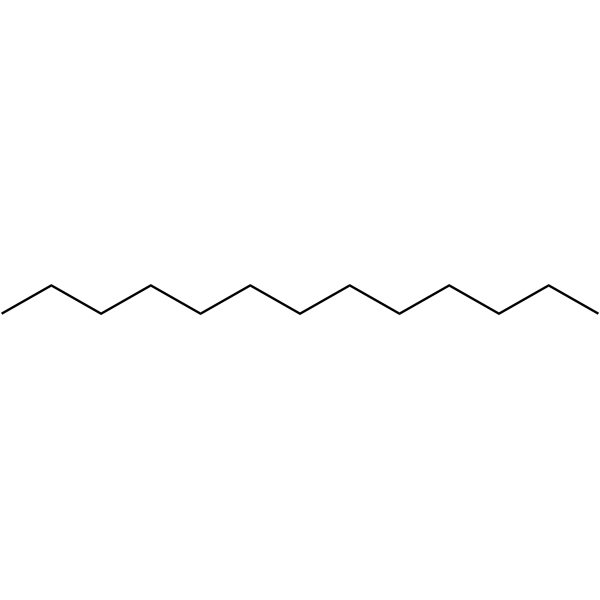
Octadecane is an alkane used as a phase change material for storing thermal energy at ambient temperature. Octadecane can endow pesticide formulations with environmental responsiveness in the field of agricultural nanomaterials, enabling precise and safe pesticide application.
For research use only. We do not sell to patients.
- Purity : 98.0%
- CAS No.: 593-45-3
- Formula: C18H38
- Molecular Weight:254.49
-
Storage:Pure form -20°C, 3 years , 4°C, 2 years ; In solvent -80°C, 6 months , -20°C, 1 month

To place orders, for customer services and technical support, please contact: MedChemExpress USA
Tel: 609-228-6898 E-mail: [email protected] [email protected]


-
 Biological Activity
-
Chemical Information
-
Solvent & Solubility
- Purity & Documentation
- References
-
 Help & FAQs


-
HY-10182
LaduviglusibGSK-3 Inhibitor -
HY-W094846
TetradecaneLow-temperature Phase Change Material -

HY-W099602
DodecaneEster Product -

HY-N6600R
Octadecane (Standard)Standard of Octadecane -

HY-W099580
HexadecaneAlkane -
HY-W089845
HeneicosaneSex Pheromone -

HY-N7933
TetracosaneNatural Product -

HY-N9929
DocosanePlant Resistance Inducer -

HY-W269368
HeptacosaneEster Product -
HY-W088037
TridecaneAliphatic Hydrocarbon -

HY-W131351
N-HeptadecaneEster Product -

HY-N5127
NonacosaneBacterial Inhibitor


Biological Activity
Description
In Vitro
Octadecane regulates the temperature-responsive release of pyraclostrobin through a phase transition process: it diffuses above its melting point, while almost no diffusion occurs below the melting point[1].
Octadecane can serve as a model of water-insoluble hydrocarbon pollutants to investigate how biosurfactants enhance its bioavailability[2].
MedChemExpress (MCE) has not independently confirmed the accuracy of these methods. They are for reference only.


Chemical Information
-
CAS No. 593-45-3
-
Appearance <28°C Solid,>28°C Liquid
-
Molecular Weight 254.49
-
Formula C18H38
-
Color Colorless to off-white
-
SMILES
CCCCCCCCCCCCCCCCCC
-
Shipping
Room temperature in continental US; may vary elsewhere.
-
Storage
Pure form -20°C 3 years 4°C 2 years In solvent -80°C 6 months -20°C 1 month


Solvent & Solubility
In Vitro:
Ethanol : 25 mg/mL (98.24 mM; Need ultrasonic)
DMSO : 5 mg/mL (19.65 mM; ultrasonic and warming and heat to 60°C; Hygroscopic DMSO has a significant impact on the solubility of product, please use newly opened DMSO)
Please refer to the solubility information to select the appropriate solvent. Once prepared, please aliquot and store the solution to prevent product inactivation from repeated freeze-thaw cycles.
Storage method and period of stock solution: -80°C, 6 months; -20°C, 1 month. When stored at -80°C, please use it within 6 months. When stored at -20°C, please use it within 1 month.
Please refer to the solubility information to select the appropriate solvent. Once prepared, please aliquot and store the solution to prevent product inactivation from repeated freeze-thaw cycles.
Storage method and period of stock solution: -80°C, 6 months; -20°C, 1 month. When stored at -80°C, please use it within 6 months. When stored at -20°C, please use it within 1 month.
Concentration (start) × Volume (start) = Concentration (final) × Volume (final)
In Vivo:
Select the appropriate dissolution method based on your experimental animal and administration route.
- For the following dissolution methods, please ensure to first prepare a clear stock solution using an In Vitro approach and then sequentially add co-solvents:
- To ensure reliable experimental results, the clarified stock solution can be appropriately stored based on storage conditions. As for the working solution for In Vivo experiments, it is recommended to prepare freshly and use it on the same day.
- The percentages shown for the solvents indicate their volumetric ratio in the final prepared solution. If precipitation or phase separation occurs during preparation, heat and/or sonication can be used to aid dissolution.
Add each solvent one by one: 10% EtOH 40% PEG300 5% Tween-80 45% Saline
Solubility: ≥ 2.5 mg/mL (9.82 mM); Clear solution
This protocol yields a clear solution of ≥ 2.5 mg/mL (saturation unknown).
Taking 1 mL working solution as an example, add 100 μL EtOH stock solution (25.0 mg/mL) to 400 μL PEG300, and mix evenly; then add 50 μL Tween-80 and mix evenly; then add 450 μL Saline to adjust the volume to 1 mL.
Preparation of Saline: Dissolve 0.9 g sodium chloride in ddH₂O and dilute to 100 mL to obtain a clear Saline solution.
Add each solvent one by one: 10% EtOH 90% (20% SBE-β-CD in Saline)
Solubility: ≥ 2.5 mg/mL (9.82 mM); Clear solution
This protocol yields a clear solution of ≥ 2.5 mg/mL (saturation unknown).
Taking 1 mL working solution as an example, add 100 μL EtOH stock solution (25.0 mg/mL) to 900 μL 20% SBE-β-CD in Saline, and mix evenly.
Preparation of 20% SBE-β-CD in Saline (4°C, storage for one week): 2 g SBE-β-CD powder is dissolved in 10 mL Saline, completely dissolve until clear.
Add each solvent one by one: 10% EtOH 90% Corn Oil
Solubility: ≥ 2.5 mg/mL (9.82 mM); Clear solution
This protocol yields a clear solution of ≥ 2.5 mg/mL (saturation unknown). If the continuous dosing period exceeds half a month, please choose this protocol carefully.
Taking 1 mL working solution as an example, add 100 μL EtOH stock solution (25.0 mg/mL) to 900 μL Corn oil, and mix evenly.
Add each solvent one by one: 10% DMSO 40% PEG300 5% Tween-80 45% Saline
Solubility: ≥ 0.5 mg/mL (1.96 mM); Clear solution
This protocol yields a clear solution of ≥ 0.5 mg/mL (saturation unknown).
Taking 1 mL working solution as an example, add 100 μL DMSO stock solution (5.0 mg/mL) to 400 μL PEG300, and mix evenly; then add 50 μL Tween-80 and mix evenly; then add 450 μL Saline to adjust the volume to 1 mL.
Preparation of Saline: Dissolve 0.9 g sodium chloride in ddH₂O and dilute to 100 mL to obtain a clear Saline solution.
Add each solvent one by one: 10% DMSO 90% (20% SBE-β-CD in Saline)
Solubility: ≥ 0.5 mg/mL (1.96 mM); Clear solution
This protocol yields a clear solution of ≥ 0.5 mg/mL (saturation unknown).
Taking 1 mL working solution as an example, add 100 μL DMSO stock solution (5.0 mg/mL) to 900 μL 20% SBE-β-CD in Saline, and mix evenly.
Preparation of 20% SBE-β-CD in Saline (4°C, storage for one week): 2 g SBE-β-CD powder is dissolved in 10 mL Saline, completely dissolve until clear.
In Vivo Dissolution Calculator
Please enter the basic information of animal experiments:
-
-
-
-
Recommended: Prepare an additional quantity of animals to account for potential losses during experiments.
Please enter your animal formula composition:
-
%DMSO +
Recommended: Keep the proportion of DMSO in working solution below 2% if your animal is weak.
-
%+
-
+%Tween-80 + +
-
%Saline +
The co-solvents required include: DMSO, . All of co-solvents are available by MedChemExpress (MCE). , Tween 80. All of co-solvents are available by MedChemExpress (MCE).
Working solution concentration: 0.22 mg/mL
Method for preparing stock solution: mg drug dissolved in μL DMSO. Stock solution concentration: mg/mL.
1. Take μL DMSO stock solution;
2. Add μL .
μL , mix evenly;
3. Then add μL Tween 80, mix evenly;
4. Then add μL
Please ensure that the stock solution in the first step is dissolved to a clear state, and add co-solvents in sequence. You can use ultrasonic heating (ultrasonic cleaner, recommended frequency 20-40 kHz), vortexing, etc. to assist dissolution.


Purity & Documentation
-
Data Sheet (266 KB)
-
SDS (419 KB)
- English - EN (419 KB)
- Français - FR (419 KB)
- Deutsch - DE (419 KB)
- Norwegian - NO (419 KB)
- Español - ES (419 KB)
- Swedish - SV (419 KB)
- Italian - IT (419 KB)
- Korean - KR (419 KB)
- Portuguese - PT (419 KB)
-
Handling Instructions (2659 KB)
References
[1]. Tleuova A, et al. Temperature-Responsive Pyraclostrobin-Loaded Octadecane Submicrocapsules with Lowered Toxicity. Nanomaterials (Basel). 2020;10(12):2374. Published 2020 Nov 28. [Content Brief]
[2]. Zhang Y, et al. Enhanced octadecane dispersion and biodegradation by a Pseudomonas rhamnolipid surfactant (biosurfactant). Appl Environ Microbiol. 1992;58(10):3276-3282. [Content Brief]


Complete Stock Solution Preparation Table
Please refer to the solubility information to select the appropriate solvent. Once prepared, please aliquot and store the solution to prevent product inactivation from repeated freeze-thaw cycles.
Storage method and period of stock solution: -80°C, 6 months; -20°C, 1 month. When stored at -80°C, please use it within 6 months. When stored at -20°C, please use it within 1 month.
| Optional Solvent | Concentration Solvent Mass | 1 mg | 5 mg | 10 mg | 25 mg |
|---|---|---|---|---|---|
| DMSO / Ethanol | 1 mM | 3.9294 mL | 19.6471 mL | 39.2943 mL | 98.2357 mL |
| 5 mM | 0.7859 mL | 3.9294 mL | 7.8589 mL | 19.6471 mL | |
| 10 mM | 0.3929 mL | 1.9647 mL | 3.9294 mL | 9.8236 mL | |
| 15 mM | 0.2620 mL | 1.3098 mL | 2.6196 mL | 6.5490 mL | |
| Ethanol | 20 mM | 0.1965 mL | 0.9824 mL | 1.9647 mL | 4.9118 mL |
| 25 mM | 0.1572 mL | 0.7859 mL | 1.5718 mL | 3.9294 mL | |
| 30 mM | 0.1310 mL | 0.6549 mL | 1.3098 mL | 3.2745 mL | |
| 40 mM | 0.0982 mL | 0.4912 mL | 0.9824 mL | 2.4559 mL | |
| 50 mM | 0.0786 mL | 0.3929 mL | 0.7859 mL | 1.9647 mL | |
| 60 mM | 0.0655 mL | 0.3275 mL | 0.6549 mL | 1.6373 mL | |
| 80 mM | 0.0491 mL | 0.2456 mL | 0.4912 mL | 1.2279 mL |


Octadecane Related Classifications
HY-N6600 Related Classifications
 Powered by Bioz
Keywords
- Octadecane
- 593-45-3
- Environmental Pollutants
- Biochemical Assay Reagents
- rhamnolipid biosurfactant
- Pyrenophora teres CPPF-453
- phase-change material
- net blotch
- temperature-responsive release modulator
- Pseudomonas aeruginosa ATCC 9027
- pyraclostrobin
- barley
- Artemia salina nauplii
- Pyrenophora teres
- Inhibitor
- inhibitor
- inhibit