



Oxotremorine M iodide

Based on 1 Customer Validation
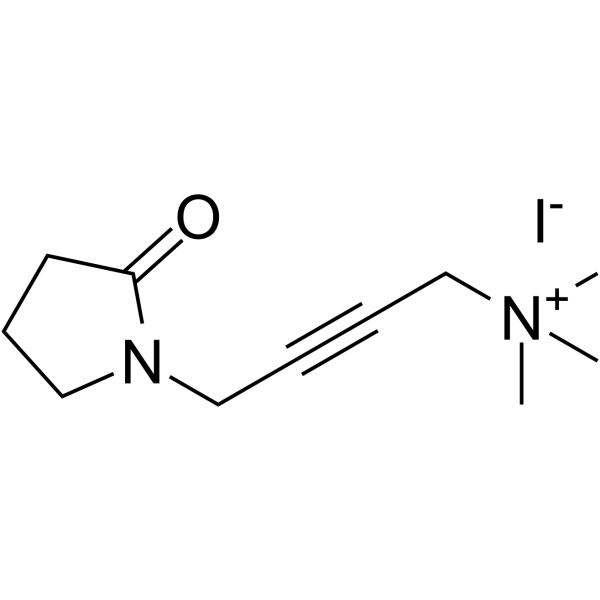
Oxotremorine M iodide is a potent and non-selective muscarinic acetylcholine receptor (mAChR) agonist. Oxotremorine M iodide potentiates NMDA receptors by muscarinic receptor dependent and independent mechanisms.
For research use only. We do not sell to patients.
- Purity : 98.84%
- CAS No.: 3854-04-4
- Formula: C11H19IN2O
- Molecular Weight:322.19
-
Storage:
4°C, sealed storage, away from moisture
* In solvent : -80°C, 6 months; -20°C, 1 month (sealed storage, away from moisture)

To place orders, for customer services and technical support, please contact: MedChemExpress USA
Tel: 609-228-6898 E-mail: [email protected] [email protected]


-
 Biological Activity
-
Chemical Information
-
Solvent & Solubility
- Purity & Documentation
- References
-
 Help & FAQs


-
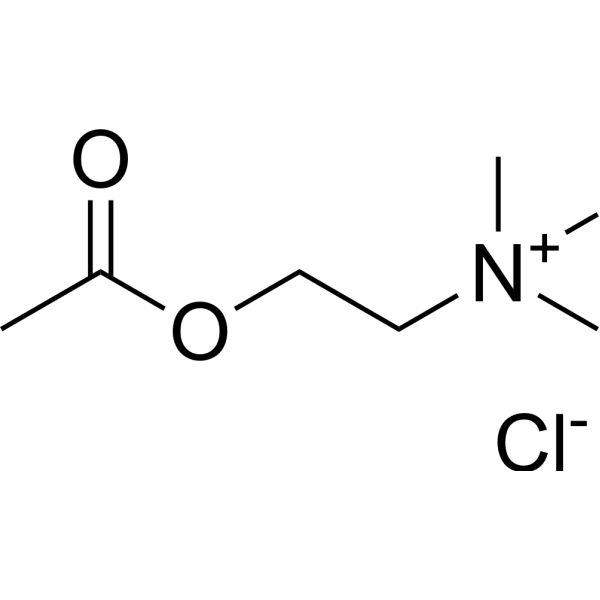
HY-B0282
Acetylcholine chloride -
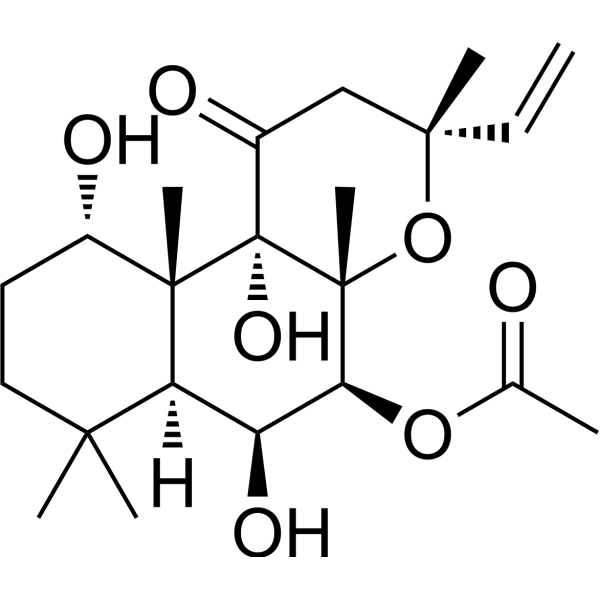
HY-15371
Forskolin -
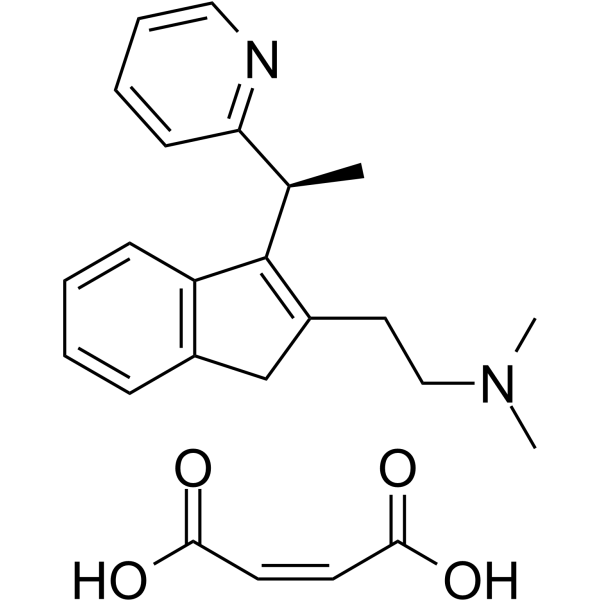
HY-107647
(S)-(+)-Dimethindene maleate -
HY-B1205
Atropine -
HY-B0166
L-Ascorbic acid -
HY-10002
Calcitriol -
HY-B0726
Pilocarpine Hydrochloride -
HY-14538
Haloperidol -
HY-10182
Laduviglusib -
HY-122743
Iperoxo -
HY-107648
McN-A-343 -
HY-B1395
Mecamylamine hydrochloride


Biological Activity
Description
Cellular Effect
|
Cell Line

|
Type | Value | Description | References |
|---|---|---|---|---|
| HEK293 | EC50 |
1.8 μM
Compound: Oxo M
|
Activation of M3-ACh receptor-FLASH/CFP expressed in HEK293 cells assessed as FRET signal
Activation of M3-ACh receptor-FLASH/CFP expressed in HEK293 cells assessed as FRET signal
|
[PMID: 20716489] |
| HEK293 | EC50 |
2.3 μM
Compound: Oxo M
|
Activation of M5-ACh receptor-FLASH/CFP expressed in HEK293 cells assessed as FRET signal
Activation of M5-ACh receptor-FLASH/CFP expressed in HEK293 cells assessed as FRET signal
|
[PMID: 20716489] |
| HEK293 | EC50 |
7.4 μM
Compound: Oxo M
|
Activation of M1-ACh receptor-FLASH/CFP expressed in HEK293 cells assessed as FRET signal
Activation of M1-ACh receptor-FLASH/CFP expressed in HEK293 cells assessed as FRET signal
|
[PMID: 20716489] |
In Vitro
Oxotremorine M iodide (0.1, 0.3, 1, 3, 10, 30 μM) inhibits KCNQ2/3 currents in the concentration-dependence[2].
Oxotremorine M iodide elicits a robust phosphoinositide response characterized with an EC50 of 0.22 μM. Oxotremorine M iodide has EC50s of 0.36, 0.52, 1.62, and 1.48 μM for wild-type, M2, M3, and M2/M3 knockout mice, respectively[3].
MedChemExpress (MCE) has not independently confirmed the accuracy of these methods. They are for reference only.
In Vivo
MedChemExpress (MCE) has not independently confirmed the accuracy of these methods. They are for reference only.


Chemical Information
-
CAS No. 3854-04-4
-
Appearance Solid
-
Molecular Weight 322.19
-
Formula C11H19IN2O
-
Color Light yellow to yellow
-
SMILES
O=C1N(CC#CC[N+](C)(C)C)CCC1.[I-]
-
Shipping
Room temperature in continental US; may vary elsewhere.
-
Storage
4°C, sealed storage, away from moisture
* In solvent : -80°C, 6 months; -20°C, 1 month (sealed storage, away from moisture)


Solvent & Solubility
In Vitro:
DMSO : 125 mg/mL (387.97 mM; Need ultrasonic; Hygroscopic DMSO has a significant impact on the solubility of product, please use newly opened DMSO)
H2O : 8.33 mg/mL (25.85 mM; Need ultrasonic)
Please refer to the solubility information to select the appropriate solvent. Once prepared, please aliquot and store the solution to prevent product inactivation from repeated freeze-thaw cycles.
Storage method and period of stock solution: -80°C, 6 months; -20°C, 1 month (sealed storage, away from moisture). When stored at -80°C, please use it within 6 months. When stored at -20°C, please use it within 1 month.
* Note: If you choose water as the stock solution, please dilute it to the working solution, then filter and sterilize it with a 0.22 μm filter before use.
Please refer to the solubility information to select the appropriate solvent. Once prepared, please aliquot and store the solution to prevent product inactivation from repeated freeze-thaw cycles.
Storage method and period of stock solution: -80°C, 6 months; -20°C, 1 month (sealed storage, away from moisture). When stored at -80°C, please use it within 6 months. When stored at -20°C, please use it within 1 month.
* Note: If you choose water as the stock solution, please dilute it to the working solution, then filter and sterilize it with a 0.22 μm filter before use.
Concentration (start) × Volume (start) = Concentration (final) × Volume (final)
In Vivo:
Select the appropriate dissolution method based on your experimental animal and administration route.
- For the following dissolution methods, please ensure to first prepare a clear stock solution using an In Vitro approach and then sequentially add co-solvents:
- To ensure reliable experimental results, the clarified stock solution can be appropriately stored based on storage conditions. As for the working solution for In Vivo experiments, it is recommended to prepare freshly and use it on the same day.
- The percentages shown for the solvents indicate their volumetric ratio in the final prepared solution. If precipitation or phase separation occurs during preparation, heat and/or sonication can be used to aid dissolution.
Add each solvent one by one: 10% DMSO 40% PEG300 5% Tween-80 45% Saline
Solubility: ≥ 2.08 mg/mL (6.46 mM); Clear solution
This protocol yields a clear solution of ≥ 2.08 mg/mL (saturation unknown).
Taking 1 mL working solution as an example, add 100 μL DMSO stock solution (20.8 mg/mL) to 400 μL PEG300, and mix evenly; then add 50 μL Tween-80 and mix evenly; then add 450 μL Saline to adjust the volume to 1 mL.
Preparation of Saline: Dissolve 0.9 g sodium chloride in ddH₂O and dilute to 100 mL to obtain a clear Saline solution.
Add each solvent one by one: 10% DMSO 90% (20% SBE-β-CD in Saline)
Solubility: ≥ 2.08 mg/mL (6.46 mM); Clear solution
This protocol yields a clear solution of ≥ 2.08 mg/mL (saturation unknown).
Taking 1 mL working solution as an example, add 100 μL DMSO stock solution (20.8 mg/mL) to 900 μL 20% SBE-β-CD in Saline, and mix evenly.
Preparation of 20% SBE-β-CD in Saline (4°C, storage for one week): 2 g SBE-β-CD powder is dissolved in 10 mL Saline, completely dissolve until clear.
For the following dissolution methods, please prepare the working solution directly:
It is recommended to prepare fresh solutions and use them promptly within a short period of time.
The percentages shown for the solvents indicate their volumetric ratio in the final prepared solution. If precipitation or phase separation occurs during preparation, heat and/or sonication can be used to aid dissolution.
Add each solvent one by one: PBS
Solubility: 7.14 mg/mL (22.16 mM); Clear solution; Need ultrasonic and warming and heat to 60°C
In Vivo Dissolution Calculator
Please enter the basic information of animal experiments:
-
-
-
-
Recommended: Prepare an additional quantity of animals to account for potential losses during experiments.
Please enter your animal formula composition:
-
%DMSO +
Recommended: Keep the proportion of DMSO in working solution below 2% if your animal is weak.
-
%+
-
+%Tween-80 + +
-
%Saline +
The co-solvents required include: DMSO, . All of co-solvents are available by MedChemExpress (MCE). , Tween 80. All of co-solvents are available by MedChemExpress (MCE).
Working solution concentration: 0.22 mg/mL
Method for preparing stock solution: mg drug dissolved in μL DMSO. Stock solution concentration: mg/mL. * In solvent : -80°C, 6 months; -20°C, 1 month (sealed storage, away from moisture)
1. Take μL DMSO stock solution;
2. Add μL .
μL , mix evenly;
3. Then add μL Tween 80, mix evenly;
4. Then add μL
Please ensure that the stock solution in the first step is dissolved to a clear state, and add co-solvents in sequence. You can use ultrasonic heating (ultrasonic cleaner, recommended frequency 20-40 kHz), vortexing, etc. to assist dissolution.


Purity & Documentation
-
Data Sheet (273 KB)
-
SDS (252 KB)
- English - EN (252 KB)
- Français - FR (252 KB)
- Deutsch - DE (252 KB)
- Norwegian - NO (252 KB)
- Español - ES (252 KB)
- Swedish - SV (252 KB)
- Italian - IT (252 KB)
- Korean - KR (252 KB)
- Portuguese - PT (252 KB)
-
Handling Instructions (2659 KB)
References
[1]. Zwart R, et al. Oxotremorine-M potentiates NMDA receptors by muscarinic receptor dependent and independentmechanisms. Biochem Biophys Res Commun. 2018 Jan 1;495(1):481-486. [Content Brief]
[2]. Zwart R, et al. A novel muscarinic receptor-independent mechanism of KCNQ2/3 potassium channel blockadeby Oxotremorine-M. Eur J Pharmacol. 2016 Nov 15;791:221-228. [Content Brief]
[3]. Tran JA, et al. Differential coupling of muscarinic M1, M2, and M3 receptors to phosphoinositide hydrolysis in urinary bladder and longitudinal muscle of the ileum of the mouse. J Pharmacol Exp Ther. 2006 Aug;318(2):649-56. Epub 2006 May 4. [Content Brief]
[4]. Ichikawa J, et al. Cholinergic modulation of basal and amphetamine-induced dopamine release in rat medial prefrontal cortex and nucleus accumbens. Brain Res. 2002 Dec 20;958(1):176-84. [Content Brief]


Complete Stock Solution Preparation Table
Please refer to the solubility information to select the appropriate solvent. Once prepared, please aliquot and store the solution to prevent product inactivation from repeated freeze-thaw cycles.
Storage method and period of stock solution: -80°C, 6 months; -20°C, 1 month (sealed storage, away from moisture). When stored at -80°C, please use it within 6 months. When stored at -20°C, please use it within 1 month.
| Optional Solvent | Concentration Solvent Mass | 1 mg | 5 mg | 10 mg | 25 mg |
|---|---|---|---|---|---|
| H2O / DMSO | 1 mM | 3.1038 mL | 15.5188 mL | 31.0376 mL | 77.5940 mL |
| 5 mM | 0.6208 mL | 3.1038 mL | 6.2075 mL | 15.5188 mL | |
| 10 mM | 0.3104 mL | 1.5519 mL | 3.1038 mL | 7.7594 mL | |
| 15 mM | 0.2069 mL | 1.0346 mL | 2.0692 mL | 5.1729 mL | |
| 20 mM | 0.1552 mL | 0.7759 mL | 1.5519 mL | 3.8797 mL | |
| 25 mM | 0.1242 mL | 0.6208 mL | 1.2415 mL | 3.1038 mL | |
| DMSO | 30 mM | 0.1035 mL | 0.5173 mL | 1.0346 mL | 2.5865 mL |
| 40 mM | 0.0776 mL | 0.3880 mL | 0.7759 mL | 1.9398 mL | |
| 50 mM | 0.0621 mL | 0.3104 mL | 0.6208 mL | 1.5519 mL | |
| 60 mM | 0.0517 mL | 0.2586 mL | 0.5173 mL | 1.2932 mL | |
| 80 mM | 0.0388 mL | 0.1940 mL | 0.3880 mL | 0.9699 mL | |
| 100 mM | 0.0310 mL | 0.1552 mL | 0.3104 mL | 0.7759 mL |
* Note: If you choose water as the stock solution, please dilute it to the working solution, then filter and sterilize it with a 0.22 μm filter before use.


Oxotremorine M iodide Related Classifications
HY-101372A Related Classifications
 Powered by Bioz