



Parstatin(mouse) TFA

Based on 1 Customer Validation
Parstatin(mouse) TFA, a cell-penetrating PAR-1 thrombin receptor agonist peptide, is a potent inhibitor of angiogenesis.
Nos produits utilisent uniquement pour la recherche. Nous ne vendons pas aux patients.
- Pureté : 99.71%
- Formule: C191H327F3N58O59S3
- Masse moléculaire:4533.18
-
Stockage:
Sealed storage, away from moisture and light, under nitrogen.
Powder -80°C, 2 years , -20°C, 1 year* In solvent : -80°C, 6 months; -20°C, 1 month (sealed storage, away from moisture and light, under nitrogen)

To place orders, for customer services and technical support, please contact: MedChemExpress USA
Tel: 609-228-6898 E-mail: [email protected] [email protected]


-
 Activité biologique
-
Chemical Information
-
Solvant et solubilité
- Protocole
- Pureté et documentation
- Références
-
 Help & FAQs




Activité biologique
Description
In Vitro
Parstatin (0-10 µM) increases recovery of LVDP in a concentration-dependent manner. The optimal concentration was 1 µM which produced a 23% recovery of LVDP[2].
MedChemExpress (MCE) has not independently confirmed the accuracy of these methods. They are for reference only.
In Vivo
MedChemExpress (MCE) has not independently confirmed the accuracy of these methods. They are for reference only.
-
Animal Model:Male Sprague–Dawley rats at 8 weeks of age (250-300 g)[1].
-
Dosage:1-25 µg/kg.
-
Administration:IV injected 15 min prior to ischaemia.
-
Result:A significant decrease in infarct size was detected with the 5-15 µg/kg doses with 10 µg/kg as the optimal dose. These hearts had an infarct size of 46 ± 3% of the area at risk, which is a 26% reduction in infarct size compared with the control.


Chemical Information
-
Appearance Solid
-
Masse moléculaire 4533.18
-
Formule C191H327F3N58O59S3
-
Color White to off-white
-
Sequence Shortening
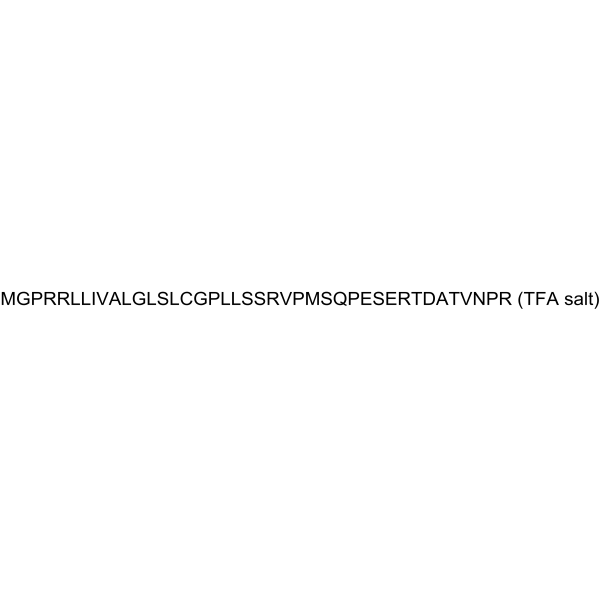
MGPRRLLIVALGLSLCGPLLSSRVPMSQPESERTDATVNPR
-
Livraison
Room temperature in continental US; may vary elsewhere.
-
Stockage
Sealed storage, away from moisture and light, under nitrogen
Powder -80°C 2 years -20°C 1 year * In solvent : -80°C, 6 months; -20°C, 1 month (sealed storage, away from moisture and light, under nitrogen)


Solvant et solubilité
In Vitro:
H2O : 100 mg/mL (22.06 mM; Need ultrasonic)
Please refer to the solubility information to select the appropriate solvent. Once prepared, please aliquot and store the solution to prevent product inactivation from repeated freeze-thaw cycles.
Storage method and period of stock solution: -80°C, 6 months; -20°C, 1 month (sealed storage, away from moisture and light, under nitrogen). When stored at -80°C, please use it within 6 months. When stored at -20°C, please use it within 1 month.
* Note: If you choose water as the stock solution, please dilute it to the working solution, then filter and sterilize it with a 0.22 μm filter before use.
Please refer to the solubility information to select the appropriate solvent. Once prepared, please aliquot and store the solution to prevent product inactivation from repeated freeze-thaw cycles.
Storage method and period of stock solution: -80°C, 6 months; -20°C, 1 month (sealed storage, away from moisture and light, under nitrogen). When stored at -80°C, please use it within 6 months. When stored at -20°C, please use it within 1 month.
* Note: If you choose water as the stock solution, please dilute it to the working solution, then filter and sterilize it with a 0.22 μm filter before use.
Concentration (start) × Volume (start) = Concentration (final) × Volume (final)


Pureté et documentation
-
Fiche technique (269 KB)
-
SDS (252 KB)
- English - EN (252 KB)
- Français - FR (252 KB)
- Deutsch - DE (252 KB)
- Norwegian - NO (252 KB)
- Español - ES (252 KB)
- Swedish - SV (252 KB)
- Italian - IT (252 KB)
- Korean - KR (252 KB)
- Portuguese - PT (252 KB)
-
Instruction de manipulation (2659 KB)
Références
[1]. Panagiota Zania, et al. Parstatin, the Cleaved Peptide on Proteinase-Activated Receptor 1 Activation, Is a Potent Inhibitor of Angiogenesis. J Pharmacol Exp Ther. 2009 Feb;328(2):378-89. [Content Brief]
[2]. Jennifer L Strande, et al. Parstatin: A Cryptic Peptide Involved in Cardioprotection After Ischaemia and Reperfusion Injury. Cardiovasc Res. 2009 Jul 15;83(2):325-34. [Content Brief]


Complete Stock Solution Preparation Table
Please refer to the solubility information to select the appropriate solvent. Once prepared, please aliquot and store the solution to prevent product inactivation from repeated freeze-thaw cycles.
Storage method and period of stock solution: -80°C, 6 months; -20°C, 1 month (sealed storage, away from moisture and light, under nitrogen). When stored at -80°C, please use it within 6 months. When stored at -20°C, please use it within 1 month.
| Optional Solvent | Concentration Solvent Mass | 1 mg | 5 mg | 10 mg | 25 mg |
|---|---|---|---|---|---|
| H2O | 1 mM | 0.2206 mL | 1.1030 mL | 2.2060 mL | 5.5149 mL |
| 5 mM | 0.0441 mL | 0.2206 mL | 0.4412 mL | 1.1030 mL | |
| 10 mM | 0.0221 mL | 0.1103 mL | 0.2206 mL | 0.5515 mL | |
| 15 mM | 0.0147 mL | 0.0735 mL | 0.1471 mL | 0.3677 mL | |
| 20 mM | 0.0110 mL | 0.0551 mL | 0.1103 mL | 0.2757 mL |
* Note: If you choose water as the stock solution, please dilute it to the working solution, then filter and sterilize it with a 0.22 μm filter before use.


Parstatin(mouse) TFA Related Classifications
HY-P1261A Related Classifications
 Powered by Bioz