



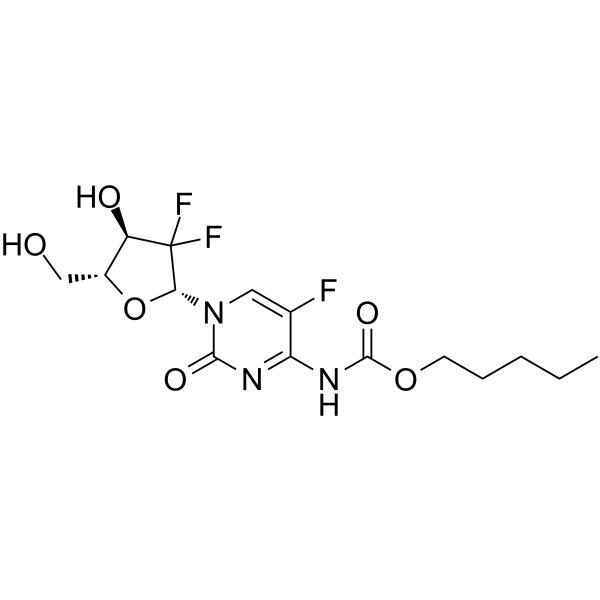
Pencitabine
Pencitabine (Pen) is an orally active anticancer agent. Pencitabine interferes with DNA synthesis and function by inhibiting multiple nucleotide-metabolizing enzymes and by misincorporation into DNA.
Nur für Forschungszwecke. Wir verkaufen nicht an Patienten.
- CAS. Nr.: 2249843-29-4
- Formel: C15H20F3N3O6
- Molecular Weight:395.33
-
Speicherung:
Please store the product under the recommended conditions in the Certificate of Analysis.

To place orders, for customer services and technical support, please contact: MedChemExpress USA
Tel: 609-228-6898 E-mail: [email protected] [email protected]


-
 Biologische Aktivität
-
Chemical Information
- Protokoll
- Reinheit & Dokumentation
- Verweise
-
 Help & FAQs


Alle DNA/RNA Synthesis Isoform-spezifische Produkte anzeigen
More

Biologische Aktivität
Beschreibung
Cellular Effect
|
Cell Line

|
Type | Value | Description | References |
|---|---|---|---|---|
| HCT-116 | IC50 |
0.37 μM
Compound: Pen
|
Antiproliferative activity against human HCT-116 cells assessed as reduction in cell viability incubated for 72 hrs by MTT assay
Antiproliferative activity against human HCT-116 cells assessed as reduction in cell viability incubated for 72 hrs by MTT assay
|
[PMID: 35300092] |
| KG-1 | IC50 |
0.13 μM
Compound: Pen
|
Antiproliferative activity against human KG-1 cells assessed as reduction in cell viability incubated for 72 hrs by MTT assay
Antiproliferative activity against human KG-1 cells assessed as reduction in cell viability incubated for 72 hrs by MTT assay
|
[PMID: 35300092] |


Chemical Information
-
CAS. Nr. 2249843-29-4
-
Molecular Weight 395.33
-
Formel C15H20F3N3O6
-
SMILES
FC1([C@H](N2C(N=C(C(F)=C2)NC(OCCCCC)=O)=O)O[C@@H]([C@H]1O)CO)F
-
Versand
Room temperature in continental US; may vary elsewhere.
-
Speicherung
Please store the product under the recommended conditions in the Certificate of Analysis.

Protokoll
-
EdU Incorporation Assay (Click Chemistry-Based DNA Synthesis Measurement)
The EdU incorporation assay measures DNA synthesis by adding the thymidine analog 5-ethynyl-2′-deoxyuridine to cells or tissues, where it is incorporated into newly synthesized DNA during S phase. Incorporated EdU is detected by copper-catalyzed azide-alkyne cycloaddition, in which a fluorescent azide covalently reacts with the ethynyl group on EdU, allowing S-phase cells to be detected by fluorescence microscopy, flow cytometry, or high-content imaging. EdU detection does not require DNA denaturation or anti-BrdU antibody access, which preserves sample structure and improves compatibility with immunostaining and multiparameter cytometry compared with BrdU-based detection. EdU can be cytotoxic in a cell-type- and exposure-dependent manner, so pulse duration, concentration, and continuous-labeling designs should be validated for each cell type.
-
BrdU Incorporation Assay
Bromodeoxyuridine (BrdU) incorporation assay is based on the principle that BrdU, a thymidine analog, is incorporated into newly synthesized DNA during the S phase of the cell cycle, thereby serving as a marker of DNA replication and cellular proliferation. Incorporated BrdU can be detected using anti-BrdU antibodies following DNA denaturation, enabling visualization or quantification of proliferating cells through immunochemical detection methods such as immunofluorescence or immunohistochemistry.


Reinheit & Dokumentation
Verweise

Calculators
Konzentration (Stammlösung) × Volumen (Stammlösung) = Konzentration (Ziellösung) × Volumen (Ziellösung)


Pencitabine Related Classifications
HY-145705 Related Classifications
 Powered by Bioz