



Pendulone

Based on 1 Customer Validation
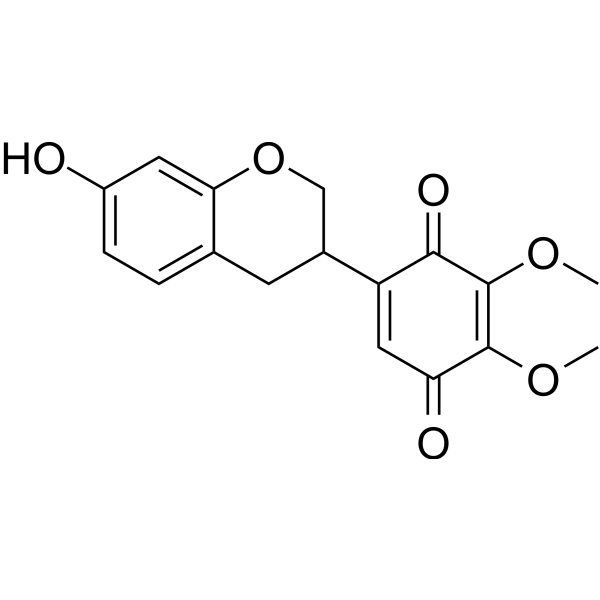
Pendulone is a isoflavanquinone with good antiplasmodial activity with an IC50 of 7.0 μM. Pendulone also has antileishmanial, antibacterial and anticancer activity.
For research use only. We do not sell to patients.
- Purity : 98.86%
- CAS No.: 69359-09-7
- Formula: C17H16O6
- Molecular Weight:316.31
-
Storage:
4°C, sealed storage, away from moisture
* In solvent : -80°C, 6 months; -20°C, 1 month (sealed storage, away from moisture)

To place orders, for customer services and technical support, please contact: MedChemExpress USA
Tel: 609-228-6898 E-mail: [email protected] [email protected]


-
 Biological Activity
-
Chemical Information
- Protocols
- Purity & Documentation
- References
-
 Help & FAQs


All Parasite Isoforms
More

Biological Activity
Description
IC50 & Target
|
Plasmodium |
Leishmania |
In Vitro
Pendulone displays moderate antiproliferative activity against the A2780 human ovarian cancer cell line, with an IC50 value 19.6 μM[1].
Pendulone displays an IC50 value of 0.43 μg/mL, against L. donovani promastigotes. Pendulone also displays antibacterial activity against Staphylococcus aureus and methicillin-resistant S. aureus (each IC50 of 1.44 μg/mL)[2].
Pendulone exhibits moderate anticancer activity against human cancer cell lines (SK-MEL, KB, BT-549 and SK-OV-3) with IC50 values of 5.5 and 10.5 μg/mL. Pendulone also shows moderate cytotoxicities against monkey kidney fibroblasts (VERO) and pig kidney epithelial cells (LLC-PK11)[2].
Pendulone shows strong inhibition on the effect of the cell cycle induced by 12-O-tetradecanoyl-phorbol-13-acetate (TPA) in Raji cells[3].
MedChemExpress (MCE) has not independently confirmed the accuracy of these methods. They are for reference only. Further protocols information, click here.
In Vivo
MedChemExpress (MCE) has not independently confirmed the accuracy of these methods. They are for reference only.


Chemical Information
-
CAS No. 69359-09-7
-
Appearance Solid
-
Molecular Weight 316.31
-
Formula C17H16O6
-
Color Yellow to orange
-
SMILES
O=C1C(OC)=C(OC)C(C(C2COC3=CC(O)=CC=C3C2)=C1)=O
-
Structure Classification
-
Initial Source
-
Shipping
Room temperature in continental US; may vary elsewhere.
-
Storage
4°C, sealed storage, away from moisture
* In solvent : -80°C, 6 months; -20°C, 1 month (sealed storage, away from moisture)

Protocols
-
Research Protocol for Infectious Diseases
Infectious-disease experiments test how pathogens interact with host barriers, innate immune receptors, inflammatory signaling, pathogen replication, and tissue injury; pattern-recognition receptors such as TLRs, RIG-I-like receptors, NOD-like receptors, and inflammasomes detect microbial molecules and activate NF-κB, interferon, and cytokine responses. The central hypothesis is that infection severity reflects the balance between pathogen burden and host response: protective inflammation restricts pathogen growth, whereas excessive or mislocalized inflammation contributes to tissue damage and disease phenotype. Unresolved questions include which host pathways are protective versus pathogenic, why some infection models fail to translate to human disease, and which combined readouts best predict clinically relevant infection outcomes.
-
Cell Cytotoxicity Assay
Cytotoxicity assays are usually based on the assessment of cell membrane damage, which can also be indirectly detected by measuring cell viability. Detection methods include MTT assay, CKK-8 assay, LDH assay and ATP assay, etc.


Purity & Documentation
-
Data Sheet (280 KB)
-
SDS (252 KB)
- English - EN (252 KB)
- Français - FR (252 KB)
- Deutsch - DE (252 KB)
- Norwegian - NO (252 KB)
- Español - ES (252 KB)
- Swedish - SV (252 KB)
- Italian - IT (252 KB)
- Korean - KR (252 KB)
- Portuguese - PT (252 KB)
-
Handling Instructions (2659 KB)
References
[1]. Qingxi Su, et al. Antiplasmodial Isoflavanes and Pterocarpans from Apoplanesia paniculata. Planta Med. 2015 Aug;81(12-13):1128-32. [Content Brief]
[2]. Aziz A Rahman, et al. Antiparasitic and antimicrobial isoflavanquinones from Abrus schimperi. Nat Prod Commun. 2011 Nov;6(11):1645-50. [Content Brief]
[3]. T Konoshima, et al. Anti-tumor promoting activities of isoflavonoids from Wistaria brachybotrys. Biol Pharm Bull. 1997 Aug;20(8):865-8. [Content Brief]

Calculators
Concentration (start) × Volume (start) = Concentration (final) × Volume (final)


Pendulone Related Classifications
HY-N7985 Related Classifications
 Powered by Bioz