



Platensimycin
Based on 1 publication(s) in Google Scholar
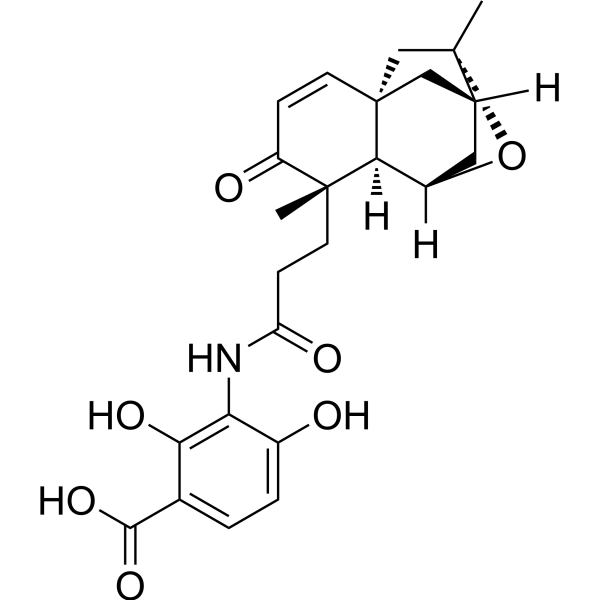
APOL1-IN-1 is a natural product antibiotic and selective FabF inhibitor discovered in Streptomyces platensis. Platensimycin exhibits IC50 values of 48 nM and 160 nM against Staphylococcus aureus and Escherichia coli FabF, respectively. Platensimycin preferentially recognizes the acyl-enzyme conformation of FabF, occupies the malonyl-binding subsite, and competes with malonyl-ACP, thereby inhibiting bacterial fatty acid elongation. Platensimycin is useful for research on bacterial fatty acid biosynthesis and Gram-positive bacterial infections.
For research use only. We do not sell to patients.
- Purity : 95.17%
- CAS No.: 835876-32-9
- Formula: C24H27NO7
- Molecular Weight:441.47
-
Storage:Powder -20°C, 3 years ; In solvent -80°C, 6 months , -20°C, 1 month

To place orders, for customer services and technical support, please contact: MedChemExpress USA
Tel: 609-228-6898 E-mail: [email protected] [email protected]


-
 Biological Activity
-
Chemical Information
- Protocols
- Purity & Documentation
- References
-
 Help & FAQs


-
HY-116290
Zaragozic acid A -
HY-N8376
FustinAβ Inhibitor -
HY-113870
6-NBDGFluorescent Dye -
HY-100355S1
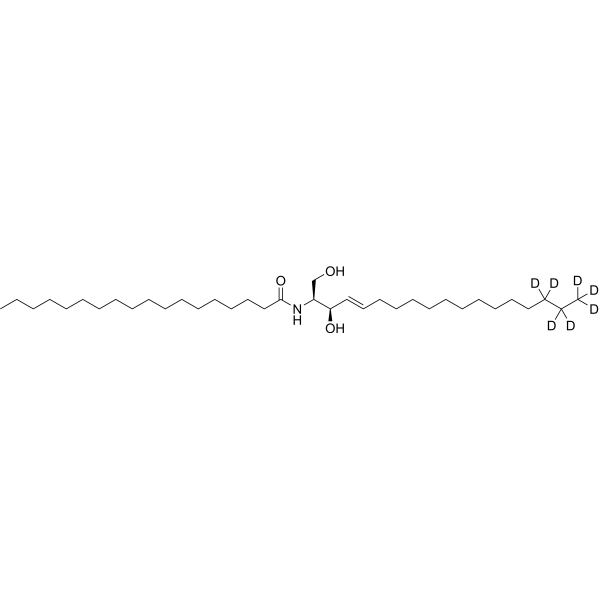
C18-Ceramide-d7Stable Isotope -
HY-D0031
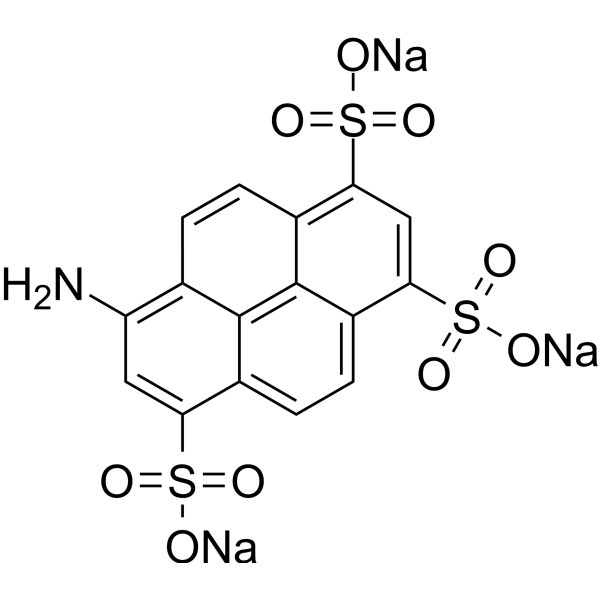
8-Aminopyrene-1,3,6-trisulfonic acid trisodiumFluorescent dye -
HY-N12408
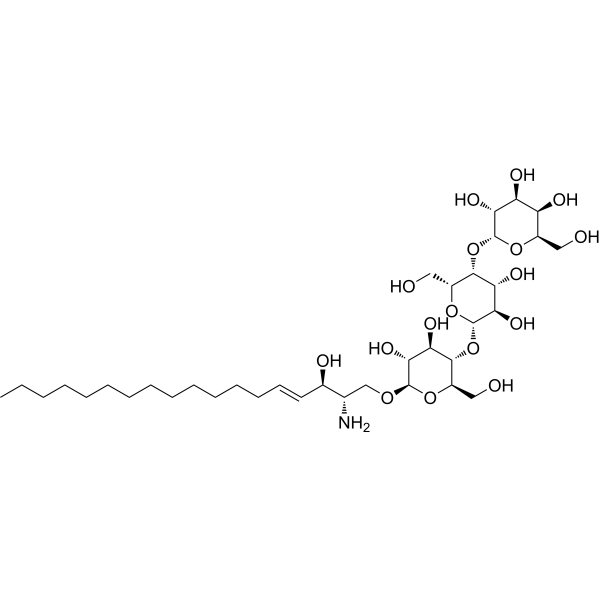
GlobotriaosylsphingosineGlobotriaosylceramide -
HY-N0138S
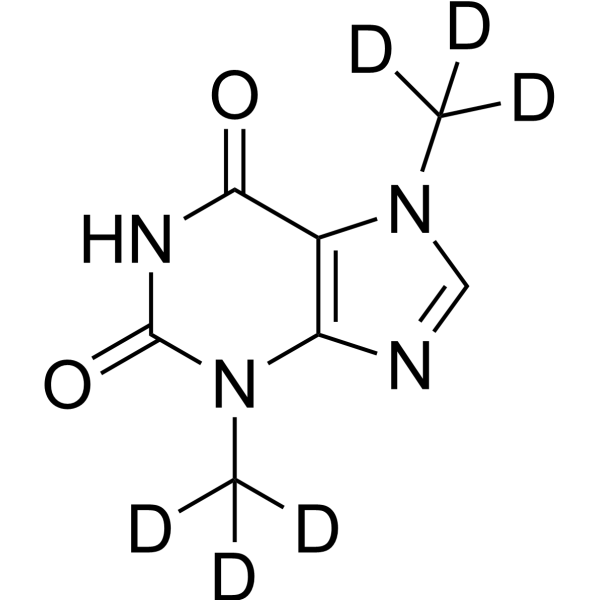
Theobromine-d6Stable Isotope -
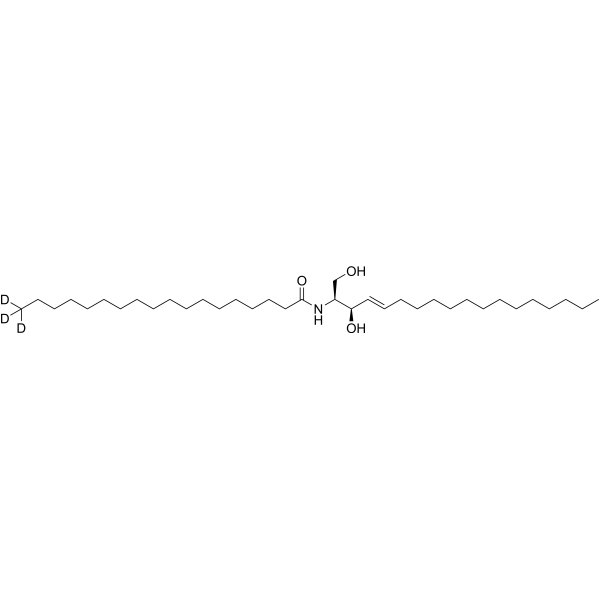
HY-100355S
C18-Ceramide-d3Stable Isotope -
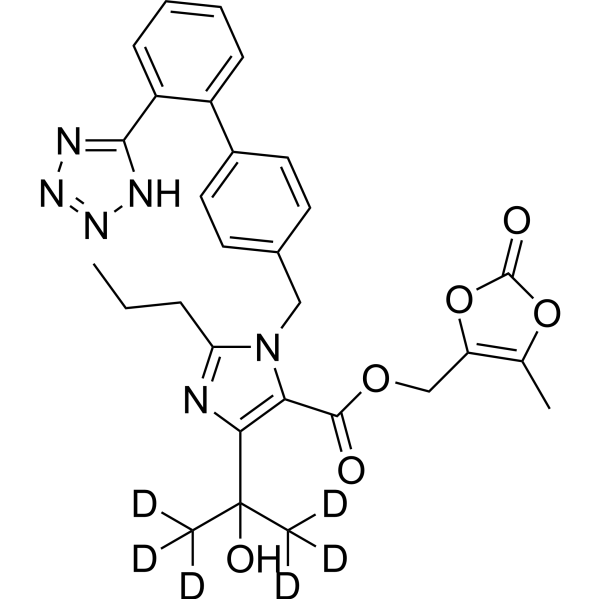
HY-17005S
Olmesartan medoxomil-d6Stable Isotope
Publications Citing Use of MedChemExpress (MCE) Platensimycin
MoreAll Antibiotic Isoforms
More

Biological Activity
Description
In Vitro
Platensimycin inhibits cellular lipid biosynthesis in S. aureus with an IC50 of 0.1 μg/mL, whereas it does not significantly inhibit DNA, RNA, protein, or cell wall biosynthesis at concentrations up to 500 μg/mL[1].
Platensimycin inhibits cellular lipid biosynthesis in S. pneumoniae with an IC50 of 0.8 μg/mL[1].
Platensimycin inhibits the fatty acid synthase system in the S. aureus FASII cell-free gel elongation assay with an IC50 of 0.2 μg/mL[1].
Platensimycin exhibits antibacterial activity against MSSA, MRSA, VISA, VRE, and S. pneumoniae, with MIC values up to 0.5, 0.5, 0.5, 0.1, and 1 μg/mL, respectively; its MIC against wild-type E. coli is >64 μg/mL, whereas its MIC against efflux-negative E. coli (tolC) is 16 μg/mL[1].
Platensimycin (0.5-64 μg/mL; 16 h) exhibits MICs of 1, 0.5, and 0.5 μg/mL against S. aureus ATCC 29213, clinical MSSA, and MRSA strains, respectively[3].
Platensimycin retains antibacterial activity against 4 clinical MSSA and 45 clinical MRSA isolates, with an MIC of 1.0 μg/mL[3].
Platensimycin (0.125-64 μg/mL; 12 or 24 h) inhibits MRSA growth, and growth inhibition is observed at concentrations below 2 μg/mL[4].
Platensimycin has an MIC of 1 μg/mL against extracellular MRSA, whereas its MIC against intracellular MRSA is >128 μg/mL[4].
Platensimycin (2-8 μg/mL; 24 h) inhibits MRSA biofilm formation[4].
The permeability coefficients of PLGA/PTM and PAMAM/PTM nanoparticles (100 μM) in Caco-2 cell monolayers (4.7 × 10⁻⁷ cm s−1 and 6.0 × 10⁻⁷ cm s−1, respectively) increase compared with free PTM[5].
Platensimycin (0.5 μg/mL; 24 h) reduces biofilm formation by 88.3% in S. aureus ATCC 29213[5].
MedChemExpress (MCE) has not independently confirmed the accuracy of these methods. They are for reference only.
Parmacokinetics
In Vivo
Platensimycin (10 mg/kg; i.p.; at 1 and 5 h after bacterial challenge) does not maintain survival in MRSA peritonitis C57BL/6J mice, and none of the PTM group mice survive to the observation endpoint[3].
Platensimycin (20 mg/kg; i.p.; at 1 and 5 h after bacterial challenge) results in survival of all animals in the 1.25 × 10⁷ CFU MRSA peritonitis mouse model, whereas in the more severe model with 2.5 × 10⁷ CFU, no mice survive beyond day 2[4].
Platensimycin (10 mg/kg; i.p.; twice after MRSA challenge) does not maintain survival in C57BL/6J mice with 2.5 × 10⁷ CFU MRSA peritonitis, and none of the 5 mice survive beyond 24 h[5].
MedChemExpress (MCE) has not independently confirmed the accuracy of these methods. They are for reference only.
-
Animal Model:Mice[1]
-
Dosage:50, 100, 150 μg/h
-
Administration:i.v.; 24 h
-
Result:Produced a 4-5 log reduction in viable kidney bacteria at 100 and 150 μg/h.
Yielded no detectable viable bacteria in 20% and 40% of kidneys at 100 and 150 μg/h, respectively.
-
Animal Model:C57BL/6J (six-week-old)[3]
-
Dosage:10 mg/kg
-
Administration:i.p.; at 1 and 5 h post-infection
-
Result:Failed to rescue any mice from lethal MRSA peritonitis, with a 0% survival rate.
-
Animal Model:C57BL/6J (female, 6-8 weeks old, MRSA-induced acute peritonitis)[5]
-
Dosage:10 mg/kg
-
Administration:wice after MRSA challenge
-
Result:None of five mice survived beyond 24 h.
-
Animal Model:C57BL/6J mice (6-8 weeks old, 18-21 g)[4]
-
Dosage:20 mg/kg
-
Administration:i.p.; administered at 1 h and 5 h post-infection
-
Result:No mice survived beyond day 2.
Produced survival of all mice.


Chemical Information
-
CAS No. 835876-32-9
-
Appearance Solid
-
Molecular Weight 441.47
-
Formula C24H27NO7
-
Color White to off-white
-
SMILES
O=C(O)C1=CC=C(O)C(NC(CC[C@]([C@@]2([H])[C@]34C[C@]5([H])[C@@](C4)(C)O[C@@]2([H])C5)(C)C(C=C3)=O)=O)=C1O
-
Shipping
Room temperature in continental US; may vary elsewhere.
-
Storage
Powder -20°C 3 years In solvent -80°C 6 months -20°C 1 month


Publications (1)
-
Journal Impact Factor
-
Most Recent


Purity & Documentation
-
Data Sheet (296 KB)
-
SDS (251 KB)
- English - EN (251 KB)
- Français - FR (251 KB)
- Deutsch - DE (251 KB)
- Norwegian - NO (251 KB)
- Español - ES (251 KB)
- Swedish - SV (251 KB)
- Italian - IT (251 KB)
- Korean - KR (251 KB)
- Portuguese - PT (251 KB)
-
Handling Instructions (2659 KB)
References

Calculators
Concentration (start) × Volume (start) = Concentration (final) × Volume (final)


Platensimycin Related Classifications
HY-127146 Related Classifications
 Powered by Bioz