



Polyvinylpyrrolidone K120

Based on 1 Customer Validation
Polyvinylpyrrolidone K120 is a multifunctional synthetic polymer with excellent adhesiveness and thickening properties. Polyvinylpyrrolidone K120 is a versatile excipient for both conventional formulations and novel controlled or targeted delivery systems. Polyvinylpyrrolidone K120 can be used to prepare drug-loaded hydrogel patches.
For research use only. We do not sell to patients.
- Purity : 98.0%
- CAS No.: 9003-39-8
- Formula: (C6H9NO)n
-
Storage:Powder -20°C, 3 years , 4°C, 2 years


To place orders, for customer services and technical support, please contact: MedChemExpress USA
Tel: 609-228-6898 E-mail: [email protected] [email protected]


-
 Biological Activity
-
Chemical Information
-
Solvent & Solubility
- Protocols
- Purity & Documentation
- References
-
 Help & FAQs


-
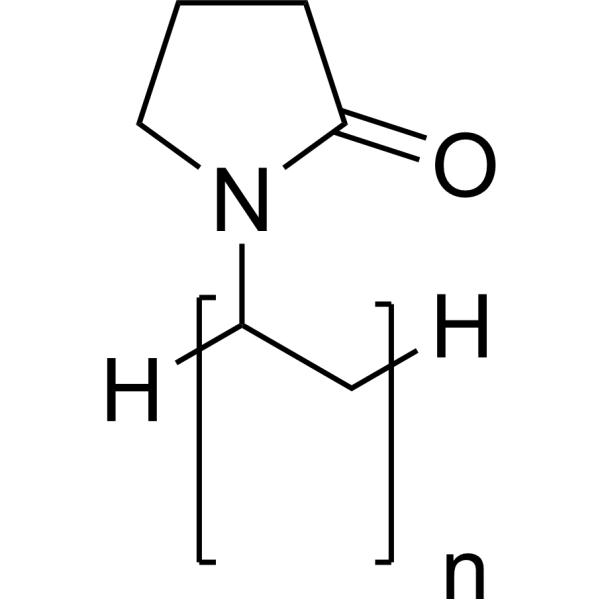
HY-B1620
Polyvinylpyrrolidone K30Disinfectant -

HY-B1620L
Polyvinylpyrrolidone, average Mw~40000Polyvinylpyrrolidone -

HY-B1620J
Polyvinylpyrrolidone, average Mw~10000Polyvinylpyrrolidone -

HY-B1620N
Polyvinylpyrrolidone, average Mw~360000Polyvinylpyrrolidone -

HY-B1620C
Polyvinylpyrrolidone K17Polymer -

HY-B1620B
Polyvinylpyrrolidone K15Polyvinylpyrrolidone -

HY-B1620H
Polyvinylpyrrolidone K90Disinfectant -

HY-B1620D
Polyvinylpyrrolidone K25Polyvinylpyrrolidone -

HY-B1620K
Polyvinylpyrrolidone, average Mw~29000Polyvinylpyrrolidone -

HY-B1620E
Polyvinylpyrrolidone K60Polyvinylpyrrolidone -

HY-B1620O
Polyvinylpyrrolidone, average Mw~1300000Polyvinylpyrrolidone -
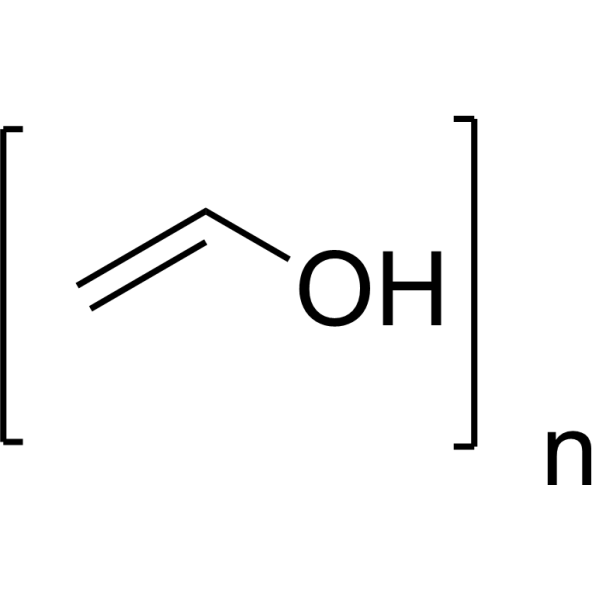
HY-Y0850E
Polyvinyl alcohol (Mw 30000-70000, 87-90% hydrolyzed)Dressing Meterial


Biological Activity
Description
In Vitro
Polyvinylpyrrolidone (PVP), a non-ionic polymer, has been employed in multifarious fields such as paper, fibers and textiles, ceramics, and pharmaceutics due to its superior properties. Especially in pharmacy, the properties of inertness, non-toxicity, and biocompatibility make it a versatile excipient for both conventional formulations and novel controlled or targeted delivery systems, serving as a binder, coating agent, suspending agent, pore-former, solubilizer, stabilizer, etc. Polyvinylpyrrolidone with different molecular weights (MWs) and concentrations is used in a variety of formulations for different purposes[2].
MedChemExpress (MCE) has not independently confirmed the accuracy of these methods. They are for reference only. Further protocols information, click here.


Chemical Information
-
CAS No. 9003-39-8
-
Appearance Solid
-
Formula (C6H9NO)n
-
Color White to off-white
-
SMILES
O=C1CCCN1C(C[H])[H].[n]
-
Synonyms
PVP K120; Polyvidone K120; Povidone K120
-
Shipping
Room temperature in continental US; may vary elsewhere.
-
Storage
Powder -20°C 3 years 4°C 2 years


Solvent & Solubility
In Vitro:
DMSO : 40 mg/mL (ultrasonic and warming and heat to 60°C; Hygroscopic DMSO has a significant impact on the solubility of product, please use newly opened DMSO)

Protocols
-
3D Hydrogel Synthetic Scaffold Culture
3D hydrogel synthetic scaffold culture embeds cells, spheroids, organoids, or tissue fragments inside a hydrated crosslinked polymer network so that cells receive matrix and cell-cell cues in three dimensions rather than from a flat plastic surface. A literature-supported model protocol is PEG-4MAL hydrogel culture, in which four-arm maleimide-terminated PEG is functionalized with cysteine-containing adhesive peptides such as RGD and crosslinked with protease-degradable peptides such as GPQ-W; this creates a defined, modular scaffold that supports human organoid generation and culture. The readouts are scaffold-supported growth, morphology, lumen formation, budding, viability, proliferation, lineage-marker expression, and matrix-dependent expansion or differentiation; reported assays include transmitted-light imaging, immunofluorescence, in situ hybridization, qRT-PCR, and rheological characterization.


Purity & Documentation
-
Data Sheet (272 KB)
-
SDS (393 KB)
- English - EN (393 KB)
- Français - FR (393 KB)
- Deutsch - DE (393 KB)
- Norwegian - NO (393 KB)
- Español - ES (393 KB)
- Swedish - SV (393 KB)
- Italian - IT (393 KB)
- Korean - KR (393 KB)
- Portuguese - PT (393 KB)
-
Handling Instructions (2659 KB)
References
[1]. Li WZ, et al. An Optimized and Feasible Preparation Technique for the Industrial Production of Hydrogel Patches. AAPS PharmSciTech. 2018 Apr;19(3):1072-1083. [Content Brief]
[2]. Luo Y, et al. Multifunctional Role of Polyvinylpyrrolidone in Pharmaceutical Formulations. AAPS PharmSciTech. 2021 Jan 6;22(1):34. [Content Brief]

Calculators
Concentration (start) × Volume (start) = Concentration (final) × Volume (final)


Polyvinylpyrrolidone K120 Related Classifications
HY-B1620I Related Classifications
 Powered by Bioz
Keywords
- Polyvinylpyrrolidone K120
- 9003-39-8
- PVP K120
- Polyvidone K120
- Povidone K120
- Polyvinylpyrrolidone K 120
- Polyvinylpyrrolidone K-120
- PVP K 120
- PVP K-120
- Polyvidone K120
- Polyvidone K 120
- Polyvidone K-120
- Povidone K120
- Povidone K 120
- Povidone K-120
- Environmental Pollutants
- Biochemical Assay Reagents
- pharmaceutical preparations
- binder
- coating agent
- suspending agent
- pore-former
- solubilizer
- stabilizer
- Inhibitor
- inhibitor
- inhibit