



ProTx II TFA
Based on 1 publication(s) in Google Scholar
ProTx II TFA is a selective blocker of Nav1.7 sodium channels, with an IC50 value of 0.3 nM and a Ki of 0.389 nM against human NaV1.7. ProTx II TFA selectively blocks spinal cord NaV1.7 by reducing conductance and altering voltage dependence of activation, preferentially binds to the splice region of aNaV1.5, and can also block sodium channel subtypes such as Nav1.4 and Nav1.6. ProTx II TFA alleviates thermal hyperalgesia in diabetic mice and prevents the propagation of action potentials in nociceptors. ProTx II TFA can be used for research related to painful diabetic neuropathy and pain disorders.
Nos produits utilisent uniquement pour la recherche. Nous ne vendons pas aux patients.
- Pureté : 99.86%
- Formule: C168H250N46O41S8.xC2HF3O2
- Masse moléculaire:3826.59 (free base)
-
Stockage:
Sealed storage, away from moisture and light, under nitrogen.
Powder -80°C, 2 years , -20°C, 1 year* In solvent : -80°C, 6 months; -20°C, 1 month (sealed storage, away from moisture and light, under nitrogen)

To place orders, for customer services and technical support, please contact: MedChemExpress USA
Tel: 609-228-6898 E-mail: [email protected] [email protected]


-
 Activité biologique
-
Chemical Information
-
Solvant et solubilité
- Pureté et documentation
- Références
-
 Help & FAQs


Publications Citing Use of MedChemExpress (MCE) ProTx II TFA
More

Activité biologique
Description
IC50 & Target
|
hNav1.5 48 nM (IC50) |
h Nav1.7 0.3 nM (IC50) |
h Nav1.7 0.389 nM (Ki) |
In Vitro
ProTx-II TFA potently inhibits aNaV1.5 expressed in Xenopus oocytes, with an IC50 of 173 nM; it exhibits approximately 12-fold higher affinity for aNaV1.5 compared to nNaV1.5[2].
ProTx-II TFA potently inhibits aNaV1.5 expressed in EBNA-293 cells, with an IC50 of 48 nM; it exhibits approximately 25-fold higher affinity for aNaV1.5 compared to nNaV1.5 or nNaV1.5K211D[2].
ProTx-II TFA potently and selectively inhibits wild-type hNaV1.7 channels in HEK-293 cells, with an IC50 of 0.3 nM, and exhibits at least 100-fold selectivity over the other 6 hNaV1 subtypes[3].
Mutation of Phe813 in hNaV1.7 abolishes the subtype selectivity of ProTx-II TFA, reducing its inhibitory potency to a level similar to that against other hNaV1 subtypes, whereas the reverse mutation in hNaV1.2 does not enhance sensitivity to ProTx-II[3].
ProTx-II TFA competitively displaces radiolabeled probes from their binding to hNaV1.7/β1 channels in HEK-293 cells, with a Ki value of 389 pM[3].
Unlabeled ProTx-II (4 h) TFA displaces the binding of 125I-ProTx-II to hNaV1.7/β1 channels in HEK-293 cells, whereas a series of other sodium channel modulators do not interact with the ProTx-II binding site[3].
MedChemExpress (MCE) has not independently confirmed the accuracy of these methods. They are for reference only.
In Vivo
ProTx II (4 ng; intrathecal injection; single dose) TFA has no effect on the thermal nociceptive threshold in non-diabetic mice[1].
MedChemExpress (MCE) has not independently confirmed the accuracy of these methods. They are for reference only.
-
Animal Model:ICR mice (male, 4-week-old, ~20g at study start, rendered diabetic via intravenous streptozotocin injection)[1]
-
Dosage:0.04 ng; 0.4 ng; 4 ng
-
Administration:i.t.; single dose
-
Result:Increased tail-flick latency dose-dependently and significantly in diabetic mice.
Produced a peak effect at 60 minutes post-administration with 4 ng dose, raising latency from 6.6 seconds to 15.2 seconds, with effects returning to baseline within 150 minutes.
Produced an additive antihyperalgesic effect when coadministered with 30 ng A803467 at 0.4 ng dose, raising latency from 6.3 seconds to 16.8 seconds at 30 minutes post-administration, compared to 11.7 seconds with 0.4 ng alone.
-
Animal Model:ICR mice (male, 4-week-old, ~20g at study start, nondiabetic, injected with citrate buffer vehicle)[1]
-
Dosage:4 ng; 0.4 ng (coadministered with 30 ng A803467 (HY-11079))
-
Administration:i.t.; single dose
-
Result:Did not significantly change tail-flick latency in nondiabetic mice at 4 ng dose.
Showed no effect on tail-flick latency when coadministered with 30 ng A803467 at 0.4 ng dose, with latency remaining near baseline (11.9 seconds to 12.4 seconds at 30 minutes post-administration).


Chemical Information
-
Appearance Solid
-
Masse moléculaire 3826.59 (free base)
-
Formule C168H250N46O41S8.xC2HF3O2
-
Color White to off-white
-
Sequence
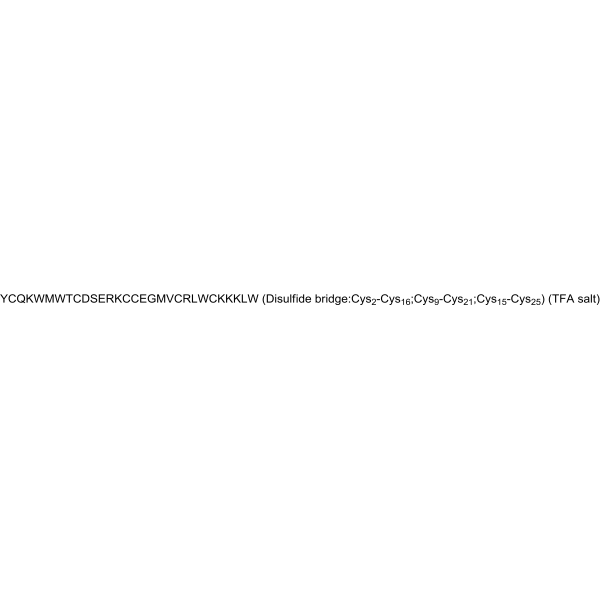
Tyr-Cys-Gln-Lys-Trp-Met-Trp-Thr-Cys-Asp-Ser-Glu-Arg-Lys-Cys-Cys-Glu-Gly-Met-Val-Cys-Arg-Leu-Trp-Cys-Lys-Lys-Lys-Leu-Trp (Disulfide bridge:Cys2-Cys16;Cys9-Cys21;Cys15-Cys25)
-
Sequence Shortening
YCQKWMWTCDSERKCCEGMVCRLWCKKKLW (Disulfide bridge:Cys2-Cys16;Cys9-Cys21;Cys15-Cys25)
-
Livraison
Room temperature in continental US; may vary elsewhere.
-
Stockage
Sealed storage, away from moisture and light, under nitrogen
Powder -80°C 2 years -20°C 1 year * In solvent : -80°C, 6 months; -20°C, 1 month (sealed storage, away from moisture and light, under nitrogen)


Publications (1)
-
Journal Impact Factor
-
Most Recent


Solvant et solubilité
In Vitro:
H2O : 100 mg/mL (Need ultrasonic)
DMSO : 50 mg/mL (Need ultrasonic; Hygroscopic DMSO has a significant impact on the solubility of product, please use newly opened DMSO)


Pureté et documentation
-
Fiche technique (277 KB)
-
SDS (252 KB)
- English - EN (252 KB)
- Français - FR (252 KB)
- Deutsch - DE (252 KB)
- Norwegian - NO (252 KB)
- Español - ES (252 KB)
- Swedish - SV (252 KB)
- Italian - IT (252 KB)
- Korean - KR (252 KB)
- Portuguese - PT (252 KB)
-
Instruction de manipulation (2659 KB)
Références
[1]. Tanaka K, et al. Antihyperalgesic effects of ProTx-II, a Nav1.7 antagonist, and A803467, a Nav1.8 antagonist, in diabetic mice. Journal of experimental pharmacology. 2015;7:11-6. [Content Brief]
[3]. Schmalhofer WA, et al. ProTx-II, a selective inhibitor of NaV1.7 sodium channels, blocks action potential propagation in nociceptors. Molecular pharmacology. 2008 Nov;74(5):1476-84. [Content Brief]

Calculators
Concentration (start) × Volume (start) = Concentration (final) × Volume (final)


ProTx II TFA Related Classifications
HY-P1221A Related Classifications
 Powered by Bioz