



BCMA/TNFRSF17 Trimer Protein, Human (Biotinylated, HEK293, His-Avi)
Based on 1 Customer Validation
B Cell Maturation Antigen (BCMA) also referred to as TNFRSF17 or CD269, is a transmembrane glycoprotein member of the tumor necrosis factor receptor (TNFR) superfamily. BCMA is used as a biomarker for Multiple myeloma (MM). BCMA mainly plays an important role in B cells for their proliferation, survival and also differentiates them into plasma cells. BCMA/TNFRSF17 Trimer Protein, Human (Biotinylated, HEK293, His-Avi) is a biotinylated recombinant protein with a C-Terminal Avi label and a C-Terminal His label, It consists of 54 amino acids (M1-A54) and is produced in HEK293 cells.
- Species: Human
- Source: HEK293
-
Storage:Stored at -20°C for 2 years from date of receipt. After reconstitution, it is stable at 4°C for 1 week or -20°C for longer (with carrier protein). It is recommended to freeze aliquots at -20°C or -80°C for extended storage.


To place orders, for customer services and technical support, please contact: MedChemExpress USA
Tel: 609-228-6898 E-mail: [email protected] [email protected]


-
 Biological Activity
-
Technical Parameters
-
Product Properties
- Documentation
- References
- Help & FAQs




Biological Activity
Description
B Cell Maturation Antigen (BCMA) also referred to as TNFRSF17 or CD269, is a transmembrane glycoprotein member of the tumor necrosis factor receptor (TNFR) superfamily. BCMA is used as a biomarker for Multiple myeloma (MM). BCMA mainly plays an important role in B cells for their proliferation, survival and also differentiates them into plasma cells[1]. BCMA/TNFRSF17 Trimer Protein, Human (Biotinylated, HEK293, His-Avi) is a biotinylated recombinant protein with a C-Terminal Avi label and a C-Terminal His label, It consists of 54 amino acids (M1-A54) and is produced in HEK293 cells.
Background
BCMA is expressed preferentially by mature B lymphocytes, with minimal expression in hematopoietic stem cells or nonhematopoietic tissue[1]. BCMA is almost exclusively expressed on plasmablasts and PCs[2].
The amino acid sequence of human BCMA protein has low homology for mouse BCMA protein.
BCMA is a 184 amino acid and 20.2-kDa type III transmembrane glycoprotein, with the extracellular N terminus containing a conserved motif of 6 cysteines. BCMA has two agonist ligands: a proliferation-inducing ligand (APRIL) and B cell activating factor (BAFF). Upon binding of the ligands to BCMA, activates B cells (NF-κβ), rat sarcoma/mitogen-activated protein kinase (RAS/MAPK), and phosphoinositide-3-kinase-protein kinase B/Akt (PI3K-PKB/Akt) signaling pathway. These pathways result in proliferation stimulation by modulating cell cycle checkpoints, increasing survival by upregulating anti-apoptotic proteins, and production of cell adhesion molecules, angiogenesis factors, and immunosuppressive molecules[2].
BCMA can be used as a promising antigen to target using a variety of immuno-therapy treatments including CART cells, for MM patients[3]. BCMA markedly reduces plasma IgA, IgG, and IgM levels and splenic Ig heavy chain mRNA levels in mouse[4]. In BCMA−/− mice, the long-term survival of PCs is impaired, but lack of BCMA has no effect in short-lived PCs, B cell development, or early humoral immune response, and the splenic architecture and germinal centers appear intact in these BCMA-deficient mice[5]. BCMA overexpression significantly promotes in vivo growth of xenografted MM cells in murine models[6].
In Vitro
BCMA (human; 10000 ng/mL; 24 h) blocks the activity of ARI2m cells and inhibits the IFNγ production[3].
In Vivo
BCMA (human; 100 µg; i.p.; on days -4, -2, 0, 2, and 4) decreases the IgA and IgM levels in C57 Bl/6 mice[4].
Verified Bioactivity
1. Immobilized Biotinylated Human BCMA (Trimer) at 0.5 μg/mL (100μL/Well) on the plate. Dose response curve for Anti-BCMA Antibody hFc with the EC50 < 8.3 ng/mL determined by ELISA.
2. Loaded Serum BCMA/TNFRSF17 Trimer Protein, Human (Biotinylated, HEK293, His-Avi) on NTA biosensor, can bind Vonsetamig (HY-P990095) with an affinity constant of 2.585E-11 M as determined in BLI assay.
3. Loaded BCMA/TNFRSF17 Trimer Protein, Human (Biotinylated, HEK293, His-Avi) on NTA biosensor, can bind Elranatamab (HY-P99909) with an affinity constant of 2.432E-11 M as determined in BLI assay.
MCE Validation Data
-
Bioactivity - BLI
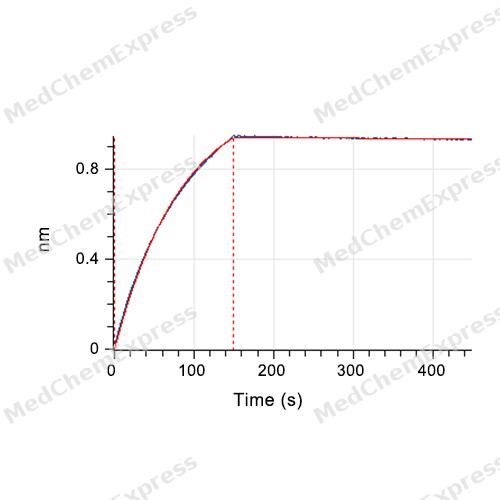
Bioactivity - BLI
-
Bioactivity - BLI
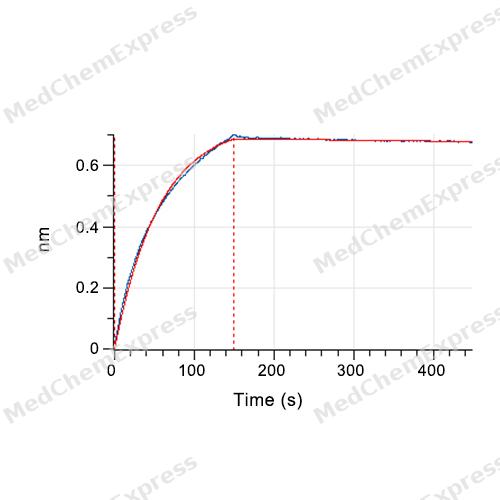
Bioactivity - BLI


Technical Parameters
-
Species Human
-
Source HEK293
-
Tag C-Avi;C-8*His
-
Accession
Q02223 (M1-A54)
-
Molecular Construction
-
N-term
-
BCMA (M1-A54)
Accession # Q02223 -
8*His-Avi
-
C-term
-
-
Protein Length
Extracellular Domain
-
Conjugation
Biotin
-
Conjugate Method
The single lysine residue in Avitag is biotinylated through an enzymatic reaction.
-
Synonyms
TNFRSF17; TNFRSF13A; Prev. BCMA; Tumor Necrosis Factor Receptor Superfamily, Member 17; BCM; B Cell Maturation Antigen; Tumor Necrosis Factor Receptor Superfamily Member 17; B-Cell Maturation Factor; B-Cell Maturation Protein; CD269 Antigen; TNF Receptor Superfamily Member 17; CD269
-
AA Sequence
MLQMAGQCSQNEYFDSLLHACIPCQLRCSSNTPPLTCQRYCNASVTNSVKGTNA
-
Predicted Molecular Mass
29.5 kDa
-
Molecular Weight
Approximately 35-50 kDa, based on SDS-PAGE under reducing conditions, due to the glycosylation.
-
Glycosylation
Yes
-
Purity
≥ 95%, as determined by Bis-Tris PAGE.


Product Properties
Lyophilized powder.
Lyophilized from a 0.22 μm filtered solution of PBS, pH 7.4, 5% trehalose.
<1 EU/μg, determined by LAL method.
It is not recommended to reconstitute to a concentration less than 100 μg/mL in ddH2O.
Stored at -20°C for 2 years from date of receipt. After reconstitution, it is stable at 4°C for 1 week or -20°C for longer (with carrier protein). It is recommended to freeze aliquots at -20°C or -80°C for extended storage.
Room temperature in continental US; may vary elsewhere.


Documentation
-
Data Sheet (264 KB)
-
SDS (254 KB)
- English - EN (254 KB)
- Français - FR (254 KB)
- Deutsch - DE (254 KB)
- Norwegian - NO (254 KB)
- Español - ES (254 KB)
- Swedish - SV (254 KB)
- Italian - IT (254 KB)
- Korean - KR (254 KB)
- Portuguese - PT (254 KB)
-
Handling Instructions (2659 KB)


References
[1]. Nobari ST, et al. B-cell maturation antigen targeting strategies in multiple myeloma treatment, advantages and disadvantages. J Transl Med. 2022 Feb 10;20(1):82. [Content Brief]
[2]. Yu B, et al. BCMA-targeted immunotherapy for multiple myeloma. J Hematol Oncol. 2020 Sep 17;13(1):125. [Content Brief]
[3]. Perez-Amill L, et al. Preclinical development of a humanized chimeric antigen receptor against B cell maturation antigen for multiple myeloma. Haematologica. 2021 Jan 1;106(1):173-184. [Content Brief]
[4]. Sanchez E, et al. Soluble B-Cell Maturation Antigen Mediates Tumor-Induced Immune Deficiency in Multiple Myeloma. Clin Cancer Res. 2016 Jul 1;22(13):3383-97. [Content Brief]
[5]. O'Connor BP, et al. BCMA is essential for the survival of long-lived bone marrow plasma cells. J Exp Med. 2004 Jan 5;199(1):91-8. [Content Brief]
[6]. Tai YT, et al. APRIL and BCMA promote human multiple myeloma growth and immunosuppression in the bone marrow microenvironment. Blood. 2016 Jun 23;127(25):3225-36. [Content Brief]

Calculators
Concentration (start) × Volume (start) = Concentration (final) × Volume (final)


 Powered by Bioz

