



BDNF Protein, Mouse (R129A, R130A, HEK293, His, Solution)
Based on 3 publication(s) in Google Scholar
Brain Derived Neurotrophic Factor (BDNF) is a neurotrophin that belongs to NGF-beta family. BDNF can bind to its high affinity receptor TrkB and activates signal transduction cascades (IRS1/2, PI3K, Akt). BDNF can also bind to the p75NTR, but the affinity for the p75NTR receptor is lower than for TrkB. BDNF is a neurotransmitter modulator, and is vital in maturation, survival and differentiation of neuronal populations during development. BDNF also participates in neuronal plasticity, which is essential for learning and memory. BDNF is widely expressed in the CNS. BDNF Protein, Mouse (R129A, R130A, HEK293, His) is a recombinant mouse BDNF (M1-R249, R129A, R130A) with C-terminal His tag, which is produced in HEK293.
- Species: Mouse
- Source: HEK293
-
Storage:Stored at -80°C for 1 year from date of receipt. It is stable at -20°C for 3 months after opening. It is recommended to freeze aliquots at -80°C for extended storage. Avoid repeated freeze-thaw cycles.


To place orders, for customer services and technical support, please contact: MedChemExpress USA
Tel: 609-228-6898 E-mail: [email protected] [email protected]


-
 Biological Activity
-
Technical Parameters
-
Product Properties
- Documentation
- References
- Help & FAQs




Biological Activity
Description
Brain Derived Neurotrophic Factor (BDNF) is a neurotrophin that belongs to NGF-beta family. BDNF can bind to its high affinity receptor TrkB and activates signal transduction cascades (IRS1/2, PI3K, Akt)[1]. BDNF can also bind to the p75NTR, but the affinity for the p75NTR receptor is lower than for TrkB[2]. BDNF is a neurotransmitter modulator, and is vital in maturation, survival and differentiation of neuronal populations during development. BDNF also participates in neuronal plasticity, which is essential for learning and memory. BDNF is widely expressed in the CNS[1]. BDNF Protein, Mouse (R129A, R130A, HEK293, His) is a recombinant mouse BDNF (M1-R249, R129A, R130A) with C-terminal His tag, which is produced in HEK293.
Background
BDNF, a neurotrophin that belongs to NGF-beta family. BDNF is widely expressed in the CNS, gut and other tissues. BDNF regulates neurodevelopmental processes, including maturation, survival and differentiation of neuronal populations, and synaptic plasticity[1].
BDNF can bind to its high affinity receptor TrkB and activates signal transduction cascades (IRS1/2, PI3K, Akt), thereby inducing increased Ca2+ intake and phosphorylation of transcription factors. BDNF can also bind to the p75NTR, but the affinity for the p75NTR receptor is lower than for TrkB. The activation of p75NTR increases apoptotic and inflammatory signaling in neurons and glial cells by activation of c-Jun N-terminal kinases (JNK) and NF-κB expression, respectively[2]. In BDNF knockout mouse, recombinant BDNF rescues deficits in basal synaptic transmission and hippocampal LTP[3]. Mouse BDNF shares >97% aa sequence identity with human. Mouse BDNF shares >99% aa sequence identity with rat.
BDNF is a neurotransmitter modulator which is vital in maturation, survival and differentiation of neuronal populations during development. BDNF also participates in neuronal plasticity, which is essential for learning and memory[1].
In Vitro
BDNF (mouse, 1 ng/mL, 3 min-2 h hippocampal slices from BDNF knockout mice) significantly improves deficits in basal synaptic transmission at the Schaffer collateral–CA1 synapse [3].
In Vivo
BDNF (mouse, 0.25 μg/side, intrahippocampal administration) mimics the beneficial effects (improve cognition) of NSC transplantation in AD mice[4].
Verified Bioactivity
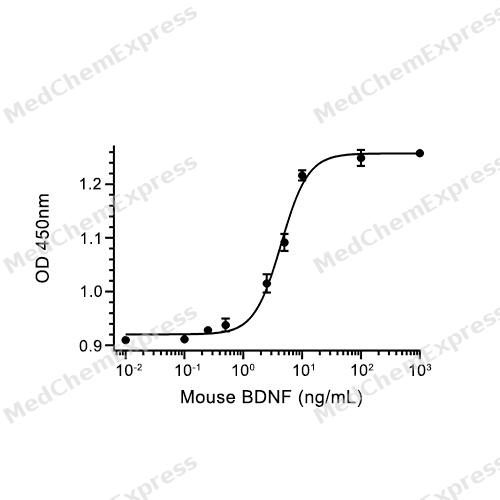
Measured in a cell proliferation assay using BaF3 mouse pro-B cells transfected with TrkB. The ED50 for this effect is 4.391 ng/mL, corresponding to a specific activity is 2.277×10⁵ units/mg.
MCE Validation Data
-
Purity - SDS-PAGE
Purity - SDS-PAGE
-
Bioactivity - Cell-Based Assay
Bioactivity - Cell-Based Assay


Publications (3)
-
Journal Impact Factor
-
Most Recent
-
Acta Pharmacol Sin
G-protein coupled receptor kinase 2 mediates rheumatoid arthritis-induced depression-like behaviors via the hippocampal CRHR1 signaling pathway. [Abstract]2025 Jul 21. PMID: 40691271 -
Exp Neurol
Axonal injury mediated by neuronal p75NTR/TRAF6/JNK pathway contributes to cognitive impairment after repetitive mTBI. [Abstract]2024 Feb:372:114618. PMID: 38029807 -


Technical Parameters
-
Species Mouse
-
Source HEK293
-
Tag C-His
-
Accession
P21237-1 (A19-R249, R129A, R130A)
-
Molecular Construction
-
N-term
-
BDNF (A19-R249, R129A, R130A)
Accession # P21237-1 -
His
-
C-term
-
-
Protein Length
Full Length of Neurotrophic factor BDNF, precursor form
-
Synonyms
BDNF; Abrineurin; Brain Derived Neurotrophic Factor; Brain-Derived Neurotrophic Factor Preproprotein Isoform 2; ProBDNF; Brain-Derived Neurotrophic Factor Isoform 1; Neurotrophic Factor BDNF Precursor Form; ANON2; Brain-Derived Neurotrophic Factor; BULN2;
-
AA Sequence
APMKEVNVHGQGNLAYPGVRTHGTLESVNGPRAGSRGLTTTSLADTFEHVIEELLDEDQKVRPNEENHKDADLYTSRVMLSSQVPLEPPLLFLLEEYKNYLDAANMSMRVAAHSDPARRGELSVCDSISEWVTAADKKTAVDMSGGTVTVLEKVPVSKGQLKQYFYETKCNPMGYTKEGCRGIDKRHWNSQCRTTQSYVRALTMDSKKRIGWRFIRIDTSCVCTLTIKRGR
-
Predicted Molecular Mass
27.4 kDa
-
Molecular Weight
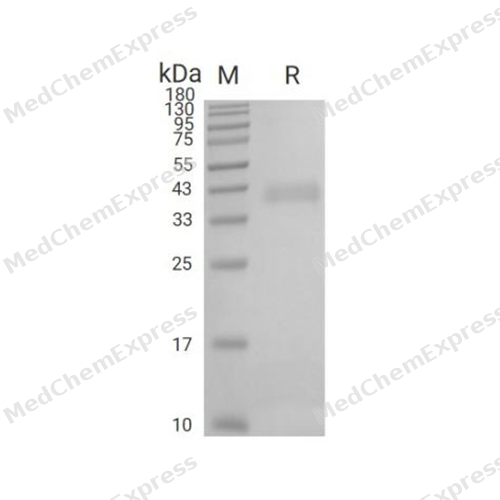
Approximately 35-45 kDa, based on SDS-PAGE under reducing conditions, due to the glycosylation.
-
Glycosylation
Yes
-
Purity
≥ 95%, as determined by reducing SDS-PAGE.


Product Properties
Solution
Supplied as a 0.22 μm filtered solution of PBS, pH 7.4.
<1 EU/μg, determined by LAL method.
Stored at -80°C for 1 year from date of receipt. It is stable at -20°C for 3 months after opening. It is recommended to freeze aliquots at -80°C for extended storage. Avoid repeated freeze-thaw cycles.
Shipping with dry ice.


Documentation
-
Data Sheet (264 KB)
-
SDS (252 KB)
- English - EN (252 KB)
- Français - FR (252 KB)
- Deutsch - DE (252 KB)
- Norwegian - NO (252 KB)
- Español - ES (252 KB)
- Swedish - SV (252 KB)
- Italian - IT (252 KB)
- Korean - KR (252 KB)
- Portuguese - PT (252 KB)
-
Handling Instructions (2659 KB)


References
[1]. Bathina S, et al. Brain-derived neurotrophic factor and its clinical implications. Arch Med Sci. 2015 Dec 10;11(6):1164-78. [Content Brief]
[2]. Lima Giacobbo B, et al. Brain-Derived Neurotrophic Factor in Brain Disorders: Focus on Neuroinflammation. Mol Neurobiol. 2019 May;56(5):3295-3312. [Content Brief]
[3]. Patterson SL, et al. Recombinant BDNF rescues deficits in basal synaptic transmission and hippocampal LTP in BDNF knockout mice. Neuron. 1996 Jun;16(6):1137-45. [Content Brief]
[4]. Blurton-Jones M, et al. Neural stem cells improve cognition via BDNF in a transgenic model of Alzheimer disease. Proc Natl Acad Sci U S A. 2009 Aug 11;106(32):13594-9. [Content Brief]

Calculators
Concentration (start) × Volume (start) = Concentration (final) × Volume (final)


 Powered by Bioz

