



IL-22 Protein, Mouse (His)

Based on 1 Customer Validation
IL-22 Protein is an secreted IL-10 family cytokine that take part in inflammation responses, reactive oxygen species metabolic process as well as the regeneration and spreading of epithelial cells. IL22 promotes cell survival and proliferation through STAT3, ERK1/2, MAPK and PI3K/AKT pathways. IL-22 Protein, Mouse (His) is the recombinant mouse-derived IL-22 protein, expressed by E. coli , with N-6*His labeled tag.
- Species: Mouse
- Source: E. coli
-
보관:Stored at -20°C for 2 years from date of receipt. After reconstitution, it is stable at 4°C for 1 week or -20°C for longer (with carrier protein). It is recommended to freeze aliquots at -20°C or -80°C for extended storage.


To place orders, for customer services and technical support, please contact: MedChemExpress USA
Tel: 609-228-6898 E-mail: [email protected] [email protected]


-
 Biological Activity
-
Technical Parameters
-
Product Properties
- 각종 서류
- References
- Help & FAQs




Biological Activity
제품 설명
IL-22 Protein is an secreted IL-10 family cytokine that take part in inflammation responses, reactive oxygen species metabolic process as well as the regeneration and spreading of epithelial cells. IL22 promotes cell survival and proliferation through STAT3, ERK1/2, MAPK and PI3K/AKT pathways. IL-22 Protein, Mouse (His) is the recombinant mouse-derived IL-22 protein, expressed by E. coli , with N-6*His labeled tag.
Background
IL-22 is a secreted IL-10 family cytokine that plays a critical role in modulating tissue responses during inflammation, reactive oxygen species metabolic process as well as the regeneration and spreading of epithelial cells[1][2][3][4].
IL-22 is produced by several T cells, ILC3, neutrophils and macrophages, IL-22 has a specific receptor which is composed of IL-22R1 and IL-10R2, presenting on non-immune cells in many organs. Ligation of IL22RA1 with IL22 induces activation of the tyrosine kinases JAK1 and TYK2, which activates STAT3, and p38 MAPK, in turn, promotes cell survival and proliferation through STAT3, ERK1/2, MAPK and PI3K/AKT pathways. IL-22 promotes phosphorylation of GSK3B at 'Ser-9' and CTTN as well[5].
IL-22 gets positive regulation from IL-23, IL-1β, IL-7, AhR and Notch, IL-22 gets negative regulation from IL-22BP, TGF-β, IL-27, ICOS, c-Maf and IL-25[6].
Verified Bioactivity
Measured by its ability to induce IL-10 secretion in COLO 205 human colorectal adenocarcinoma cells. The ED50 for this effect is 106.7 pg/mL, corresponding to a specific activity is 9.3721×10⁶ units/mg.
MCE Validation Data
-
Purity - SDS-PAGE
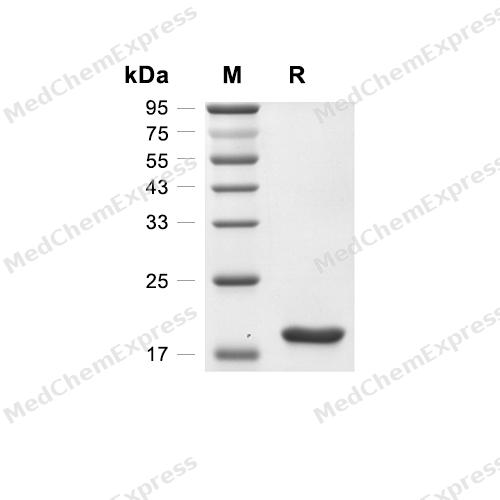
Purity - SDS-PAGE
-
Bioactivity - Cell-Based Assay
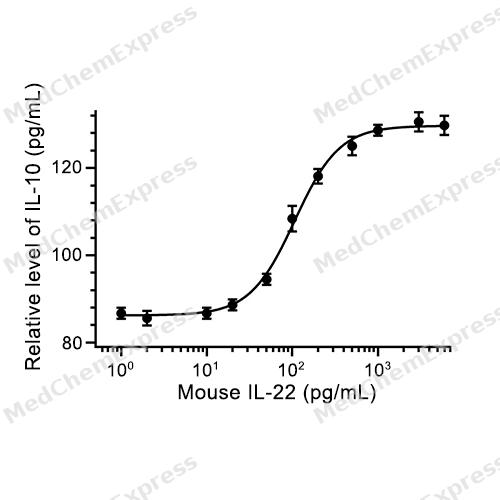
Bioactivity - Cell-Based Assay


Technical Parameters
-
Species Mouse
-
Source E. coli
-
Tag N-6*His
-
Accession
Q9JJY9 (L34-V179)
-
Molecular Construction
-
N-term
-
6*His
-
IL-22 (L34-V179)
Accession # Q9JJY9 -
C-term
-
-
Protein Length
Full Length of Mature Protein
-
Synonyms
IL22; TIFa; Interleukin 22; IL-10-Related T-Cell-Derived Inducible Factor; IL-TIF; Cytokine Zcyto18; ILTIF; Interleukin-22; IL-22; MGC79382; TIFIL-23; MGC79384; Zcyto18; IL-10-Related T-Cell-Derived-Inducible Factor; IL-D110; Interferon 2B1; IL-21; ZCYTO1
-
AA Sequence
LPVNTRCKLEVSNFQQPYIVNRTFMLAKEASLADNNTDVRLIGEKLFRGVSAKDQCYLMKQVLNFTLEDVLLPQSDRFQPYMQEVVPFLTKLSNQLSSCHISGDDQNIQKNVRRLKETVKKLGESGEIKAIGELDLLFMSLRNACV
-
Predicted Molecular Mass
18.6 kDa
-
분자량
Approximately 19 kDa, based on SDS-PAGE under reducing conditions, due to the glycosylation.
-
Purity
≥ 95%, as determined by reducing SDS-PAGE.


Product Properties
Lyophilized powder.
Lyophilized from a 0.22 μm filtered solution of PBS, 300 mM NaCl, pH 7.4.
<1 EU/μg, determined by LAL method.
It is not recommended to reconstitute to a concentration less than 100 μg/mL in ddH2O. For long term storage it is recommended to add a carrier protein (0.1% BSA, 5% HSA, 10% FBS or 5% Trehalose).
Stored at -20°C for 2 years from date of receipt. After reconstitution, it is stable at 4°C for 1 week or -20°C for longer (with carrier protein). It is recommended to freeze aliquots at -20°C or -80°C for extended storage.
Room temperature in continental US; may vary elsewhere.


각종 서류
-
Data Sheet (264 KB)
-
SDS (252 KB)
- English - EN (252 KB)
- Français - FR (252 KB)
- Deutsch - DE (252 KB)
- Norwegian - NO (252 KB)
- Español - ES (252 KB)
- Swedish - SV (252 KB)
- Italian - IT (252 KB)
- Korean - KR (252 KB)
- Portuguese - PT (252 KB)
-
Handling Instructions (2659 KB)


References
[1]. Saxton RA, et al. The tissue protective functions of interleukin-22 can be decoupled from pro-inflammatory actions through structure-based design. Immunity. 2021 Apr 13;54(4):660-672.e9. [Content Brief]
[2]. Delbue D, et al. Reprogramming Intestinal Epithelial Cell Polarity by Interleukin-22. Front Med (Lausanne). 2021 Apr 12;8:656047. [Content Brief]
[3]. Weathington NM, et al. Glycogen synthase kinase-3β stabilizes the interleukin (IL)-22 receptor from proteasomal degradation in murine lung epithelia. J Biol Chem. 2014 Jun 20;289(25):17610-9. [Content Brief]
[4]. Wei CC, et al. Cloning and characterization of mouse IL-22 binding protein. Genes Immun. 2003 Apr;4(3):204-11. [Content Brief]
[5]. Dudakov JA, et al. Interleukin-22: immunobiology and pathology. Annu Rev Immunol. 2015;33:747-85. [Content Brief]

Calculators
Concentration (start) × Volume (start) = Concentration (final) × Volume (final)


 Powered by Bioz

