



RANKL/TNFSF11 Protein, Mouse (HEK293, N-His)
Based on 1 publication(s) in Google Scholar
RANKL (TNFSF11), a type II transmembrane protein, is a receptor activator of NF-κB (RANK) ligand. RANKL is an activator of RANK. When binding to RANK, it induces the differentiation of monocyte/macrophage-lineage cells into osteoclasts and leads to osteoclast precursor maturation. RANKL is critical for osteoclasts maturation, bone modeling, and bone remodeling, as well as the development of lymph nodes (LNs). RANKL/TNFSF11 Protein, Mouse (HEK293, N-His) is a recombinant mouse RANKL (R72-D316) with N-terminal 6*His tag, which is produced in HEK293.
- Species: Mouse
- Source: HEK293
-
Storage:Stored at -20°C for 2 years from date of receipt. After reconstitution, it is stable at 4°C for 1 week or -20°C for longer (with carrier protein). It is recommended to freeze aliquots at -20°C or -80°C for extended storage.


To place orders, for customer services and technical support, please contact: MedChemExpress USA
Tel: 609-228-6898 E-mail: [email protected] [email protected]


-
 Biological Activity
-
Technical Parameters
-
Product Properties
- Documentation
- References
- Help & FAQs




Biological Activity
Description
RANKL (TNFSF11), a type II transmembrane protein, is a receptor activator of NF-κB (RANK) ligand. RANKL is an activator of RANK. When binding to RANK, it induces the differentiation of monocyte/macrophage-lineage cells into osteoclasts and leads to osteoclast precursor maturation. RANKL is critical for osteoclasts maturation, bone modeling, and bone remodeling, as well as the development of lymph nodes (LNs). RANKL/TNFSF11 Protein, Mouse (HEK293, N-His) is a recombinant mouse RANKL (R72-D316) with N-terminal 6*His tag, which is produced in HEK293[1][2].
Background
RANKL (TNFSF11) belongs to TNF family. RANKL is a type II transmembrane protein and is a receptor activator of NF-κB (RANK) ligand. RANKL is an activator of RANK. RANKL binds to RANK and induces the differentiation of monocyte/macrophage-lineage cells into osteoclasts and leads to osteoclast precursor maturation. In bone tissue, RANKL is expressed by osteoblasts, osteocytes and immune cells, especially in osteoblasts and osteocytes[1]. RANKL is also expressed by T cells and increases proliferation and survival of dendritic cells[2]. In mice, RANKL/RANK signaling attenuates inflammation in ischemic brains through a Toll-like receptor signaling pathway[4].
RANKL consists of cytoplasmic domain (1-47), helical domain (48-68), and extracellular domain (69-317). The soluble chain (140-317) is released when cleaved by enzymes such as matrix metalloproteinases (MMP3 or 7) and ADAM[1][3].
RANKL is critical for osteoclasts maturation, bone modeling, and bone remodeling, as well as the development of lymph nodes (LNs)[1].
In Vitro
RANKL (mouse, 3 ng/mL, 4 days) induces osteoclast differentiation from RAW264.7 cells, and can be inhibited by Resveratrol[5].
RANKL (mouse,10 ng/mL, 0-3 h) induces NF-κB activation in murine hepatocyte cell line (AML-12) [6].
In Vivo
RANKL (mouse, i.c.v., 5 ng in 2 μL) reduces IL-1β, MCP-1, IL-6 and TNFα expression in WT mice[4].
RANKL (mouse, i.p., 1-10 μg) protects against hepatic ischemia/reperfusion liver injury in mice[6].
Verified Bioactivity
1.Immobilized Human OPG-Fc at 2 μg/mL(100 μl/well) can bind Mouse RANKL-His and the ED50 is 3.91 ng/mL.
2.Measured by its ability to induce osteoclast differentiation of RAW 264.7 mouse leukemia cells of monocyte macrophage. The ED50 for this effect is 0.7470 ng/mL, corresponding to a specific activity is 1.339×10⁶ U/mg.
MCE Validation Data
-
Purity - SDS-PAGE
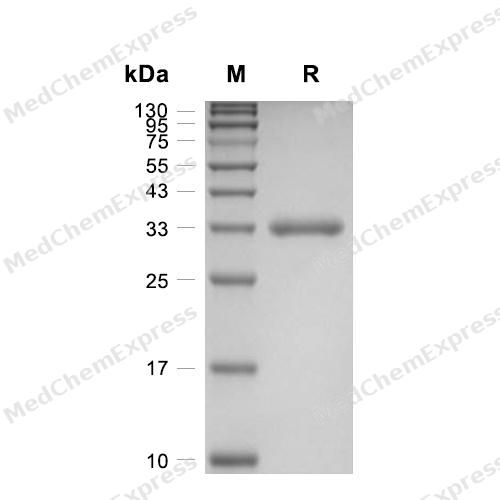
Purity - SDS-PAGE


Publications (1)
-
Journal Impact Factor
-
Most Recent
-
Biochem Biophys Res Commun
2025 Mar 8:752:151410. PMID: 39946982


Technical Parameters
-
Species Mouse
-
Source HEK293
-
Tag N-6*His
-
Accession
O35235-1 (R72-D316)
-
Molecular Construction
-
N-term
-
6*His
-
RANK L/TNFSF11 (R72-D316)
Accession # O35235-1 -
C-term
-
-
Protein Length
Extracellular Domain
-
Synonyms
TNFSF11; Tumor Necrosis Factor (Ligand) Superfamily, Member 11; TNF Superfamily Member 11; Receptor Activator Of Nuclear Factor Kappa-B Ligand; TRANCE; TNLG6B; RANKL; Receptor Activator Of Nuclear Factor Kappa B Ligand; OPGL; Tumor Necrosis Factor Ligand
-
AA Sequence
RAQMDPNRISEDSTHCFYRILRLHENADLQDSTLESEDTLPDSCRRMKQAFQGAVQKELQHIVGPQRFSGAPAMMEGSWLDVAQRGKPEAQPFAHLTINAASIPSGSHKVTLSSWYHDRGWAKISNMTLSNGKLRVNQDGFYYLYANICFRHHETSGSVPTDYLQLMVYVVKTSIKIPSSHNLMKGGSTKNWSGNSEFHFYSINVGGFFKLRAGEEISIQVSNPSLLDPDQDATYFGAFKVQDID
-
Predicted Molecular Mass
27.6 kDa
-
Molecular Weight
Approximately 32-35 kDa, based on SDS-PAGE under reducing conditions, due to the glycosylation.
-
Glycosylation
Yes
-
Purity
≥ 90%, as determined by reducing SDS-PAGE.


Product Properties
Lyophilized powder.
Lyophilized from a 0.22 μm filtered solution of 20 mM PB, 150 mM NaCl, pH 7.8.
<1 EU/μg, determined by LAL method.
It is not recommended to reconstitute to a concentration less than 100 μg/mL in ddH2O. For long term storage it is recommended to add a carrier protein (0.1% BSA, 5% HSA, 10% FBS or 5% Trehalose).
Stored at -20°C for 2 years from date of receipt. After reconstitution, it is stable at 4°C for 1 week or -20°C for longer (with carrier protein). It is recommended to freeze aliquots at -20°C or -80°C for extended storage.
Room temperature in continental US; may vary elsewhere.


Documentation
-
Data Sheet (265 KB)
-
SDS (254 KB)
- English - EN (254 KB)
- Français - FR (254 KB)
- Deutsch - DE (254 KB)
- Norwegian - NO (254 KB)
- Español - ES (254 KB)
- Swedish - SV (254 KB)
- Italian - IT (254 KB)
- Korean - KR (254 KB)
- Portuguese - PT (254 KB)
-
Handling Instructions (2659 KB)


References
[1]. Ono T, et al. RANKL biology: bone metabolism, the immune system, and beyond. Inflamm Regen. 2020 Feb 7;40:2. [Content Brief]
[2]. Li B, et al. Roles of the RANKL-RANK Axis in Immunity-Implications for Pathogenesis and Treatment of Bone Metastasis. Front Immunol. 2022 Mar 21;13:824117. [Content Brief]
[3]. Tobeiha M, et al. RANKL/RANK/OPG Pathway: A Mechanism Involved in Exercise-Induced Bone Remodeling. Biomed Res Int. 2020 Feb 19;2020:6910312. [Content Brief]
[4]. Shimamura M, et al. OPG/RANKL/RANK axis is a critical inflammatory signaling system in ischemic brain in mice. Proc Natl Acad Sci U S A. 2014 Jun 3;111(22):8191-6. [Content Brief]
[5]. He X, et al. Resveratrol prevents RANKL-induced osteoclast differentiation of murine osteoclast progenitor RAW 264.7 cells through inhibition of ROS production. Biochem Biophys Res Commun. 2010 Oct 22;401(3):356-62. [Content Brief]

Calculators
Concentration (start) × Volume (start) = Concentration (final) × Volume (final)


 Powered by Bioz

