



UPP1 Protein, Human (His)
Based on 1 publication(s) in Google Scholar
UPP1 belongs to the family of pentosyltransferases. UPP1 is expressed in the cytosol of most tissues and is important for the homeostatic regulation of intracellular and plasma uridine concentrations. UPP1 elevates its expression levels in many tumors. UPP1 Protein, Human (His) is a recombinant human UPP1 protein expressed by E. coli, with an N-6*His tag, consisting of 173 amino acids (M1-A173).
- Species: Human
- Source: E. coli
-
Storage:Stored at -80°C for 1 year from date of receipt. It is stable at -20°C for 3 months after opening. It is recommended to freeze aliquots at -80°C for extended storage. Avoid repeated freeze-thaw cycles.


To place orders, for customer services and technical support, please contact: MedChemExpress USA
Tel: 609-228-6898 E-mail: [email protected] [email protected]


-
 Biological Activity
-
Technical Parameters
-
Product Properties
- Documentation
- References
- Help & FAQs




Biological Activity
Description
UPP1 belongs to the family of pentosyltransferases. UPP1 is expressed in the cytosol of most tissues and is important for the homeostatic regulation of intracellular and plasma uridine concentrations. UPP1 elevates its expression levels in many tumors. UPP1 Protein, Human (His) is a recombinant human UPP1 protein expressed by E. coli, with an N-6*His tag, consisting of 173 amino acids (M1-A173).
Background
Uridinephosphorylase 1 (UPP1) is a member of the family of pentosyltransferase. UPP1 plays an important role in the pyrimidine salvage pathway through its catalysis of the reversible phosphorolysis of uridine to uracil. UPP1 is important for the homeostatic regulation of intracellular and plasma uridine concentratios. UPP1 is expressed in a variety of tissues including liver kidney and colon reflecting its diverse physiological roles. UPP 1 has been linked to cancer and metabolic disorders. The expression levels and the enzymatic activity of UPP1 are higher in human solid tumors than in adjacent normal tissues. The high level of UPP1 expression makes it a potential prognosticfactor for some cancers, such as oral squamous cell carcinoma[1].
In Vitro
UPP1 Protein, Human (His) can directly binds with recombinant AKT in vitro, as showed in the GST pull-down analysis[1].
MCE Validation Data
-
Purity - SDS-PAGE
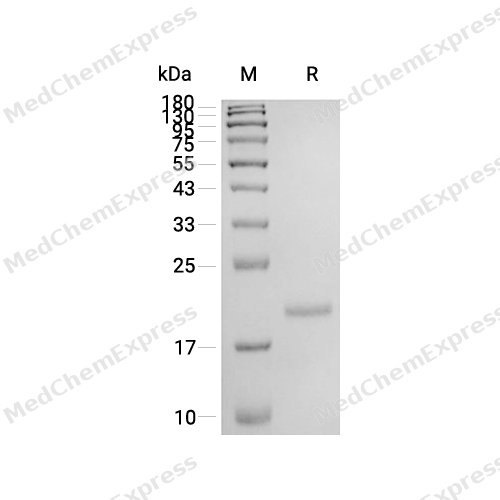
Purity - SDS-PAGE


Publications (1)
-
Journal Impact Factor
-
Most Recent
-
Cell Metab
2025 Dec 29:S1550-4131(25)00530-3. PMID: 41468885


Technical Parameters
-
Species Human
-
Source E. coli
-
Tag N-6*His
-
Accession
Q86Y75 (M1-A173)
-
Molecular Construction
-
N-term
-
6*His
-
UPP1 (M1-A173)
Accession # Q86Y75 -
C-term
-
-
Protein Length
Full Length
-
Synonyms
UPP1; Uridine Phosphorylase 1; UP; UDRPASE; UPASE; UPP; UrdPase 1; UPase 1; Uridine Phosphorylase
-
AA Sequence
MQRKLKVTSLEPGTVVITEQAVDTCFKAEFEQIVLGKRVIRKTDLNKKLVQELLLCSAELSEFTTVVGNTMCTLDFYEGQGRLDGALCSYTEKDKQAYLEAAYAAGVRNIEMESSVFAAMCSACGLQAAVVCVTLLNRLEGDQISSPRNVLSEYQQRPQRLVSYFIKKKLSKA
-
Predicted Molecular Mass
20 kDa
-
Molecular Weight
Approximately 20 kDa, based on SDS-PAGE under reducing conditions.
-
Purity
≥ 90%, as determined by reducing SDS-PAGE.


Product Properties
Solution
Supplied as a 0.22 μm filtered solution of 20 mM Tris-HCl, 200 mM NaCl, 1 mM DTT, pH 8.0.
Note: For SPR assay, please replace the buffer. Primary amine components (e.g., Tris, imidazole) can affect protein-coupled chips.
<1 EU/μg, determined by LAL method.
Stored at -80°C for 1 year from date of receipt. It is stable at -20°C for 3 months after opening. It is recommended to freeze aliquots at -80°C for extended storage. Avoid repeated freeze-thaw cycles.
Shipping with dry ice.


Documentation
-
Data Sheet (261 KB)
-
SDS (251 KB)
- English - EN (251 KB)
- Français - FR (251 KB)
- Deutsch - DE (251 KB)
- Norwegian - NO (251 KB)
- Español - ES (251 KB)
- Swedish - SV (251 KB)
- Italian - IT (251 KB)
- Korean - KR (251 KB)
- Portuguese - PT (251 KB)
-
Handling Instructions (2659 KB)


References

Calculators
Concentration (start) × Volume (start) = Concentration (final) × Volume (final)


 Powered by Bioz

