190 Results for "

Nitro

" in MedChemExpress (MCE) Product Catalog:
Products (190)

190 Results for "Nitro" in MCE Product Catalog:

Cat. No.: HY-149308
CAS No.: 2951012-00-1
Purity:  98.69%
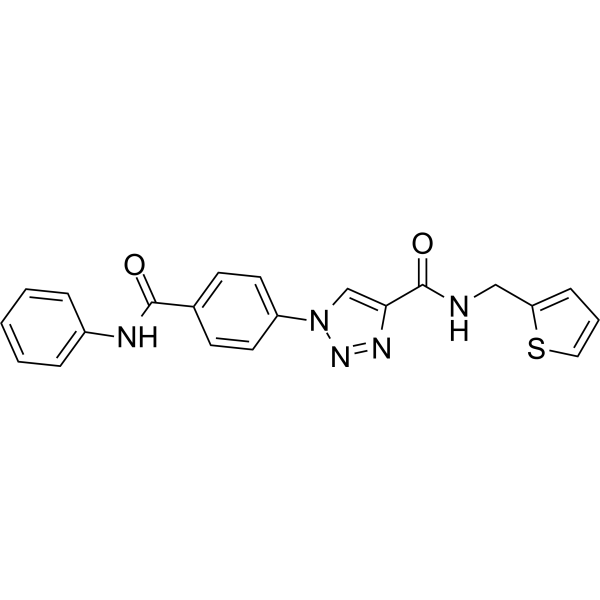
MKA031 (compound 6y) is a non-competitive MIF inhibitor with an IC50 value of 1.7 μM. MKA031 (compound 6y) interferes with MIF/AIF interaction, MIF nuclear translocation, and N-methyl-N'-nitro-N-nitrosoguanidine (MNNG)-induced dependent cell death. MKA031 can be used in the study of chronic hepatitis C virus infection .
loading...
    loading...
Cat. No.: HY-101761R
CAS No.: 1190221-43-2
TM5441 (Standard) is the analytical standard of TM5441 (HY-101761). This product is intended for research and analytical applications. TM5441 is an orally bioavailable inhibitor of plasminogen activator inhibitor-1 (PAI-1), has IC50 values between 13.9 and 51.1 μM and induces intrinsic apoptosis in several human cancer cell lines. TM5441 attenuates Nω-nitro-l-arginine methyl ester-induced cardiac hypertension and vascular senescence .
loading...
    loading...
Cat. No.: HY-119475
CAS No.: 56302-13-7
Research Areas:  

Infection

Satranidazole is an orally active insecticide and antimicrobial agent with high electron affinity. Satranidazole forms reduced nitro intermediates, which interact with DNA, causing helix instability, strand breakage and release of thymidine derivatives. Satranidazole exhibits antitrichomonal activity against Trichomonas vaginalis and Trichomonas foetus, and antiamoebic activity in rodent models of hepatic amoebiasis and caecal amoebiasis. Satranidazole inhibits the replication of bacteriophage φX174 DNA. Satranidazole can be used in research related to caecal amoebiasis, trichomoniasis and anaerobic bacterial infections .
loading...
    loading...
Cat. No.: HY-Y0251
CAS No.: 603-11-2
Synonyms: m-Nitrophthalic acid; o-Nitrophthalic acid; 3-Nitrophthalic acid
3-Nitrophthalic acid (m-Nitrophthalic acid) is a nitro-substituted aromatic carboxylic acid that acts as a DPPH radical scavenger through hydrogen donation. 3-Nitrophthalic acid induces cellular oxidative stress and Apoptosis. 3-Nitrophthalic acid inhibits NRF2/HO-1 antioxidant signaling and impairs follicular development and ovulation. 3-Nitrophthalic acid can be used to construct functional MOF . 3-Nitrophthalic acid can be used in the study of premature ovarian insufficiency .
loading...
    loading...
Cat. No.: HY-119475S
Satranidazole-d3 is the deuterium labeled Satranidazole. Satranidazole is an orally active insecticide and antimicrobial agent with high electron affinity. Satranidazole forms reduced nitro intermediates, which interact with DNA, causing helix instability, strand breakage and release of thymidine derivatives. Satranidazole exhibits antitrichomonal activity against Trichomonas vaginalis and Trichomonas foetus, and antiamoebic activity in rodent models of hepatic amoebiasis and caecal amoebiasis. Satranidazole inhibits the replication of bacteriophage φX174 DNA. Satranidazole can be used in research related to caecal amoebiasis, trichomoniasis and anaerobic bacterial infections.
loading...
    loading...
Cat. No.: HY-176180
Target:  

PROTACs STING IKK NF-κB

Research Areas:  

Inflammation/Immunology

PROTAC STING degrader-4 is a nitro-free covalent STING PROTAC degrader with a DC50 of 3.23 μM. PROTAC STING degrader-4 effectively inhibits STING as well as its downstream signaling, such as p-TBK1 and p-NF-κB (p-P65), and immune-inflammatory cytokines. PROTAC STING degrader-4 mitigates kidney and blood inflammation in Cisplatin (HY-17394)-induced acute kidney injury (AKI) mice model .
loading...
    loading...
Cat. No.: HY-D3240
CAS No.: 2375541-43-6
Photoactive NTR probe (Compound 1) is a covalent crosslinker and Fluorescent indicator targeting Nitroreductase. The Photoactive NTR probe undergoes a sequential activation process: it is first activated via nitroreductase-mediated nitro-to-amino conversion, and then forms a fluorescent product upon photoactivation. The Photoactive NTR probe can form covalent adducts with the side chains of cysteine, tyrosine, lysine and histidine in adjacent proteins to reduce fluorophore diffusion. The Photoactive NTR probe enables super-resolution (STORM) imaging of active mitochondrial nitroreductase microdomains in living cells .
loading...
    loading...
Cat. No.: HY-W761397
CAS No.: 117568-28-2
Target:  

COMT

Research Areas:  

Neurological Disease

COMT-IN-3 is a competitive inhibitor of soluble catechol-O-methyltransferase (S-COMT). COMT-IN-3 coordinates with the Mg 2+ ion at the COMT active site via its catechol hydroxyl group, and its nitro group, as a strong electron-withdrawing substituent, further enhances the binding affinity. COMT-IN-3 interacts with the hydrophobic residues Trp38, Met40, and Trp143 at the back of the active site via its neutral nitrile tail, thereby competitively inhibiting COMT activity. COMT-IN-3 can be used in research related to Parkinson's disease .
loading...
    loading...
Cat. No.: HY-107208R
CAS No.: 29106-51-2
Synonyms: (-)-Procyanidin B4 (Standard)
Procyanidol B4 (Standard) is the analytical standard of Procyanidol B4 (HY-107208). This product is intended for research and analytical applications. Procyanidol B4 ((-)-Procyanidin B4) is an orally active polyphenol found in Q.gilva. Procyanidol B4 exerts antioxidant activity by scavenging DPPH (HY-112053) (IC50: 12.15 μM) and Nitro blue tetrazolium chloride (NBT) (HY-15925) (IC50: 8.67 μM). Procyanidol B4 exhibits anti-inflammatory activity by inhibiting the expression of COX-2 and IL-1β and iNOS .
loading...
    loading...
Cat. No.: HY-169433
Naph-Se-TMZ is a PROTAC-like HDAC1 degrader. Naph-Se-TMZ induces ROS-dependent reduction in HDAC1 protein expression and total HDAC activity, and decreases cell viability in a dose-dependent manner. Naph-Se-TMZ exhibits activity in both TMZ-sensitive and TMZ-resistant glioma cells, and its cytotoxicity is reversed by the ROS scavenger N-acetylcysteine (HY-B0215). Naph-Se-TMZ can be used in studies related to glioblastoma .
Naph-Se-TMZ consists of a target protein ligand (red segment): Temozolomide (HY-17364), a DNA intercalator (blue segment): Nitro-Naphthalimide-C2-acylamide (HY-169437), and a molecular linker (black segment). Meanwhile, the activity control for the target protein ligand is Temozolomide-amino hydrochloride (HY-169439), and the DNA intercalator+linker is NNISC-2 (HY-169438).
loading...
    loading...

