245 Results for "

Complexing agent

" in MedChemExpress (MCE) Product Catalog:
Products (245)

245 Results for "Complexing agent" in MCE Product Catalog:

Cat. No.: HY-DY2036
Target:  

Fluorescent Dye

Research Areas:  

Others

Cellulose Staining Solution (Zinc Chloride-Iodine Method) is a cellulose-targeted staining agent. Cellulose Staining Solution (Zinc Chloride-Iodine Method) enables cellulose cell walls to turn blue-purple to blue by forming iodine-cellulose complexes between iodine and cellulose. Cellulose Staining Solution (Zinc Chloride-Iodine Method) can be used for the identification of plant phloem fibers, cellulose layers of algal cell walls, residual mineralized plant fibers from archaeological samples, and cellulose deposited on PET surfaces .
loading...
    loading...
Cat. No.: HY-Y1375
CAS No.: 6737-42-4
Synonyms: 1,3-DPPP
1,3-Bis (diphenylphosphino) propane (1,3-DPPP) is a Pd 2+-targeting ligand and anticancer agent. 1,3-Bis (diphenylphosphino) propane forms stable Pd 2+ complexes with acetate or trifluoroacetate auxiliary ligands. 1,3-Bis (diphenylphosphino) propane exhibits anticancer activity against colon cancer. 1,3-Bis (diphenylphosphino) propane can be used in research related to breast cancer, lung adenocarcinoma, prostate cancer and Gram-positive bacterial infections .
loading...
    loading...
Cat. No.: HY-175225
Research Areas:  

Cancer

PROTAC BRD4 Degrader-37 is a BRD4 PROTAC degrader with a DC50 of 36.4 nM. PROTAC BRD4 Degrader-37 recruits the E3 ubiquitin ligase TRIM21, binds to the PRYSPRY domain of TRIM21 (KD = 123 nM), and thereby mediates the ubiquitination and degradation of BRD4. PROTAC BRD4 Degrader-37 exhibits cytotoxicity against PANC-1 cells (GI50 = 0.282 μM). PROTAC BRD4 Degrader-37 can be used in studies related to pancreatic cancer .
loading...
    loading...
Cat. No.: HY-114220
CAS No.: 873546-31-7
Purity:  98.41%
Research Areas:  

Infection

T-2307 is an antifungal agent with blood-brain barrier penetration. T-2307 exhibits broad-spectrum antifungal activity against Candida species, including echinocandin-resistant strains, Cryptococcus neoformans, Cryptococcus gattii, and some Aspergillus species. T-2307 selectively targets fungal mitochondrial respiratory chain complexes III and IV, causing collapse of the fungal mitochondrial membrane potential and exerting fungicidal or fungistatic effects. T-2307 can be used in research related to fungal infections such as invasive candidiasis, cryptococcosis, and aspergillosis .
loading...
    loading...
Cat. No.: HY-17516R
CAS No.: 129558-76-5
Tolfenpyrad (Standard) is the analytical standard of Tolfenpyrad (HY-17516). This product is intended for research and analytical applications. Tolfenpyrad is an orally active insecticide, acaricide and antibacterial agent. Tolfenpyrad inhibits Complex I in the mitochondrial respiratory electron transport chain, interfering with the cell respiration process. Tolfenpyrad has significant insecticidal activity against a variety of insect pests such as H. contortus, Coccinella septempunctata. Tolfenpyrad has antibacterial activity against Francisella novicida, with an IC50 of 1.2 µM or 1.5 µM .
loading...
    loading...
Cat. No.: HY-U00035
CAS No.: 1000277-08-6
Research Areas:  

Infection

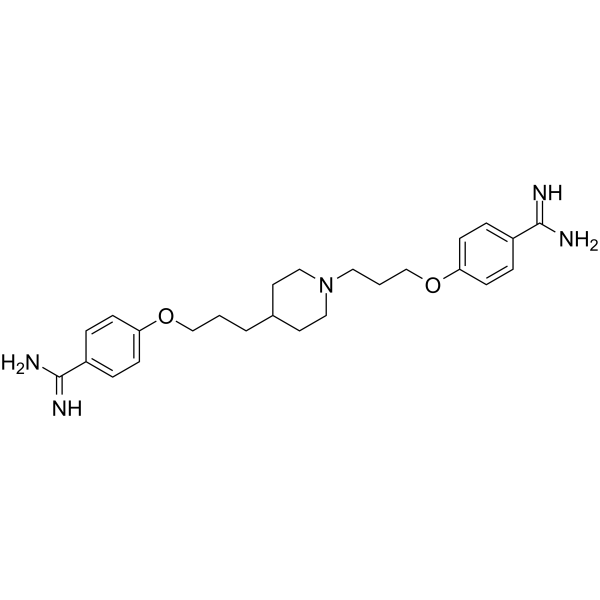
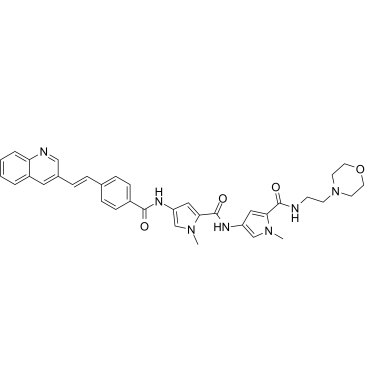
MGB-BP-3 is an orally aective Gram-positive bactericide and DNA-binding agent. MGB-BP-3 blocks transcription initiation by binding to AT-rich bacterial DNA regions, and interferes with the functions of DNA gyrase and topoisomerase IV, but does not stabilize cleavage complexes or induce the SOS response. MGB-BP-3 induces energy depletion in *Staphylococcus aureus* and inhibits spore formation in *Clostridioides difficile*, exhibiting intrinsic resistance resilience. MGB-BP-3 can be used in the research of *Clostridioides difficile*-associated diseases .
loading...
    loading...
Cat. No.: HY-W348485
CAS No.: 899937-47-4
Target:  

mTOR

Research Areas:  

Cancer

WRX606 is an orally active nonrapalog inhibitor for mTOR complex 1 (mTORC1M). WRX606 inhibits the phosphorylation of mTORC1 substrate S6 kinase 1 (S6K1) (IC50 = 10 nM) and eukaryotic translation initiation factor 4E binding protein (p-4E-BP1) (IC50 = 0.27 μM) in MCF-7 cells. WRX606 suppresses tumor growth in mice without promotion of metastasis. WRX606 can be studied in research as an antitumor agent .
loading...
    loading...
Cat. No.: HY-159067
CAS No.: 9064-91-9
Synonyms: DEAE-dextran, MW 500000 hydrochloride, from bacterial (Leuconostoc mesenteroides); Diethylaminoethyl-dextran, MW 500000 hydrochloride
DEAE-dextran, MW 500000 hydrochloride (DEAE-dextran, MW 500000 hydrochloride, from bacterial (Leuconostoc mesenteroides)) is a high-molecular-weight positively charged polymer that significantly enhances the uptake of viral RNA by tissue culture cells. When employed in the delivery system for "tumor immunity" RNA-splenocyte transfer, DEAE-dextran can markedly extend the lifespan of tumor-bearing animals, comparable to that of actively immunized animals. Furthermore, DEAE-dextran serves as a complexing agent for nucleic acids, forming composite particles with DNA/RNA for extensive applications in gene delivery. Additionally, DEAE-dextran can be utilized as a coating for liposomes .
loading...
    loading...
Cat. No.: HY-169081
Research Areas:  

Cancer

QS-57 is a heterobifunctional targeted protein localization (TPL) agent. QS-57 binds to BRD4 via its JQ1 domain and covalently targets 14-3-3σ to form a ternary complex. QS-57 sequesters nuclear BRD4 in the cytoplasm, impairing the nuclear transcriptional regulatory function mediated by BRD4. QS-57 significantly reduces the nuclear BRD4 protein level and increases the cytoplasmic BRD4 protein abundance in cancer cells. QS-57 can be used for research on breast cancer and colorectal cancer .
loading...
    loading...
Cat. No.: HY-181739
Target:  

CD1

Research Areas:  

Cancer

GCB-27a is a CD1d-binding immunostimulant and antitumor agent. GCB-27a binds to CD1d to form a stable complex and presents it to NKT cells, enhancing hydrophobic interactions within the A' pocket of CD1d through branched-chain conformation restriction. GCB-27a induces a Th1-biased immune response, drives IFN?γ production and limits IL-4 levels. GCB-27a is applicable to research related to melanoma lung metastasis .
loading...
    loading...
Cat. No.: HY-184081
CAS No.: 5118-17-2
Target:  

Bacterial

Research Areas:  

Infection

Furazolium hydrochloride is a broad-spectrum antibacterial agent with inhibitory activity against a variety of Gram-positive and Gram-negative Bacterial strains. In a gelatin-acacia complex coacervate system, Furazolium hydrochloride exhibits protein-binding properties, where protein binding dominates at low concentrations, while micellization occurs at high concentrations. Furazolium hydrochloride does not alter the water permeability of cellulose membranes, and it can induce delayed-type hypersensitivity reactions in guinea pigs, with cross-reactivity observed in animals sensitized with aflatoxin B1. Furazolium hydrochloride can be used in studies related to bacterial infections and local wound infections .
loading...
    loading...
Cat. No.: HY-W011060R
CAS No.: 23978-09-8
Synonyms: 4,7,13,16,21,24-Hexaoxa-1,10-diazabicyclo[8.8.8]hexacosane (Standard)
Research Areas:  

Others

Cryptand 2.2.2 (Standard) is the analytical standard of Cryptand 2.2.2 (HY-W011060). This product is intended for research and analytical applications. Cryptand 2.2.2 is a metal ion chelating agent that can selectively form complexes with metal ions. At room temperature, Cryptand 2.2.2 can serve as a host molecule, using the chelation effect to selectively bind desired ions (such as Zn 2+, Co 2+, Ni 2+, Cu 2+). Cryptand 2.2.2 can be used in the preparation of nanoparticles, transition metal compounds, and so on .
loading...
    loading...
Cat. No.: HY-130256
CAS No.: 2380000-55-3
Purity:  99.37%
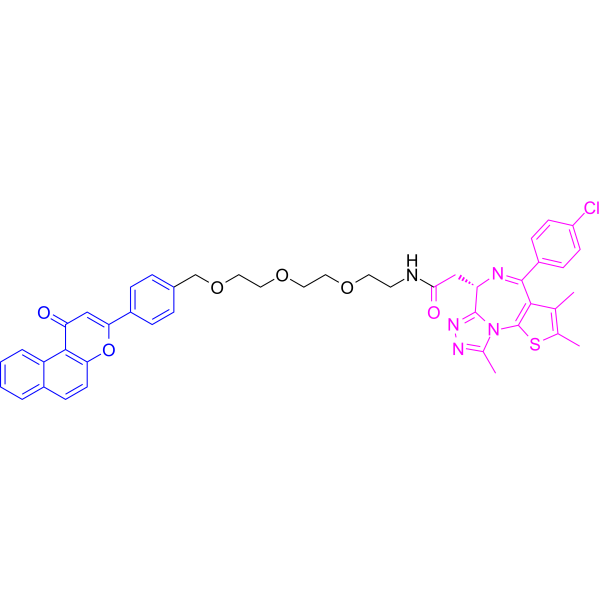
β-NF-JQ1 is a BRD2/3/4 PROTAC degrader. β-NF-JQ1 recruits the AhR E3 ligase complex to BRD2, BRD3 and BRD4, induces AhR-BRD interaction, and mediates AhR-dependent degradation through the proximity effect between the target protein and AhR. β-NF-JQ1 acts as an antiproliferative and cytotoxic agent that induces anticancer activity associated with BRD protein knockdown. β-NF-JQ1 can be used for research on breast cancer and neuroblastoma .
loading...
    loading...
Cat. No.: HY-181966
Research Areas:  

Infection

Sideromycin 7 is an antibacterial agent. Sideromycin 7 forms a 7-Bi 3+ coordination complex with bismuth citrate, exerting a three-pronged antibacterial mode of action: direct DNA binding to induce damage and arrest replication, suppression of KdpC synthesis to block KdpFABC-mediated potas-sium transport, and inhibition of ATP production. Sideromycin 7 exhibits potent antibacterial activity against Ciprofloxacin (HY-B0356)-resistant Pseudomonas aeruginosa strains. Sideromycin 7 exerts antibiofilm activity against Pseudomonas aeruginosa. Sideromycin 7 can be used for the research of ciprofloxacin-resistant Pseudomonas aeruginosa infection .
loading...
    loading...
Cat. No.: HY-184248
FM-74-103 is a selective GSPT1 PROTAC degrader and broad-spectrum antiviral agent. FM-74-103 recruits GSPT1 to the Cereblon E3 ligase to form a ternary complex, thereby driving GSPT1 ubiquitination and proteasomal degradation. FM-74-103 inhibits the replication of IAV, SARS-CoV-2 and CMV (including Nucleozin (HY-50001)-resistant influenza A virus). FM-74-103 can be used in research related to influenza A virus infection, SARS-CoV-2 infection and cytomegalovirus infection .
loading...
    loading...
Cat. No.: HY-184249
CAS No.: 1145869-35-7
Target:  

RSV DNA/RNA Synthesis

Research Areas:  

Infection

4'-C-Azido-2'-deoxy-2'-fluorocytidine is an antiviral agent. 4'-C-Azido-2'-deoxy-2'-fluorocytidine potently inhibits RNA synthesis of crude RSV RNP complexes with an IC50 of 0.1 μM. 4'-C-Azido-2'-deoxy-2'-fluorocytidine inhibits RSV replication in a subgenomic RSV replicon system. 4'-C-Azido-2'-deoxy-2'-fluorocytidine can be used for the research of respiratory syncytial virus (RSV) infection .
loading...
    loading...
Cat. No.: HY-155882
CAS No.: 80506-64-5
Synonyms: mPEG750-NH2
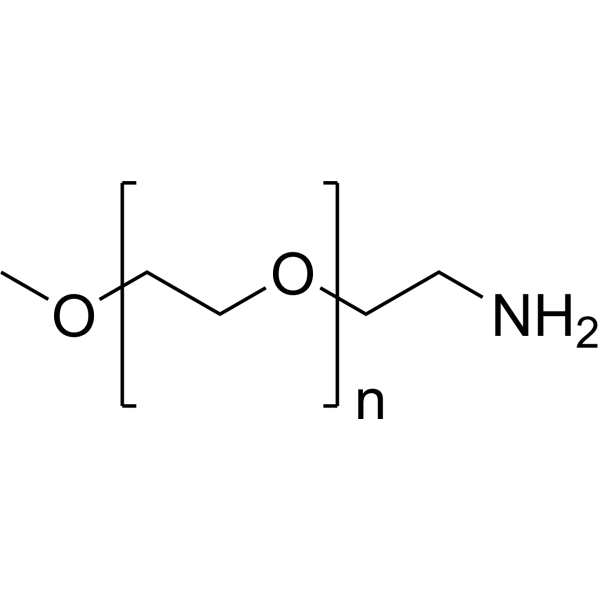
mPEG750-amine (mPEG750-NH2) is a chemical modification reagent for nanoparticles, capable of covalently binding to Ad-PVA to form Ad-PVA-PEG polymers. mPEG750-amine stabilizes gene delivery complexes by providing steric hindrance, reducing particle aggregation, while enhancing the water solubility and serum stability of the complex, reducing carrier cytotoxicity, and assisting in the efficient condensation of pDNA by cationic components to form nanoparticles that can be endocytosed by cells. mPEG750-amine can also be used to synthesize folate-conjugated polymer micelles for encapsulating the anticancer agent Camptothecin (HY-16560). Folate-conjugated polymer micelles are effective carriers for poorly soluble anticancer drugs, capable of avoiding macrophages and acting through folate receptor (FR)-mediated endocytosis to target tumor cells. mPEG750-amine can be applied to research in the field of non-viral gene delivery, as a component of gene delivery vectors, facilitating the safe and efficient delivery of nucleic acid drugs to target cells .
loading...
    loading...
Cat. No.: HY-124940
CAS No.: 446877-42-5
Research Areas:  

Cardiovascular Disease

CPU-228 is a complex class III antiarrhythmic agent. CPU-228 concentration-dependently blocks the activities of the rapid component 50 of the delayed rectifier potassium channel (IKr) and the L-type calcium channel (ICa,L), with an IC50 value of 0.909 μM for ICa,L current. CPU-228 produces negative inotropic effects and induces mild, non-frequency-dependent prolongation of the effective refractory period (ERP) in isolated left atria. CPU-228 reduces the incidence of torsades de pointes (TDP) in anesthetized rabbits and inhibits ischemia/reperfusion-induced arrhythmias in rats. CPU-228 can be used in studies related to torsades de pointes .
loading...
    loading...
Cat. No.: HY-183080
CAS No.: 2872654-37-8
Research Areas:  

Infection

VNRX-14079 is an antibacterial agent and PBP2 inhibitor, with an IC50 value of 1.7 μM against wild-type Neisseria gonorrhoeae PBP2. VNRX-14079 forms a covalent bond with Ser310 of PBP2, interacts with multiple residues of PBP2 to stabilize the complex, and induces an inward conformational change of the β34 loop in chimeric PBP2. VNRX-14079 exhibits antibacterial activity against Ceftriaxone (HY-B0712)-resistant Neisseria gonorrhoeae strains. VNRX-14079 can be used in the research of gonorrhea .
loading...
    loading...
Cat. No.: HY-20559
CAS No.: 96-99-1
4-Chloro-3-nitrobenzoic acid is a benzoic acid derivative and an important intermediate for the synthesis of anticancer agents. 4-Chloro-3-nitrobenzoic acid shows low cytotoxicity against HepG2, A549 and HeLa cancer cells in vitro (>10,000 μM). 4-Chloro-3-nitrobenzoic acid can block thymidine uptake and inhibit lymphocyte growth. 4-Chloro-3-nitrobenzoic acid serves as a ligand for Cu (II) complexes and is used in the preparation of 10H-pyrazino[2,3-b][1,4]benzothiazine derivatives .
loading...
    loading...

