250 Results for "

complex II

" in MedChemExpress (MCE) Product Catalog:
Products (250)

250 Results for "complex II" in MCE Product Catalog:

Cat. No.: HY-P72931
Purity:  ≥ 95%, as determined by Bis-Tris PAGE.
Synonyms: CD74; Ia-Associated Invariant Chain; Prev. DHLAG; HLA-DR-Gamma; CLIP; Ia Antigen-Associated Invariant Chain; CD74 Antigen (Invariant Polypeptide Of Major Histocompatibility complex, Class II Antigen-Associated); CD74 Antigen; CD74 Molecule, Major Histocom
Species:  
Human
Source:  
HEK293
loading...
    loading...
Cat. No.: HY-P705402
Purity:  ≥ 95%, as determined by reducing SDS-PAGE.
Synonyms: CD74; Ia-Associated Invariant Chain; Prev. DHLAG; HLA-DR-Gamma; CLIP; Ia Antigen-Associated Invariant Chain; CD74 Antigen (Invariant Polypeptide Of Major Histocompatibility complex, Class II Antigen-Associated); CD74 Antigen; CD74 Molecule, Major Histocom
Species:  
Human
Source:  
HEK293
loading...
    loading...
Cat. No.: HY-134813A
Target:  

Ras

Research Areas:  

Cancer

MRTX1133 formic is a noncovalent, potent, and selective KRAS G12D inhibitor. MRTX1133 formic optimally fills the switch II pocket and extends three substituents to favorably interact with the protein, resulting in an estimated KD against KRAS G12D of 0.2 pM. MRTX1133 formic prevents SOS1-catalyzed nucleotide exchange and/or formation of the KRASG12D/GTP/RAF1 complex, thereby inhibiting mutant KRAS-dependent signal transduction. MRTX1133 formic shows efficacy in tumor models harboring KRAS G12D mutations .
loading...
    loading...
Cat. No.: HY-20559
CAS No.: 96-99-1
4-Chloro-3-nitrobenzoic acid is a benzoic acid derivative and an important intermediate for the synthesis of anticancer agents. 4-Chloro-3-nitrobenzoic acid shows low cytotoxicity against HepG2, A549 and HeLa cancer cells in vitro (>10,000 μM). 4-Chloro-3-nitrobenzoic acid can block thymidine uptake and inhibit lymphocyte growth. 4-Chloro-3-nitrobenzoic acid serves as a ligand for Cu (II) complexes and is used in the preparation of 10H-pyrazino[2,3-b][1,4]benzothiazine derivatives .
loading...
    loading...
Cat. No.: HY-P11933
Research Areas:  

Others

FAHF is a polypeptide-based dual-signal fluorescent colorimetric probe synthesized by conjugating the 5-carboxyfluorescein (5-FAM) (HY-66022) fluorophore to the Ala-His-Phe-NH2 tripeptide backbone. FAHF achieves highly selective recognition of Cu 2+ via fluorescence quenching and colorimetric change. The FAHF-Cu 2+ complex responds to Glyphosate (HY-B0863) based on the displacement effect, resulting in fluorescence enhancement and a visually distinguishable color change. FAHF can penetrate cell membranes to enable cascade detection of copper (II) and glyphosate in living cells, and it can also be combined with smartphone RGB analysis for semi-quantitative identification .
loading...
    loading...
Cat. No.: HY-177786
CAS No.: 3093763-27-7
Target:  

Molecular Glues CDK

Research Areas:  

Cancer

CDK12 ligand-3 is a monovalent CDK12/13 and cyclin K molecular glue degrader. CDK12 ligand-3 recruits DDB1, a core component of CUL4-based E3 ubiquitin ligase complexes, to drive ubiquitination and degradation of its targets .
loading...
    loading...
Cat. No.: HY-179392
Research Areas:  

Cancer

Sunitinib-platinum(IV) prodrug-1 (Complex A) is a Pt(IV) prodrug based on Cisplatin (HY-17394), and this design aims to enable Pt(IV) to be reduced to active Pt(II) under intracellular reducing conditions, while simultaneously releasing a derivative of Sunitinib (HY-10255A) with tyrosine kinase inhibitor (TKI) activity. Sunitinib-platinum(IV) prodrug-1 exhibits excellent cytotoxicity against renal cell carcinoma (RCC), causing DNA crosslinking and apoptosis. Sunitinib-platinum(IV) prodrug-1 inhibits the VEGFR/PDGFR signaling pathway, suppressing tumor growth and angiogenesis. Sunitinib-platinum(IV) prodrug-1 can be used for research on renal cell carcinoma .
loading...
    loading...
Cat. No.: HY-P72710
Purity:  ≥ 95%, as determined by reducing SDS-PAGE.
Synonyms: CD74; Ia-Associated Invariant Chain; Prev. DHLAG; HLA-DR-Gamma; CLIP; Ia Antigen-Associated Invariant Chain; CD74 Antigen (Invariant Polypeptide Of Major Histocompatibility complex, Class II Antigen-Associated); CD74 Antigen; CD74 Molecule, Major Histocom
Species:  
Mouse
Source:  
HEK293
loading...
    loading...
Cat. No.: HY-P78262
Purity:  ≥ 95%, as determined by Bis-Tris PAGE.
Synonyms: CD74; Ia-Associated Invariant Chain; Prev. DHLAG; HLA-DR-Gamma; CLIP; Ia Antigen-Associated Invariant Chain; CD74 Antigen (Invariant Polypeptide Of Major Histocompatibility complex, Class II Antigen-Associated); CD74 Antigen; CD74 Molecule, Major Histocom
Species:  
Mouse
Source:  
HEK293
loading...
    loading...
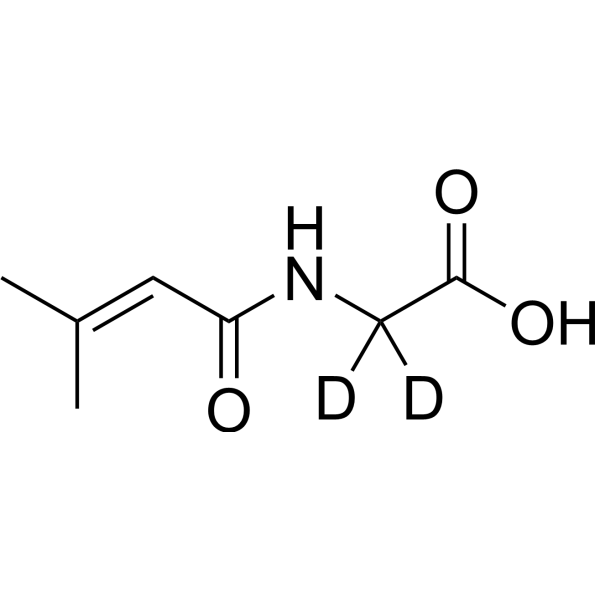
Cat. No.: HY-113232S
CAS No.: 1276197-31-9
3-Methylcrotonylglycine-d2 is the deuterated-labeled 3-Methylcrotonylglycine (HY-113232). 3-Methylcrotonylglycine is an organic acid conjugate associated with leucine catabolism that inhibits respiratory chain complex II-III, mitochondrial creatine kinase, and synaptic membrane Na +, K +-ATPase. 3-Methylcrotonylglycine increases reactive oxygen species levels to mediate oxidative damage, while inhibiting mitochondrial electron transport, reducing tricarboxylic acid cycle flux, and interfering with intracellular energy transport and neuronal ion homeostasis. 3-Methylcrotonylglycine is a neurotoxic metabolite that accumulates in the metabolic pathway of 3-methylcrotonyl-CoA carboxylase deficiency. 3-Methylcrotonylglycine can be used in studies related to 3-methylcrotonyl-CoA carboxylase deficiency .
loading...
    loading...
Cat. No.: HY-113553
CAS No.: 102185-28-4
Synonyms: (p-Aminophenyl)phosphocholine; p-Aminophenylphosphorylcholine; 4-APPC
Research Areas:  

Others

4-Aminophenylphosphorylcholine ((p-Aminophenyl) phosphocholine; p-Aminophenylphosphorylcholine; 4-APPC) is a phosphatidylcholine derivative that serves as a coupling ligand and antigen probe. When conjugated with gold nanoclusters, the phosphocholine head epitope of 4-Aminophenylphosphorylcholine is specifically recognized by anti-Pc IgM and CRP. It can be covalently coupled to human serum albumin (HSA) or glutathione-protected gold nanoclusters (Au-GSH) via covalent chemistry, respectively. The 4-Aminophenylphosphorylcholine-HSA complex acts as an ELISA coating antigen for detecting endogenous anti-Pc IgM antibodies in plasma; 4-Aminophenylphosphorylcholine-modified Au-GSH can be used to construct an ultra-stealthy NIR-II fluorescent gold nanocluster probe for imaging-related studies in mouse breast cancer and colon cancer models .
loading...
    loading...
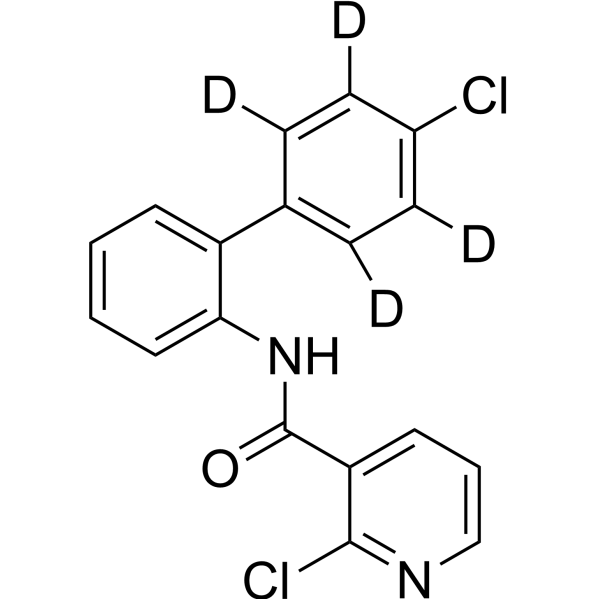
Cat. No.: HY-119976S
CAS No.: 2468796-76-9
Boscalid-d4 is the deuterium labeled Boscalid. Boscalid is a succinate dehydrogenase (SDHI) inhibitor with antifungal activity. Boscalid binds to the ubiquinone-binding site of fungal mitochondrial complex II, blocks ATP production and aerobic respiration, exhibits good control efficacy against a variety of plant fungal diseases including gray mold, sclerotinia rot and powdery mildew, and is widely used for disease control in agriculture. Boscalid induces apoptosis, altered lipid metabolism, mitochondrial dysfunction, respiratory impairment, oxidative stress, ROS accumulation and neurodevelopmental disorders in zebrafish. Boscalid reduces foraging ability, shortens median death time and causes chronic toxicity in exposed honeybees. Boscalid also possesses genotoxicity, cytotoxicity, elevated mitochondrial superoxide levels and early-stage apoptosis .
loading...
    loading...
Cat. No.: HY-183549
Target:  

Apoptosis Ferroptosis

Research Areas:  

Cancer

Ferroptosis/apoptosis inducer-4 is a pyridine-hydrazone-derived Cu (II) complex and a synergistic inducer of ferroptosis and apoptosis. Ferroptosis/apoptosis inducer-4 exerts anti-tumor proliferation and anti-metastasis effects with extremely low systemic toxicity. Ferroptosis/apoptosis inducer-4 disrupts cellular redox homeostasis by depleting glutathione and generating hydroxyl radicals through the Cu 2+/Cu + redox cycle. Ferroptosis/apoptosis inducer-4 also triggers mitochondrial dysfunction and endoplasmic reticulum stress, which in turn lead to Ca 2+ release, mitochondrial Ca 2+ overload, and the formation of a ROS−Ca 2+ self-amplifying feedback loop. Ferroptosis/apoptosis inducer-4 can be used in studies related to cervical cancer .
loading...
    loading...
Cat. No.: HY-187173
Target:  

Carbonic Anhydrase

Research Areas:  

Cancer

CAXII-IN-4 is a human carbonic anhydrase XII (hCA XII) inhibitor with Ki values of 4.9, 3079, 62.5 and 58.4 nM against hCA XII, hCA I, hCA II and hCA IX, respectively, showing high selectivity toward tumor-associated hCA XII. CAXII-IN-4 binds to the active site of hCA XII via a classic sulfamide binding mode, coordinates with Zn 2+, forms a hydrogen bond with Ser133, and stabilizes the enzyme complex to reduce structural deviation. CAXII-IN-4 possesses both lipophilicity and polarity, and is predicted to have superior membrane permeability and oral absorbability. CAXII-IN-4 can be used in studies related to tumor-associated carbonic anhydrase inhibition .
loading...
    loading...
Cat. No.: HY-189061
Research Areas:  

Infection

Topoisomerase IN-7 is a bacterial topoisomerase inhibitor, with an IC50 value of 47 nM against Staphylococcus aureus DNA gyrase, 85 nM against Escherichia coli DNA gyrase, and 1 nM against Escherichia coli topoisomerase IV. Topoisomerase IN-7 inhibits the supercoiling activity of DNA gyrase, suppresses the relaxation activity of topoisomerase IV, stabilizes single-stranded DNA cleavage complexes, inhibits biofilm formation of specific bacteria, stimulates biofilm formation of methicillin-resistant Staphylococcus aureus, and exhibits bactericidal activity. Topoisomerase IN-7 is selective for bacterial topoisomerases over human topoisomerase IIα, shows moderate cytotoxicity, and inhibits the hERG potassium channel. Topoisomerase IN-7 can be used in studies of bacterial infections .
loading...
    loading...
Cat. No.: HY-19230
CAS No.: 179185-73-0
DY-9760e is a calmodulin (CaM) inhibitor. DY-9760e selectively inhibits the activity of various calmodulin-dependent enzymes by antagonizing the Ca²⁺/CaM complex, exhibiting the strongest inhibitory activity against nNOS, CaM kinase II, and calcineurin (Ki: 0.9, 1.4, and 2.0 μM, respectively). DY-9760e inhibits excessive nitric oxide production and protein tyrosine nitration, as well as the activation of calpain and caspase-3. DY-9760e reduces infarct size, improves cardiac function, and inhibits oxidative stress and cell death. DY-9760e can be used in research on the treatment of myocardial infarction, cerebral ischemia, and other diseases .
loading...
    loading...
Cat. No.: HY-P812030
Synonyms: MED27; Mediator complex Subunit 27; CRSP34; TRAP37; CRSP8; MED3; Cofactor Required For Sp1 Transcriptional Activation, Subunit 8, 34kDa; Mediator Of RNA Polymerase II Transcription Subunit 27; Transcriptional Coactivator CRSP34; P37 TRAP/SMCC/PC2 Subunit; CRSP complex Subunit 8; Cofactor Required For Sp1 Transcriptional Activation Subunit 8; Epididymis Secretory Sperm Binding Protein; NEDSCAC; CRAP34

Host:  

Mouse

Application:  

WB

Reactivity:  

Human, Mouse, Rat

loading...
    loading...
Cat. No.: HY-P704265
Purity:  ≥ 95%, as determined by reducing SDS-PAGE.
Synonyms: FCGRT; Major Histocompatibility complex Class I-Like Fc Receptor; Fc Gamma Receptor And Transporter; Neonatal Crystallizable Fc Receptor FcRn Splice Variant 6; Neonatal Fc Receptor; Neonatal Crystallizable Fc Receptor FcRn Splice Variant 5; FcRn; Neonatal
Species:  
Cynomolgus
Source:  
HEK293
loading...
    loading...
Cat. No.: HY-P704603
Purity:  ≥ 95%, as determined by reducing SDS-PAGE.
Synonyms: FCGRT; Major Histocompatibility complex Class I-Like Fc Receptor; Fc Gamma Receptor And Transporter; Neonatal Crystallizable Fc Receptor FcRn Splice Variant 6; Neonatal Fc Receptor; Neonatal Crystallizable Fc Receptor FcRn Splice Variant 5; FcRn; Neonatal
Species:  
Human
Source:  
HEK293
loading...
    loading...
Cat. No.: HY-P704604
Purity:  ≥ 95%, as determined by reducing SDS-PAGE.
Synonyms: FCGRT; Major Histocompatibility complex Class I-Like Fc Receptor; Fc Gamma Receptor And Transporter; Neonatal Crystallizable Fc Receptor FcRn Splice Variant 6; Neonatal Fc Receptor; Neonatal Crystallizable Fc Receptor FcRn Splice Variant 5; FcRn; Neonatal
Species:  
Rat
Source:  
HEK293
loading...
    loading...

