208 Results for "

topically

" in MedChemExpress (MCE) Product Catalog:
Products (208)

208 Results for "topically" in MCE Product Catalog:

Cat. No.: HY-170448
PROTAC AR Degrader-9 is a topically applicable androgen receptor (AR) PROTAC degrader. PROTAC AR Degrader-9 recruits Cereblon (CRBN) E3 ubiquitin ligase to induce AR ubiquitination and proteasomal degradation in human dermal papilla cells (HDPCs) with a DC50 of 262.38 nM. PROTAC AR Degrader-9 possesses excellent skin retention, modulates androgenetic alopecia (AGA)-related downstream paracrine factors including TGF-β1 and β-catenin, promotes hair regeneration in mice. and exhibits favorable skin pharmacokinetics profiles with minimal systemic exposure. PROTAC AR Degrader-9 can be used for the study of androgenetic alopecia (AGA) .
loading...
    loading...
Cat. No.: HY-17357
CAS No.: 78281-72-8
Synonyms: AHR 9434; AL 6515
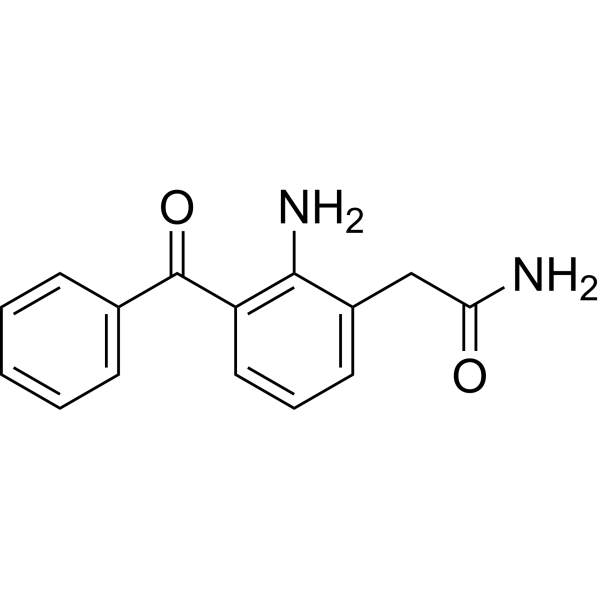
Nepafenac (AHR 9434; AL 6515), a nonsteroidal anti-inflammatory agent, is a topically administered COX-2 inhibitor with an IC50 of 0.12 μM. Nepafenac exhibits only weak COX-1 inhibitory activity (IC50 = 64.3 μM). Nepafenac possesses unique prodrug properties, which enable it to rapidly convert into the active metabolite Amfenac (HY-17479) in the ocular tissues, thereby achieving high concentrations in the retina and choroid. Nepafenac reduces inflammation and pain by inhibiting the activity of cyclooxygenase (COX) enzymes and thereby decreasing the production of prostaglandin PGE₂. Nepafenac can delay the metastasis of uveal melanoma (UM) in rabbit eyes. Nepafenac is mainly used for pain management and inflammation control after ophthalmic surgeries .
loading...
    loading...
Cat. No.: HY-183326
CAS No.: 2013542-44-2
Synonyms: IDMF
Target:  

Keap1-Nrf2

Research Areas:  

Inflammation/Immunology

Isosorbide di-(methyl fumarate) (IDMF), topical DMF (HY-17363) derivative, is an NRF2/ARE pathway activator. Isosorbide di-(methyl fumarate) downregulates ANCR targets, modulates epithelial differentiation, represses proinflammatory cytokine genes, IL-17A- and TNF-induced keratinocyte genes, psoriatic skin lesion-specific genes, and immune response genes. Isosorbide di-(methyl fumarate) stimulates oxidative stress response gene transcription, reduces erythema and scaling in Imiquimod (HY-B0180)-induced psoriasiform lesions. Isosorbide di-(methyl fumarate) exhibits no genotoxicity or radiation sensitivity in skin fibroblasts, is nonirritating and nonsensitizing in rodent models. Isosorbide di-(methyl fumarate) can be used for the research of psoriasis vulgaris .
loading...
    loading...
Cat. No.: HY-N3387
CAS No.: 30508-27-1
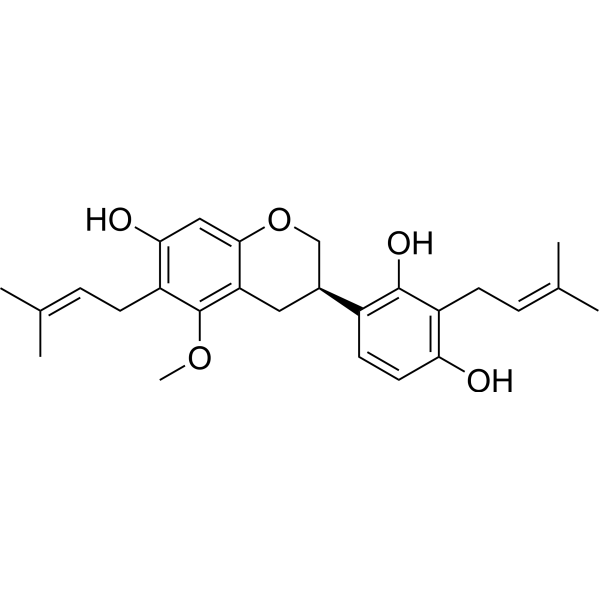
Licoricidin (LCD) is isolated from Glycyrrhiza uralensis Fisch, possesses anti-cancer activities. Licoricidin (LCD) inhibit SW480 cells (IC50=7.2 μM) by inducing cycle arrest, apoptosis and autophagy, and is a potential chemopreventive or chemotherapeutic agent against colorectal cancer . Licoricidin (LCD) inhibits Lung Metastasis by inhibition of tumor angiogenesis and lymphangiogenesis as well as changes in the local microenvironment of tumor tissues the anticarcinogenic effect . Licoricidin enhanced gemcitabine-induced cytotoxicity in Osteosarcoma (OS) cells by inactivation of the Akt and NF-κB pathways in vitro and in vivo . Licoricidin blocks UVA-induced photoaging via ROS scavenging, limits the activity of MMP-1, it can be considered as an active ingredient in new topically applied anti-ageing formulations .
loading...
    loading...
Cat. No.: HY-130349
CAS No.: 121124-29-6
Synonyms: L-656,748
Target:  

GABA Receptor

Research Areas:  

Infection

Emamectin B1a (L-656,748) is a semisynthetic derivative of avermectin B1a that binds to GABA receptors (Ki=17.6 nM in rat brain membranes) and enhances GABA responses. Emamectin B1a acitivates GABAA receptors α1β1γ2, α1β2γ2, and α1β3γ2 with IC50s of 57, 210, and 49.8 nM, respectively. Emamectin B1a also binds to glycine receptors, inhibiting glycine receptors with an IC50=218 nM in rat spinal cord. Emamectin B1a (1.067 ng/mL) caused 90% mortality of S. exigua larvae in foliar spray bioassays and topical application, making it more toxic than avermectin B1.
loading...
    loading...
Cat. No.: HY-17357R
CAS No.: 78281-72-8
Synonyms: AHR 9434 (Standard); AL 6515 (Standard)
Nepafenac (AHR 9434; AL 6515) (Standard) is the analytical standard of Nepafenac (HY-17357). This product is intended for research and analytical applications. Nepafenac, a nonsteroidal anti-inflammatory agent, is a topically administered COX-2 inhibitor with an IC50 of 0.12 μM. Nepafenac exhibits only weak COX-1 inhibitory activity (IC50 = 64.3 μM). Nepafenac possesses unique prodrug properties, which enable it to rapidly convert into the active metabolite Amfenac (HY-17479) in the ocular tissues, thereby achieving high concentrations in the retina and choroid. Nepafenac reduces inflammation and pain by inhibiting the activity of cyclooxygenase (COX) enzymes and thereby decreasing the production of prostaglandin PGE₂. Nepafenac can delay the metastasis of uveal melanoma (UM) in rabbit eyes. Nepafenac is mainly used for pain management and inflammation control after ophthalmic surgeries.
loading...
    loading...
Cat. No.: HY-17357S
CAS No.: 1246814-53-8
Synonyms: AHR-9434-d5; AL-6515-d5
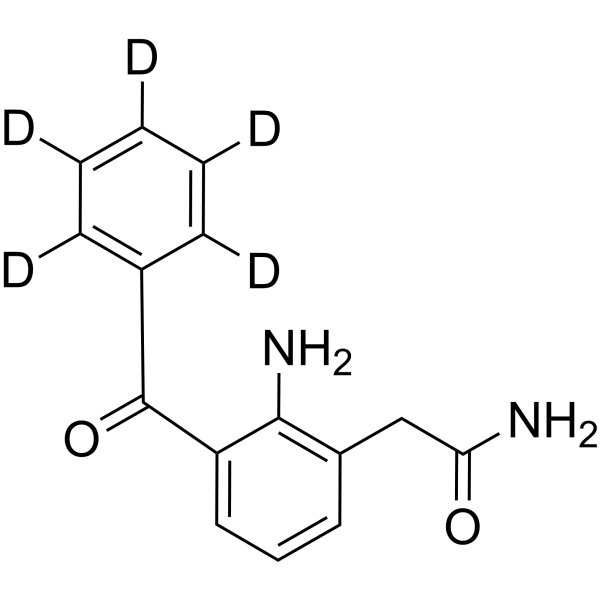
Nepafenac-d5 (AHR-9434-d5; AL-6515-d5) is the deuterium labeled Nepafenac (HY-17357). Nepafenac, a nonsteroidal anti-inflammatory agent, is a topically administered COX-2 inhibitor with an IC50 of 0.12 μM. Nepafenac exhibits only weak COX-1 inhibitory activity (IC50 = 64.3 μM). Nepafenac possesses unique prodrug properties, which enable it to rapidly convert into the active metabolite Amfenac (HY-17479) in the ocular tissues, thereby achieving high concentrations in the retina and choroid. Nepafenac reduces inflammation and pain by inhibiting the activity of cyclooxygenase (COX) enzymes and thereby decreasing the production of prostaglandin PGE₂. Nepafenac can delay the metastasis of uveal melanoma (UM) in rabbit eyes. Nepafenac is mainly used for pain management and inflammation control after ophthalmic surgeries.
loading...
    loading...
Cat. No.: HY-189218
AhR/PDE4 modulator-1 is a AhR/PDE4D dual-target modulator, with an AhR agonistic EC50 of 0.11 μM and a PDE4D inhibitory IC50 of 2.12 μM. AhR/PDE4 modulator-1 activates the AhR-CYP1A1 signaling pathway, promotes AhR nuclear translocation, and upregulates downstream CYP1A1; it inhibits PDE4D activity, elevates intracellular cAMP levels, and activates the downstream cAMP-PKA-CREB signaling pathway. Topical administration of AhR/PDE4 modulator-1 exerts anti-inflammatory effects in the Imiquimod (HY-B0180)-induced psoriasis-like mouse model, alleviates epidermal hyperplasia and inflammatory infiltration, and suppresses the expression of IL-17A/F. AhR/PDE4 modulator-1 can be used in research related to psoriasis .
loading...
    loading...

