
322 Results for "

linear

" in MedChemExpress (MCE) Product Catalog:
Products (322)

322 Results for "linear" in MCE Product Catalog:

Cat. No.: HY-W1048545E
Synonyms: Amine-PEG20000-Thiol hydrochloride
H2N-PEG20000-SH (Amine-PEG20000-Thiol) hydrochloride is a linear heterobifunctional PEGylated product containing thiol and amine. H2N-PEG20000-SH hydrochloride is an important cross-linking or bioconjugation reagent with PEG chains. Thiol or SH, sulfhydryl or thiol selectively reacts with maleimide, OPSS, vinyl sulfone and transition metal surfaces (including gold, silver, etc.) .
loading...
    loading...
Cat. No.: HY-W1048545H
Synonyms: Amine-PEG1000-Thiol hydrochloride
H2N-PEG1000-SH (Amine-PEG1000-Thiol) hydrochloride is a linear heterobifunctional PEGylated product containing thiol and amine. H2N-PEG1000-SH hydrochloride is an important cross-linking or bioconjugation reagent with PEG chains. Thiol or SH, sulfhydryl or thiol selectively reacts with maleimide, OPSS, vinyl sulfone and transition metal surfaces (including gold, silver, etc.) .
loading...
    loading...
Cat. No.: HY-W1048545I
Synonyms: Amine-PEG3400-Thiol hydrochloride
H2N-PEG3400-SH (Amine-PEG3400-Thiol) hydrochloride is a linear heterobifunctional PEGylated product containing thiol and amine. H2N-PEG3400-SH hydrochloride is an important cross-linking or bioconjugation reagent with PEG chains. Thiol or SH, sulfhydryl or thiol selectively reacts with maleimide, OPSS, vinyl sulfone and transition metal surfaces (including gold, silver, etc.) .
loading...
    loading...
Cat. No.: HY-W1048545J
Synonyms: Amine-PEG40000-Thiol hydrochloride
H2N-PEG40000-SH (Amine-PEG40000-Thiol) hydrochloride is a linear heterobifunctional PEGylated product containing thiol and amine. H2N-PEG40000-SH hydrochloride is an important cross-linking or bioconjugation reagent with PEG chains. Thiol or SH, sulfhydryl or thiol selectively reacts with maleimide, OPSS, vinyl sulfone and transition metal surfaces (including gold, silver, etc.) .
loading...
    loading...
Cat. No.: HY-W145522
CAS No.: 9057-02-7
Pullulan (Pullulan standard 5800) (Mw 362-480 kDa; Mn 100-200 kDa) is a class of orally active and water-soluble linear glucosic polysaccharide. Pullulan can be isolated from the polymorphic fungus Aureobasidium pullulans. Pullulan is composed of maltotriose repeating units linked by α-1,6 linkages and is an amorphous slime matter. Pullulan is widely used in food, environment, pharmaceutical, manufacturing, and electronics .
loading...
    loading...
Cat. No.: HY-Y1703
CAS No.: 148893-10-1
Research Areas:  

Others

HATU is a third-generation uronium salt peptide coupling reagent. HATU increases the rate of peptide coupling reactions, activates amino acids, promotes peptide bond formation in both solution-phase and solid-phase synthesis, and also facilitates peptide assembly, fragment coupling, and linear peptide cyclization. HATU can promote the N-acylation of chitosan to generate amide-linked cationic derivatives with a controllable degree of substitution. HATU is commonly used in amine acylation reactions .
loading...
    loading...
Cat. No.: HY-15582S
Auristatin E-d8 is the deuterium labeled Auristatin E (HY-15582). Auristatin E is a cytotoxic microtubule polymerization inhibitor with potent and selective antitumor activity. Auristatin E is a cytotoxin in antibody-drug conjugates (ADC). Auristatin E inhibits cell division by blocking the polymerisation of tubulin, promising for research in B-cell malignancies. Auristatin E, a synthetic analogue of the Dolastatin 10 (HY-15580), is linear peptides comprised of four amino acids .
loading...
    loading...
Cat. No.: HY-P0248F1
Research Areas:  

Others

Kemptide-FITC is a fluorescently labeled Kemptide (HY-P0248). Kemptide is a synthetic heptapeptide that acts as a specific substrate for cAMP-dependent protein kinase (PKA). Kemptide-FITC enables the quantification of PKA activity and can also indirectly determine cAMP concentrations through the activation of PKA in sperm insoluble fractions. Kemptide-FITC is applicable for kinase mobility shift assay (KiMSA), and its fluorescent signal shows a linear response with increasing peptide amount within a specific range on agarose gels .
loading...
    loading...
Cat. No.: HY-P11813
CAS No.: 160662-30-6
Target:  

Neurotensin Receptor

Research Areas:  

Neurological Disease

Cyclo (Arg-Lys-Pro-Tyr-Tle-Leu) is a cyclic peptide. Cyclo (Arg-Lys-Pro-Tyr-Tle-Leu) shows extremely low affinity for rat NTS1 expressed in cells (pKi < 4), whereas its semi-purified sample (Batch 2) exhibits moderate affinity for NTS1 (pKi = 5.83), a phenomenon attributed to contamination by an active linear peptide variant. Cyclo (Arg-Lys-Pro-Tyr-Tle-Leu) can be used in research on neurological diseases .
loading...
    loading...
Cat. No.: HY-P12210
CAS No.: 1001644-68-3
Research Areas:  

Infection

Antimicrobial peptide BP100 is a linear undecapeptide with an amphipathic α-helical structure that exhibits antibacterial activity. Antimicrobial peptide BP100 shows in vitro antibacterial activity against a variety of plant and human pathogens. Antimicrobial peptide BP100 binds to and inserts into bacterial cell membranes through electrostatic attraction, triggering membrane permeabilization and ultimately leading to membrane disruption. Antimicrobial peptide BP100 can be used for research on bacterial infections .
loading...
    loading...
Cat. No.: HY-W010922
CAS No.: 162558-25-0
Research Areas:  

Others

Fmoc-Dap (Boc)-OH is an amino acid derivative bearing the Fmoc protecting group. Fmoc-Dap (Boc)-OH supports Fmoc-based solid-phase peptide synthesis for the preparation of bicyclic tachykinin NK2 receptor antagonists .
loading...
    loading...
Cat. No.: HY-117387
CAS No.: 107572-73-6
Target:  

Endogenous Metabolite

Research Areas:  

Infection

BFE-37 is a yeast introduction with heat resistance activity. The survival rate change of BFE-37 after heating at 55 °C for 5 minutes was 6.53 log CFU/mL, showing its strong heat resistance in acidic orange juice. The dynamic behavior of BFE-37 at different temperatures showed a first-order logarithmic linear inactivation characteristic, which indicates its stability in heat treatment. The study of BFE-37 helps to understand the effect of mild heat treatment on juice and provide guidance for microbial control in the food industry .
loading...
    loading...
Cat. No.: HY-17466R
CAS No.: 808-26-4
Synonyms: Bonomycin (Standard); 6-Demethyl-6-deoxytetracycline (Standard)
Sancycline (Standard) is the analytical standard of Sancycline. This product is intended for research and analytical applications. Sancycline (6-Demethyl-6-deoxytetracycline) acts by reversibly binding to the 30 S ribosomal subunit and inhibiting protein translation by blocking entry of aminoacyl-tRNA into the ribosome a site similar to tetracycline (HY-A0107). Sancycline, four linearly fused six-membered rings with four stereocenters, is a rare semi-synthetic tetracycline (HY-A0107) prepared by hydrogenolysis of the chloro and benzylic hydroxy moieties of Declomycin[1][2][3].
loading...
    loading...
Cat. No.: HY-W008598
CAS No.: 403-29-2
Synonyms: p-Fluorophenacyl bromide
Target:  

DNA/RNA Synthesis

Research Areas:  

Cancer

2-Bromo-4'-fluoroacetophenone (p-Fluorophenacyl bromide) is a photoinducible DNA cleavage inducer.2-Bromo-4'-fluoroacetophenone generates fluorine-substituted phenyl radicals upon excitation and irradiation to cleave DNA, converting circular supercoiled DNA to circular relaxed and linear DNA forms.2-Bromo-4'-fluoroacetophenone exhibits concentration-dependent DNA cleaving activity.2-Bromo-4'-fluoroacetophenone can be used for the research of cancer .
loading...
    loading...
Cat. No.: HY-W099504
CAS No.: 111-70-6
Synonyms: n-Heptyl alcohol
1-Heptanol (n-Heptyl alcohol) is a linear primary fatty alcohol. 1-Heptanol selectively inhibits the activating phosphorylation of SAPK/JNK and reduces the phosphorylation level of IκB-α. 1-Heptanol increases plasma membrane fluidity, decreases membrane thermal stability, alters the coupling kinetics of STIM1-ORAI1, inhibits the production of ROS and LTC4, and induces the expression of HSP70. 1-Heptanol is used in the fragrance industry due to its pleasant odor .
loading...
    loading...
Cat. No.: HY-W1150738
CAS No.: 2809367-71-1
DDO-6513 is a STING molecular glue inhibitor with an IC50 of 1.93 μM. DDO-6513 selectively targets human STING but not murine STING, and exhibits a Kd value of 151 nM for human STING. DDO-6513 induces aberrant head-to-head STING oligomerization and disrupts the formation of normal signal-competent linear STING polymers. DDO-6513 inhibits STING-dependent downstream activation of TBK1 and IRF3, and suppresses the expression of proinflammatory cytokines. DDO-6513 can be used for research on STING-related autoinflammatory diseases .
loading...
    loading...
Cat. No.: HY-Y0004
CAS No.: 586-98-1
Research Areas:  

Inflammation/Immunology

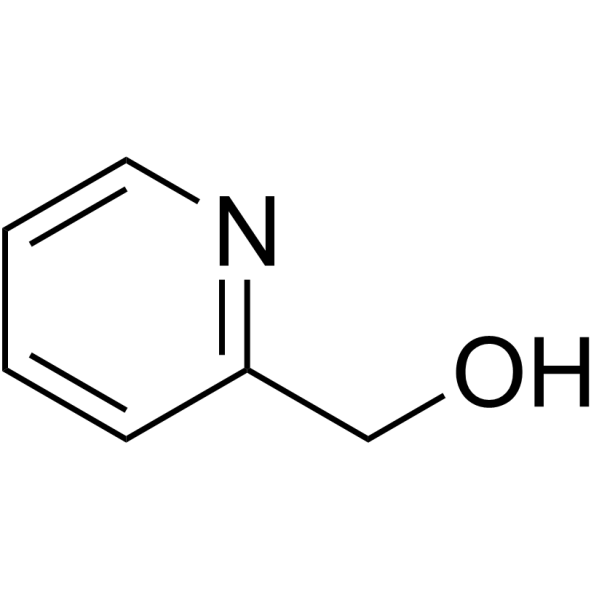
2-Pyridinemethanol acts as a chelating auxiliary, co-catalyst and ligand, with pH-dependent coordination capacity for Cu (II) ions. 2-Pyridinemethanol can be used in combination with Acetylcholine (HY-B0282) and Pyridostigmine (HY-B0207A) for research related to obstructive arthropathy .
loading...
    loading...
Cat. No.: HY-Y0004R
CAS No.: 586-98-1
2-Pyridinemethanol (Standard) is the analytical standard of 2-Pyridinemethanol (HY-Y0004). This product is intended for research and analytical applications. 2-Pyridinemethanol acts as a chelating auxiliary, co-catalyst and ligand, with pH-dependent coordination capacity for Cu (II) ions. 2-Pyridinemethanol can be used in combination with Acetylcholine (HY-B0282) and Pyridostigmine (HY-B0207A) for research related to obstructive arthropathy .
loading...
    loading...
Cat. No.: HY-151640
CAS No.: 1021422-85-4
Target:  

ADC Linkers

Research Areas:  

Others

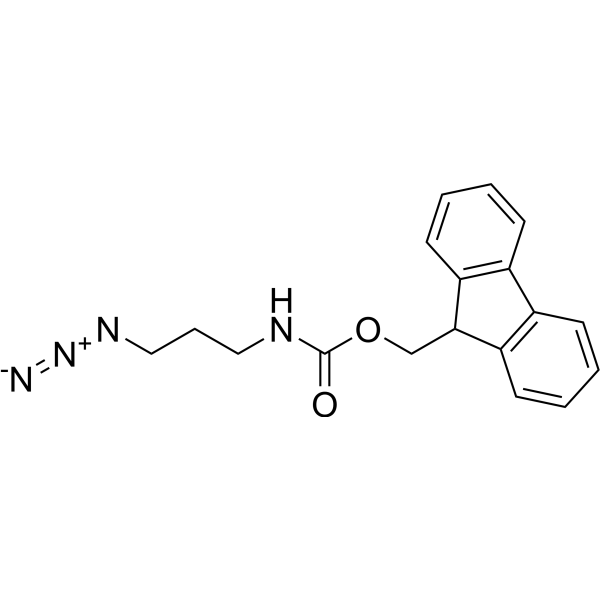
Fmoc-DAP-N3 is a click chemistry reagent containing an azide group. Fmoc-DAP-N3 is a short, linear spacer molecule with Fmoc protected amino function. Fmoc-DAP-N3 can be used in click conjugation and amid bond formation either with small molecules or for bioconjugation with proteins and antibodies . It contains an azide group and can undergo copper-catalyzed azide-alkyne cycloaddition (CuAAc) with molecules containing alkyne groups. It can also undergo ring strain-promoted alkyne-azide cycloaddition (SPAAC) with molecules containing DBCO or BCN groups.
loading...
    loading...
Cat. No.: HY-D3400
Research Areas:  

Infection

CouCyCF3 is a fluorescent probe for bacterial cytoplasmic pH, with a pKa of 7.0. CouCyCF3 can be taken up by both Gram-positive and Gram-negative bacteria. Under acidic conditions, the fluorescence of CouCyCF3 in the red channel increases, while its fluorescence in the blue channel increases with elevated pH. A linear quantitative response is achieved via the I_red/I_blue ratio within the pH range of 5.0-7.5, with excitation/emission wavelengths of 445/472 nm (blue) and 640/708 nm (red). CouCyCF3 can be used for studies on bacterial acid tolerance and phagolysosome acidification .
loading...
    loading...

