
35 Results for "

Autism Spectrum Disorder

" in MedChemExpress (MCE) Product Catalog:
Products (35)

35 Results for "Autism Spectrum Disorder" in MCE Product Catalog:

Cat. No.: HY-W001083S1
2-(3-Hydroxyphenyl-2,4,6-d3)acetic-2,2-d2 acid is the deuterium labeled 3-Hydroxyphenylacetic acid (HY-W001083). 3-Hydroxyphenylacetic acid is an orally active flavonoid metabolite produced by intestinal flora, with blood pressure-lowering activity. 3-Hydroxyphenylacetic acid can also inhibit ferroptosis by upregulating the expression of GPX4, thereby improving spermatogenic dysfunction in aged mice. In addition, abnormal levels of 3-Hydroxyphenylacetic acid are closely related to certain diseases, such as autism spectrum disorders.
loading...
    loading...
Cat. No.: HY-P1426
Target:  

Potassium Channel

Research Areas:  

Neurological Disease

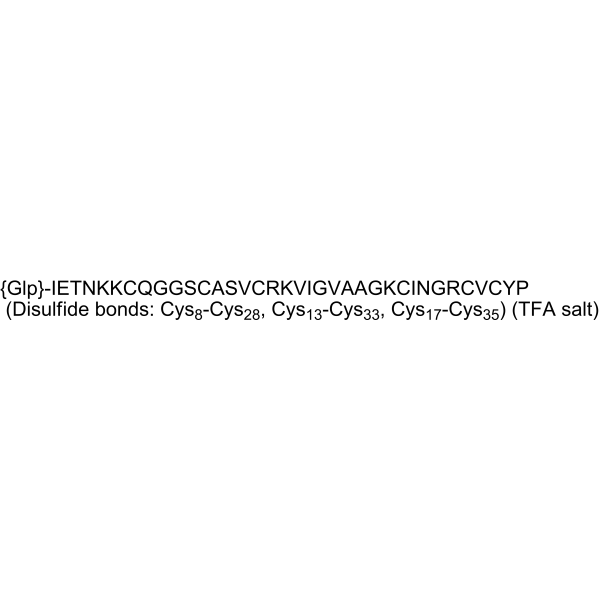
AmmTX3 is a peptide toxin identified from the venom of the scorpion Androctonus mauretanicus. AmmTX3 is a highly specific blocker of Kv4 channels, which selectively and almost completely blocks transient A-type K + currents with a Ki of 131 nM. AmmTX3 induces epileptiform behaviors and causes death in mice receiving intracerebroventricular injection. AmmTX3 increases the excitability of dentate gyrus granule cells, reduces GABAergic inhibition, enhances and stabilizes the EPSP-spike component of long-term potentiation, and impairs reference memory. AmmTX3 can be used in research related to pain, epilepsy, and autism spectrum disorder .
loading...
    loading...
Cat. No.: HY-W007894R
CAS No.: 595-46-0
Synonyms: Dimethylpropanedioic acid (Standard)
Dimethylmalonic acid (Standard) (Dimethylpropanedioic acid (Standard)) is the analytical standard of Dimethylmalonic acid (HY-W007894). This product is intended for research and analytical applications. Dimethylmalonic acid (Dimethylpropanedioic acid) is a succinate dehydrogenase inhibitor. Dimethylmalonic acid competitively inhibits succinate dehydrogenase, reduces SDH-mediated succinate accumulation, blocks a key step in oxidative phosphorylation, and decreases anti-inflammatory cytokine secretion and ROS production. Dimethylmalonic acid can be used in research on autism spectrum disorders .
loading...
    loading...
Cat. No.: HY-P10778
Research Areas:  

Neurological Disease

me4 Peptide is a synthetic peptide designed based on the microexon me4 sequence of neuronal CPEB4 protein. me4 Peptide inhibits CPEB4 aggregation. me4 Peptide can be used in the study of disorders associated with autism spectrum disorders .
loading...
    loading...
Cat. No.: HY-138830A
CAS No.: 1818253-48-3
Target:  

Histone Demethylase

Research Areas:  

Neurological Disease

(S,S)-TAK-418 is a potent inhibitor of lysine-specific demethylase 1 (LSD1), demonstrating significant normalization of aberrant gene expression in neurodevelopmental disorders. (S,S)-TAK-418 also ameliorates ASD-like behaviors in rodent models affected by maternal exposure to valproate or poly I:C. (S,S)-TAK-418 modulates gene expression differently across various models and ages, indicating its potential as a therapeutic agent for conditions like autism spectrum disorder and schizophrenia.
loading...
    loading...
Cat. No.: HY-163345
CAS No.: 1448808-50-1
Target:  

5-HT Receptor

Research Areas:  

Neurological Disease

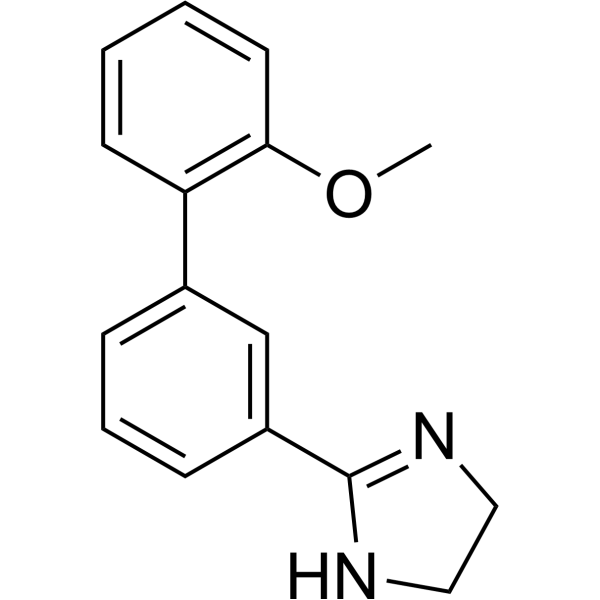
5-HT7R antagonist 2 (compound 4h) is a 5-HT7R antagonist that antagonizes the G protein and β-arrestin signaling pathways, with a Ki of 67 nM, the IC50 values in cAMP and Tango tests were 2.59 μM and 39.57 μM, respectively. 5-HT7R antagonist 2 has an effect on neurogenesis and can reduce repetitive behaviors related to autism spectrum disorder (ASD) and restore neurogenesis of ASD impairment .
loading...
    loading...
Cat. No.: HY-P1426A
Target:  

Potassium Channel

Research Areas:  

Neurological Disease

AmmTX3 TFA is a peptide toxin identified from the venom of the scorpion Androctonus mauretanicus. AmmTX3 TFA is a highly specific blocker of Kv4 channels, which selectively and almost completely blocks transient A-type K + currents with a Ki of 131 nM. AmmTX3 TFA induces epileptiform behaviors and causes death in mice receiving intracerebroventricular injection. AmmTX3 TFA increases the excitability of dentate gyrus granule cells, reduces GABAergic inhibition, enhances and stabilizes the EPSP-spike component of long-term potentiation, and impairs reference memory. AmmTX3 TFA can be used in research related to pain, epilepsy, and autism spectrum disorder .
loading...
    loading...
Cat. No.: HY-N4309A
CAS No.: 3721-76-4
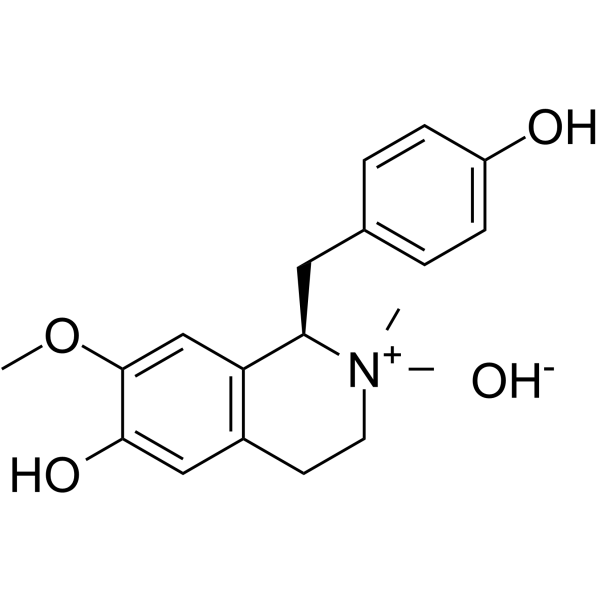
Lotusine hydroxide is an orally active signaling pathway modulator and enzyme inhibitor, with an IC50 of 30.60 μg/mL against α-amylase and an IC50 of 36.15 μg/mL against α-glucosidase. Lotusine hydroxide inhibits the EGFR-Akt-ERK signaling pathway by reducing the levels of phosphorylated EGFR, Akt and ERK. Lotusine hydroxide induces apoptosis, triggers G0/G1 cell cycle arrest and inhibits cancer cell proliferation. Lotusine hydroxide reduces lipid peroxidation and increases the activities of SOD, CAT and GPx. Lotusine hydroxide is applicable to researches related to non-small cell lung cancer, type 2 diabetes and autism spectrum disorder .
loading...
    loading...
Cat. No.: HY-B1361R
CAS No.: 7280-37-7
Synonyms: Piperazine estrone sulfate (Standard); Estrone sulfate piperazine salt (Standard)
Estropipate (Standard) (Piperazine estrone sulfate (Standard); Estrone sulfate piperazine salt (Standard)) is the analytical standard of Estropipate (HY-B1361). This product is intended for research and analytical applications. Estropipate is an inactive endogenous estrogen that can be converted into Estrone (HY-B0234) and Estradiol (HY-B0141). Estropipate is an orally active estrogen receptor α agonist and a selective OATP1B1 inhibitor. Estropipate inhibits OATP1B1-mediated uptake of statin substrates. Estropipate regulates the estrogen signaling pathway and ameliorates sensory processing and arousal-related behavioral deficits in scn1lab-mutant zebrafish. Estropipate can be used in studies related to autism .
loading...
    loading...
Cat. No.: HY-P0267A
CAS No.: 1036322-26-5
Melanotan (MT)-II acetate is a melanocortin receptor agonist. Melanotan (MT)-II acetate activates melanocortin receptor 3 and melanocortin receptor 4, and stimulates the release of central endogenous oxytocin. Melanotan (MT)-II acetate reverses recognition memory impairment, increased anxiety levels and reduced exploratory tendency in zebrafish exposed to short-term high-fat diet. Melanotan (MT)-II acetate improves impaired social behavior indicators in mouse models of autism spectrum disorder. Melanotan (MT)-II acetate induces weight loss, reduces food intake and exerts anorectic effects. Melanotan (MT)-II acetate increases intracavernous pressure and erectile activity in brown rats. Melanotan (MT)-II acetate can be used in studies related to memory impairment, anxiety, reduced exploratory behavior, autism spectrum disorder, obesity and erectile dysfunction .
loading...
    loading...
Cat. No.: HY-186116
CAS No.: 1422533-70-7
Target:  

Histone Demethylase

Research Areas:  

Neurological Disease

LSD1-IN-49 is an irreversible LSD1/KDM1A inhibitor with an IC50 of 29 nM against hLSD1. LSD1-IN-49 irreversibly inhibits the enzymatic activity of LSD1 by forming an adduct with flavin adenine dinucleotide (FAD) in the binding pocket of LSD1. LSD1-IN-49 is applicable to research related to schizophrenia, autism spectrum disorder and Huntington's disease .
loading...
    loading...
Cat. No.: HY-186116A
CAS No.: 1422534-06-2
Target:  

Histone Demethylase

Research Areas:  

Neurological Disease

LSD1-IN-49 hydrochloride (Compound (±) 1) is an irreversible LSD1/KDM1A inhibitor with an IC50 of 29 nM against hLSD1. LSD1-IN-49 hydrochloride irreversibly inhibits the enzymatic activity of LSD1 by forming an adduct with flavin adenine dinucleotide (FAD) in the binding pocket of LSD1. LSD1-IN-49 hydrochloride is applicable to research related to schizophrenia, autism spectrum disorder and Huntington's disease .
loading...
    loading...
Cat. No.: HY-P11919
CAS No.: 2422045-23-4
D-T7-cys is a D-T7 (HY-P11918) peptide with a C-terminal D-cysteine (HY-W018555). Nanoparticles modified with D-T7-cys serve as effective carriers for the delivery of compounds targeting the transferrin receptor (TfR). D-T7-cys reacts with DOX-SS-Pyr to form the DT7-SS-DOX conjugate. D-T7-cys is applicable to research related to glioma, autism spectrum disorder, glioblastoma, hepatocellular carcinoma, and lung cancer .
loading...
    loading...
Cat. No.: HY-184654
CAS No.: 2169267-60-9
MR-39 is a FPR2 agonist (EC50 = 3.9 μM). MR-39 activates FPR2 to promote neuroinflammation resolution (downregulates IL-1β and TNF-α, modulates NF-κB), upregulates synaptic proteins (synaptic proteins) and improves dendritic spine morphology. MR-39 inhibits MAPK/ERK and AKT phosphorylation in glioblastoma, induces S-phase arrest, and suppresses migration, angiogenesis, and hypoxic adaptation. MR-39 reduces Aβ plaque burden via inhibiting MyD88/NF-κB and NLRP3 inflammasome. MR-39 can be used for research on autism spectrum disorder, Alzheimer's disease, and glioblastoma .
loading...
    loading...
Cat. No.: HY-W001083S2
3-Hydroxyphenylacetic acid-d6 is the deuterium labeled 3-Hydroxyphenylacetic acid (HY-W001083). 3-Hydroxyphenylacetic acid is an orally active flavonoid metabolite produced by intestinal flora, with blood pressure-lowering activity. 3-Hydroxyphenylacetic acid can also inhibit ferroptosis by upregulating the expression of GPX4, thereby improving spermatogenic dysfunction in aged mice. In addition, abnormal levels of 3-Hydroxyphenylacetic acid are closely related to certain diseases, such as autism spectrum disorders .
loading...
    loading...

