30 Results for "

LDH release

" in MedChemExpress (MCE) Product Catalog:
Products (30)

30 Results for "LDH release" in MCE Product Catalog:

Cat. No.: HY-113308AS1
CAS No.: 1265476-97-8
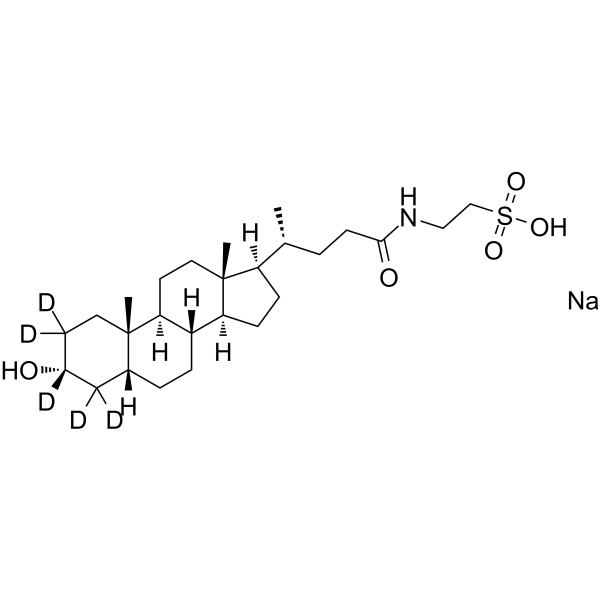
Taurolithocholic Acid-d5 (sodium) is the deuterium labeled Taurolithocholic acid sodium salt. Taurolithocholic Acid sodium salt is an orally active bile acid and antiviral agent. Taurolithocholic Acid sodium salt upregulates FADS2 by activating the TGR5-PI3K/AKT-SREBP2 signaling axis, inhibits SFTSV-induced ferroptosis, viral replication and viral entry of HBV/HDV, while reducing the release of IL-1β, lipid ROS and LDH. While exerting antiviral protective effects, Taurolithocholic Acid sodium salt also stimulates the recycling of hepatocellular membrane transporters, impairs canalicular bile acid secretion function, and induces hepatocyte cholestasis, apoptosis and acute hepatocellular injury. Taurolithocholic Acid sodium salt serves as an experimental model compound for hepatocellular cholestasis. At concentrations ≤200 μM, Taurolithocholic Acid sodium salt shows no cytotoxicity and does not activate the interferon pathway. Taurolithocholic Acid sodium salt not only protects mice from lethal SFTSV infection but also is suitable for studies related to severe fever with thrombocytopenia syndrome and cholestasis .
loading...
    loading...
Cat. No.: HY-165363
CAS No.: 75397-64-7
AK-135 hydrochloride is a Menadione (HY-B0332) derivative. AK-135 hydrochloride restores the electron flow in defective respiratory chain systems. AK-135 hydrochloride decreases LDH release, increases the amount of ATP. AK-135 hydrochloride has a protective effect against myocardial injury .
loading...
    loading...
Cat. No.: HY-173144
AChE-IN-85 (Compound 7k) is an AChE inhibitor with an IC50 of 0.083 μM. AChE-IN-85 can inhibit the release of NO, the production of TNF-α and IL-1β, the levels of LDH and ROS, as well as the aggregation of Aβ42. AChE-IN-85 has anti-inflammatory and neuroprotective effects and can be used in the research of diseases such as Alzheimer's disease .
loading...
    loading...
Cat. No.: HY-178144
FPR2 agonist 5 is a selective Formyl Peptide Receptor 2 (FPR2) agonist. FPR2 agonist 5 induces Ca 2+ mobilization in FPR2-HL60 transfected cells with an EC50 of 1.2 μM and causes FPR2 desensitization with an IC50 of 0.32 μM. FPR2 agonist 5 exerts neuroprotective effects by mitigating LDH release, NO production, IL-1β, IL-6, IL-33, and IL-10 levels in LPS (HY-D1056)-induced mouse primary microglial cells. FPR2 agonist 5 can be used for the study of neuroinflammatory-related diseases .
loading...
    loading...
Cat. No.: HY-113308AS2
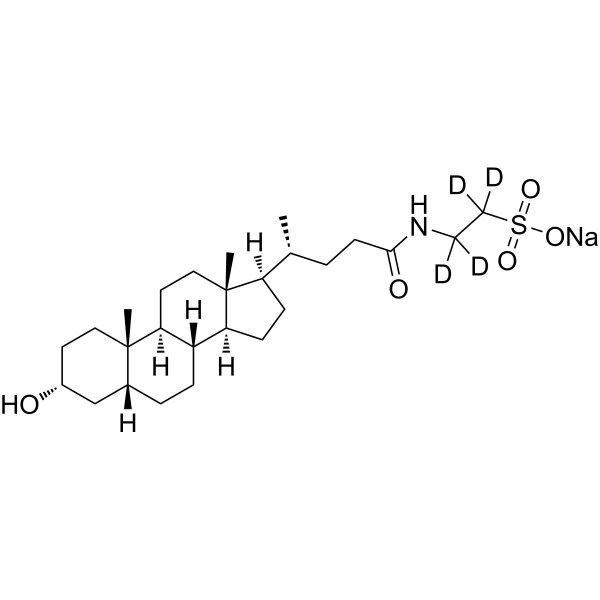
Taurolithocholic acid-d4-1 (sodium) is the deuterium labeled Taurolithocholic acid. Taurolithocholic acid sodium is an orally active bile acid and antiviral agent. Taurolithocholic acid sodium upregulates FADS2 by activating the TGR5-PI3K/AKT-SREBP2 signaling axis, inhibits SFTSV-induced ferroptosis, viral replication and viral entry of HBV/HDV, while reducing the release of IL-1β, lipid ROS and LDH. While exerting antiviral protective effects, Taurolithocholic acid sodium also stimulates the recycling of hepatocellular membrane transporters, impairs canalicular bile acid secretion function, and induces hepatocyte cholestasis, apoptosis and acute hepatocellular injury. Taurolithocholic acid sodium serves as an experimental model compound for hepatocellular cholestasis. At concentrations ≤200 μM, Taurolithocholic acid sodium shows no cytotoxicity and does not activate the interferon pathway. Taurolithocholic acid sodium not only protects mice from lethal SFTSV infection but also is suitable for studies related to severe fever with thrombocytopenia syndrome and cholestasis .
loading...
    loading...
Cat. No.: HY-113308S
CAS No.: 1265681-64-8
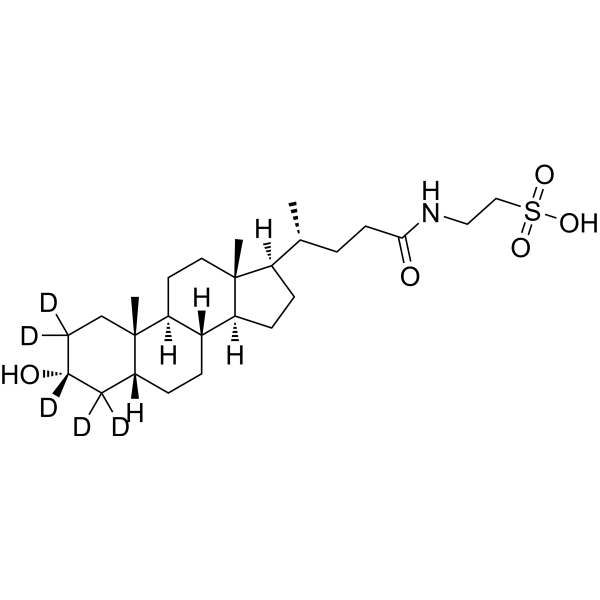
Taurolithocholic acid-d5 is deuterium labeled Taurolithocholic acid. Taurolithocholic acid is an orally active bile acid and antiviral agent. Taurolithocholic acid upregulates FADS2 by activating the TGR5-PI3K/AKT-SREBP2 signaling axis, inhibits SFTSV-induced ferroptosis, viral replication and viral entry of HBV/HDV, while reducing the release of IL-1β, lipid ROS and LDH. While exerting antiviral protective effects, Taurolithocholic acid also stimulates the recycling of hepatocellular membrane transporters, impairs canalicular bile acid secretion function, and induces hepatocyte cholestasis, apoptosis and acute hepatocellular injury. Taurolithocholic acid serves as an experimental model compound for hepatocellular cholestasis. At concentrations ≤200 μM, Taurolithocholic acid shows no cytotoxicity and does not activate the interferon pathway. Taurolithocholic acid not only protects mice from lethal SFTSV infection but also is suitable for studies related to severe fever with thrombocytopenia syndrome and cholestasis .
loading...
    loading...
Cat. No.: HY-183921
CAS No.: 135100-65-1
SQ 32547 is a dihydropyridine calcium channel inhibitor with antihypertensive and anti-ischemic activities. SQ 32547 modulates sarcolemmal voltage-dependent calcium channels to inhibit calcium influx, and exerts direct anti-ischemic activity by suppressing myocardial contracture formation and reducing lactate dehydrogenase (LDH) release. SQ 32547 can be used in research related to hypertension, angina pectoris and neurogenic inflammation .
loading...
    loading...
Cat. No.: HY-189261
Research Areas:  

Cancer

Anticancer agent-361 is a glycine-conjugated coumarin-quinazoline fused heterocyclic derivative with selective antitumor proliferation activity. Anticancer agent-361 induces G0/G1 cell cycle arrest, apoptosis, and LDH release accompanied by membrane damage. Anticancer agent-361 is predicted to be a PI3Kα/PI3Kγ inhibitor. Anticancer agent-361 can be used for research on lung cancer, pancreatic cancer, prostate cancer, and breast cancer .
loading...
    loading...
Cat. No.: HY-180830
CAS No.: 2361570-54-7
NLRP3-IN-86 (Compound 8a), a derivative of Songorine (HY-N2080), is a potent and selective NLRP3 inflammasome inhibitor. NLRP3-IN-86 can reduce LPS (HY-D1056)- and Nigericin (HY-127019)-stimulated lactate dehydrogenase (LDH) release (IC50 = 2.69 μM in THP-1 cells and 1.75 μ M in J774A.1 cells). NLRP3-IN-86 can inhibit gasdermin D (GSDMD) cleavage and IL-1β secretion. NLRP3-IN-86 can inhibit cell pyroptosis. NLRP3-IN-86 can be used for research of inflammation .
loading...
    loading...
Cat. No.: HY-P11935
CAS No.: 2410535-57-6
RR-171 is an amino acid polypeptide and an inhibitor of the Wnt signaling pathway. RR-171 reduces the expression levels of Wnt-1, GSK3β and β-catenin. RR-171 induces apoptosis (Apoptosis) in pancreatic cancer cells, which is characterized by an increased Bax/Bcl-2 ratio, activation of Caspase-3/7/9, and increased Cleaved-PARP; this pro-apoptotic effect can be partially reversed by Z-VAD-FMK (HY-16658B). RR-171 also induces pyroptosis (Pyroptosis) in pancreatic cancer cells, which is manifested by activation of the NLRP-3 inflammasome, activation of Caspase-1, cleavage of GSDMD, upregulation of IL-1β and IL-18, and increased LDH release; this pro-pyroptotic effect can be partially reversed by VX-765 (HY-13205). RR-171 inhibits the viability, proliferation and colony formation of pancreatic cancer cells, with low cytotoxicity against normal cells. RR-171 downregulates the expression of Ki-67 and PCNA in tumor tissues in vivo, with favorable biosafety. RR-171 can be used in studies related to pancreatic cancer .
loading...
    loading...

