50 Results for "

Splicing activity

" in MedChemExpress (MCE) Product Catalog:
Products (50)

50 Results for "Splicing activity" in MCE Product Catalog:

Cat. No.: HY-121473
CAS No.: 60504-57-6
Research Areas:  

Infection

Aklavin is a structural analog of Aclacinomycin A (HY-N2306) produced by Streptomyces strain A 1165. Aklavin possesses Z-DNA-inducing and stabilizing activities, along with antibiotic, anti-phage and broad-spectrum antimicrobial activities. Aklavin inhibits the proliferation of various viruses (such as influenza virus and poliovirus) and interferes with their nucleoprotein synthesis, while also exhibiting inhibitory effects on staphylococci, mycobacteria and specific fungi. Aklavin blocks phage-induced bacterial lysis by regulating host-parasite interactions. Aklavin shows specific toxicity to fertilized eggs and mice, and does not alter the splicing of the SMN2 gene .
loading...
    loading...
Cat. No.: HY-178155
Research Areas:  

Cancer

AP232 is a selective U2AF1-UHM Inhibitor with an IC50 of 7.96 μM. AP232 exhibits 2.8-24-fold selectivity against other UHM-containing proteins. AP232 exerts anti-leukemia activity and shows higher activities in cell lines carrying splicing factor mutations. AP232 can induce leukemia cells G2/M and G1 arrest, impair lysosome acidification, and inhibit autophagy. AP232 can be used for the research of cancer, such as Leukemia .
loading...
    loading...
Ultevursen sodium
0 Images
RNA, (P-thio)[2′-O-(2-methoxyethyl)](A-G-m5C-m5U-m5U-m5C-G-G-A-G-A-A-A-m5U-m5U-m5U-A-A-A-m5U-m5C), sodium salt
Cat. No.: HY-147412A
Synonyms: QR-421a sodium
Ultevursen sodium (QR-421a) is a splice-modulating antisense oligonucleotide targeting exon 13 of the USH2A gene, which restores the functional expression of Usherin protein by inducing exon skipping. Ultevursen sodium binds to USH2A pre-mRNA and modulates the splicing process to specifically skip exon 13 carrying the pathogenic mutation c.2299delG, generating an in-frame transcript and a truncated yet functionally normal protein. Ultevursen sodium exhibits concentration-dependent exon skipping activity in human cells and retinal organoid models, and restores Usherin expression and retinal function in zebrafish and gene-edited mouse models. Ultevursen sodium can be used for related research on type 2 Usher syndrome and non-syndromic retinitis pigmentosa .
loading...
    loading...
Cat. No.: HY-146397
CAS No.: 2760703-21-5
Research Areas:  

Cancer

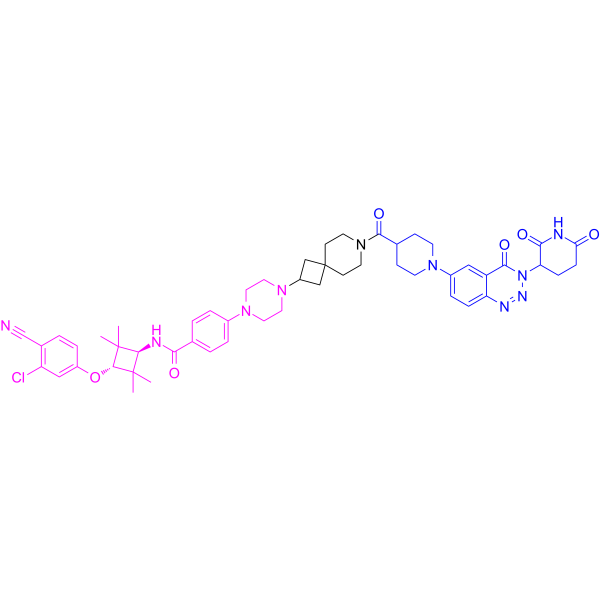
TD-802 is a CRBN-recruiting PROTAC androgen receptor (AR) degrader with liver microsomal stability and in vivo pharmacokinetic properties. TD-802 exhibits weak degrading activity against the AR-V7 splice variant, and its degradation process depends on the ubiquitin-proteasome system and Cullin-Ring ubiquitin ligase. TD-802 inhibits the proliferation of AR-dependent prostate cancer cells and the growth of AR-positive prostate cancer tumors in in vivo xenograft models .
loading...
    loading...
Cat. No.: HY-178155A
Research Areas:  

Cancer

AP232 dihydrochloride is a selective U2AF1-UHM Inhibitor with an IC50 of 7.96 μM. AP232 dihydrochloride exhibits 2.8-24-fold selectivity against other UHM-containing proteins. AP232 dihydrochloride exerts anti-leukemia activity and shows higher activities in cell lines carrying splicing factor mutations. AP232 dihydrochloride can induce leukemia cells G2/M and G1 arrest, impair lysosome acidification, and inhibit autophagy. AP232 dihydrochloride can be used for the research of cancer, such as Leukemia .
loading...
    loading...
Cat. No.: HY-180907
Target:  

PROTACs Deubiquitinase

Research Areas:  

Cancer

PROTAC USP39 Degrader-1 is a USP39 PROTAC degrader with Kd values of 136 nM and 232 nM, and a DC50 value of 1.06 nM (24 h). PROTAC USP39 Degrader-1 binds to the VHL E3 ubiquitin ligase, forms a ternary complex with USP39, mediates USP39 ubiquitination and proteasomal degradation dependent on VHL recruitment, modulates splicing activity and induces 5' splice site-specific splicing patterns. PROTAC USP39 Degrader-1 can be used in the research of cervical cancer .
loading...
    loading...
Cat. No.: HY-144399A
CAS No.: 2762547-06-6
Research Areas:  

Neurological Disease

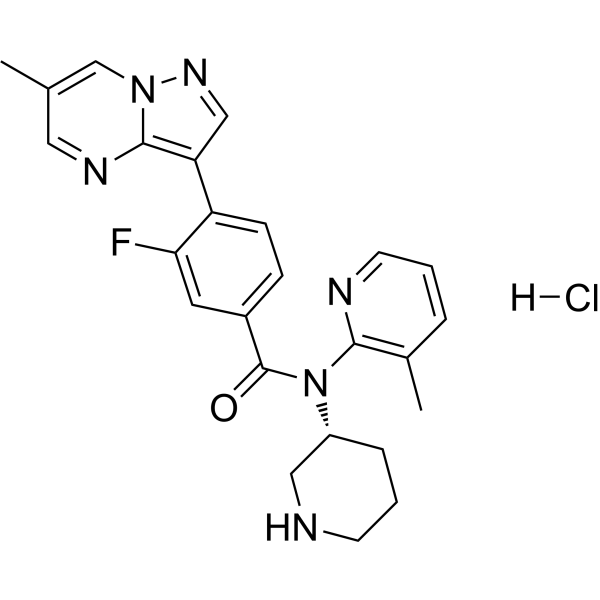
CD33 splicing modulator 1 (Compound 1) hydrochloride is a CD33 splicing modulator. CD33/Siglec 3 is a myeloid cell surface receptor known to regulate microglial activity. CD33 splicing modulator 1 hydrochloride increases exon 2 skipping in the cellular mRNA pool and can be used to study neurodegenerative diseases including Alzheimer's disease .
loading...
    loading...
Cat. No.: HY-114461
CAS No.: 147025-57-8
Research Areas:  

Cancer

FD-895 is a spliceosome modulator derived from a polyketide natural product, targeting the SF3b subunit of the spliceosome. FD-895 possesses core biological activities for regulating RNA splicing (intron retention, alternative splicing) and inducing apoptosis of cancer cells. FD-895 can be used for the research of cancer, such as chronic lymphocytic leukemia (CLL) .
loading...
    loading...
Cat. No.: HY-N2117R
CAS No.: 548-19-6
Isoginkgetin (Standard) is the analytical standard of Isoginkgetin. This product is intended for research and analytical applications. Isoginkgetin is a pre-mRNA splicing inhibitor inhibitor. Isoginkgetin also inhibits activities of both Akt, NF-κB and MMP-9. Isoginkgetin inhibits the activity of the 20S proteasome, induces apoptosis and activates autophagy .
loading...
    loading...
Cat. No.: HY-120907
CAS No.: 1197054-49-1
Target:  

SF3B1

Research Areas:  

Cancer

Sudemycin E is an analog of FR901464 (HY-16212). Sudemycin E can induce reversible changes in alternative splicing and abnormalities in chromatin modifications by binding to SF3B1, a component of the U2 small nuclear ribonucleoprotein (snRNP), thereby leading to the death of cancer cells. Sudemycin E has anti-tumor activity and can be used in tumor research .
loading...
    loading...
Cat. No.: HY-N2360R
CAS No.: 19202-36-9
Hinokiflavone is a novel modulator of pre-mRNA splicing activity extracted from plants with anti-inflammatory, anti-tumor and antiviral activities. Hinokiflavone is also a potent inhibitor for matrix metalloproteinases (MMPs). Hinokiflavone attenuates the virulence of Methicillin (HY-121544)-resistant staphylococcus aureus by inhibiting caseinolytic protease P (ClpP) with an IC50 value of 34.36 mg/mL. Hinokiflavone induces apoptosis via the reactive oxygen species-mitochondria-mediated apoptotic pathway and inhibits tumor cell migration and invasion. Hinokiflavone is a SUMO protease inhibitor against sentrin-specific protease 1 (SENP1) activity .
loading...
    loading...
Cat. No.: HY-139102
CAS No.: 1426953-23-2
Target:  

DNA/RNA Synthesis

Research Areas:  

Cancer

Thailanstatin B is a potent pre-mRNA splicing inhibitor (IC50=6.18 μM). Thailanstatin B shows antiproliferative activity .
loading...
    loading...
Cat. No.: HY-B0220H
CAS No.: 14271-02-4
Research Areas:  

Infection

Erythromycin hydrochloride is a protein synthesis inhibitor with activity against the growth of both Gram-negative and Gram-positive bacteria. Erythromycin hydrochloride is commonly used in biomedicine to inhibit diseases caused by bacterial infections. Erythromycin hydrochloride is also involved in the inhibition of mammalian mRNA splicing. The application range of erythromycin hydrochloride includes respiratory tract infections, skin infections, and other infections caused by sensitive bacteria .
loading...
    loading...
Cat. No.: HY-403733C
CAS No.: 2020353-42-6
Target:  

Androgen Receptor

Research Areas:  

Cancer

JJ-450 is a non-competitive antagonist androgen receptor (AR) that inhibits the transcriptional activity of wild-type AR and mutant AR F876L. JJ-450 has an IC50 of approximately 1-10 μM in inhibiting AR transcriptional activity in PC3 cells. It is selective for AR binding and does not compete with androgens for binding to the ligand binding domain (LBD) of AR. JJ-450 inhibits the transcriptional activity of AR and its splice variants (such as AR F876L) by inhibiting AR nuclear translocation and promoting the degradation of unliganded AR in the nucleus. JJ-450 can be used in castration-resistant prostate cancer (CRPC) studies that are resistant to Enzalutamide (MDV3100) (HY-70003) .
loading...
    loading...
Cat. No.: HY-403733B
CAS No.: 1998094-24-8
Research Areas:  

Cancer

(+)-JJ-450 is a non-competitive antagonist targeting the androgen receptor (AR) that inhibits AR nuclear localization and transcriptional activity in the absence of androgen. (+)-JJ-450 is less active than (-)-JJ-450 (HY-403733A) in inhibiting prostate-specific antigen (PSA) expression in LN95 cells, possibly because (+)-JJ-450 targets the ligand binding domain (LBD) of AR. (+)-JJ-450 inhibits the transcriptional activity of AR and its splice variants (e.g., ARv7) by promoting the degradation of unliganded AR in the nucleus and reducing the binding of AR to androgen response elements (AREs). (+)-JJ-450 can be used in castration-resistant prostate cancer (CRPC) studies that are resistant to enzalutamide (MDV3100) (HY-70003) .
loading...
    loading...
Cat. No.: HY-15867
CAS No.: 1020210-12-1
Synonyms: (+)-Meayamycin B
Research Areas:  

Cancer

Meayamycin B ((+)-Meayamycin B) is a potent SF3B1 inhibitor. Meayamycin B upregulates the proapoptotic Mcl-1S and downregulates Mcl-1L at the pre-mRNA splicing level. Meayamycin B does not regulate the alternative splicing of Bcl-x. Meayamycin B and ABT-737 (HY-50907) synergistically causes Apoptosis. Meayamycin B exhibits anticancer activity against non-small cell lung cancer .
loading...
    loading...
Cat. No.: HY-108190
CAS No.: 33103-21-8
Target:  

Antibiotic Bacterial

Research Areas:  

Infection

Tuberactinomycin A is a basic cyclic peptide antibiotic and a group I intron RNA splicing inhibitor, with an IC50 of 10 μM against the G-binding site of bacteriophage T4 group I intron RNA. Tuberactinomycin A exerts antibacterial effects by acting on the initiation and elongation steps of bacterial bacteria ribosomes to inhibit prokaryotic protein synthesis. Tuberactinomycin A competes with guanosine cofactors for binding to the G-binding site of group I intron RNA, forms electrostatic interactions with the RNA backbone, and inhibits the self-splicing of bacteriophage T4 td and sunY group I introns, and its inhibitory activity depends on Mg 2+ concentration. Tuberactinomycin A can be used in studies related to bacterial infections .
loading...
    loading...
Cat. No.: HY-139499
CAS No.: 1510837-67-8
Target:  

DNA/RNA Synthesis

Research Areas:  

Cancer

Sudemycin D6 is a pre-mRNA splicing modulator with potent antitumour activity. Sudemycin D6 changes splice site usage of the DUSP11 and SRRM1 pre-mRNA. Sudemycin D6 reduces survival and alters cell cycle in haematopoietic cells expressing mutant U2AF1. Sudemycin D6 attenuates mutant U2AF1-induced haematopoietic progenitor cell expansion in U2AF1(S34F) transgenic mice. Sudemycin D6 can be used for cancer research .
loading...
    loading...
Cat. No.: HY-181101
CAS No.: 3097563-43-1
Target:  

Fungal

Research Areas:  

Infection

Antifungal agent 151 is a Prp8 intein inhibitor that inhibits the self-splicing process of the Prp8 intein, preventing maturation of the Prp8 protein. Antifungal agent 151 exerts in vitro antifungal activity against Cryptococcus neoformans and Cryptococcus gattii. Antifungal agent 151 can be used for the research of cryptococcus pneumonia .
loading...
    loading...
Cat. No.: HY-16399R
CAS No.: 445493-23-2
Research Areas:  

Cancer

Pladienolide B (Standard) is the analytical standard of Pladienolide B (HY-16399). This product is intended for research and analytical applications. Pladienolide B is a potent cancer cell growth inhibitor that targets the SF3B1 subunit of the spliceosome. Pladienolide B exerts antitumor activities mediated through the inhibition of pre-mRNA splicing. Pladienolide B induces apoptosis .
loading...
    loading...

