101 Results for "

joint

" in MedChemExpress (MCE) Product Catalog:
Products (101)

101 Results for "joint" in MCE Product Catalog:

Cat. No.: HY-142123R
CAS No.: 152-97-6
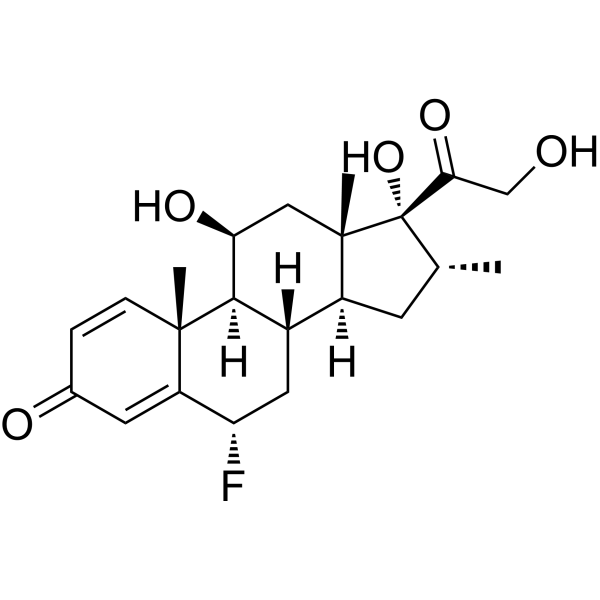
Fluocortolone (Standard) is the analytical standard of Fluocortolone. This product is intended for research and analytical applications. Fluocortolone is an orally active anti-inflammatory agent that effectively reduces plasma fibrinogen levels. Fluocortolone inhibits Mycobacterium butyricum-induced foot edema in a rat model of adjuvanted joint inflammation (3-12 mg/kg) .
loading...
    loading...
Cat. No.: HY-119447R
CAS No.: 170569-88-7
Target:  

COX

Research Areas:  

Inflammation/Immunology

Mavacoxib (Standard) is the analytical standard of Mavacoxib. This product is intended for research and analytical applications. Mavacoxib is a selective, oral long-acting cyclooxygenase-2 (COX-2) inhibitor and a long-acting non-steroidal anti-inflammatory drug (NSAID). Mavacoxib is used to treat pain and inflammation associated with degenerative joint disease in dogs .
loading...
    loading...
Cat. No.: HY-W714171
CAS No.: 181274-15-7
Synonyms: BAY MKH 6561
Target:  

Herbicide

Research Areas:  

Others

Propoxycarbazone sodium (BAY MKH 6561) is a herbicide. Propoxycarbazone sodium controls shepherd’s purse (Capsella bursa-pastoris L. Medicus), tumble mustard (Sisymbrium altissimum L.), field pennycress (Thlaspi arvense L.), and several Bromus species. Propoxycarbazone sodium also inhibits the growth of jointed goatgrass, wild oat (Avena fatua L.), and quackgrass (Elytrigia repens L. Nevski) .
loading...
    loading...
Cat. No.: HY-168841
CAS No.: 3031770-03-0
Target:  

MAPKAPK2 (MK2) p38 MAPK

Research Areas:  

Inflammation/Immunology

p38α-MK2-IN-1 (Compound 36) is a p38α-MK2 complex inhibitor (IC50: 5 nM). p38α-MK2-IN-1 has a robust inflammation inhibitory effect and joint repair ability .
loading...
    loading...
Cat. No.: HY-W714171R
CAS No.: 181274-15-7
Synonyms: BAY MKH 6561 (Standard)
Research Areas:  

Others

Propoxycarbazone (sodium) (Standard) is the analytical standard of Propoxycarbazone (sodium). This product is intended for research and analytical applications. Propoxycarbazone sodium (BAY MKH 6561) is a herbicide. Propoxycarbazone sodium controls shepherd’s purse (Capsella bursa-pastoris L. Medicus), tumble mustard (Sisymbrium altissimum L.), field pennycress (Thlaspi arvense L.), and several Bromus species. Propoxycarbazone sodium also inhibits the growth of jointed goatgrass, wild oat (Avena fatua L.), and quackgrass (Elytrigia repens L. Nevski) .
loading...
    loading...
Cat. No.: HY-A0179
CAS No.: 53-33-8
Paramethasone is an orally active long-acting glucocorticoid. Paramethasone directly inhibits testicular aromatase, thereby reducing the synthesis of estradiol. Paramethasone suppresses the basal and midcycle luteinizing hormone surges in female animals and blocks estrogen synthesis. Paramethasone also decreases circulating levels of dihydrotestosterone, androstenedione and estradiol in male animals. Paramethasone inhibits cartilage degeneration and alleviates joint pathological damage in osteoarthritis models. Paramethasone can be used in research related to osteoarthritis and endocrinology .
loading...
    loading...
Cat. No.: HY-138166S
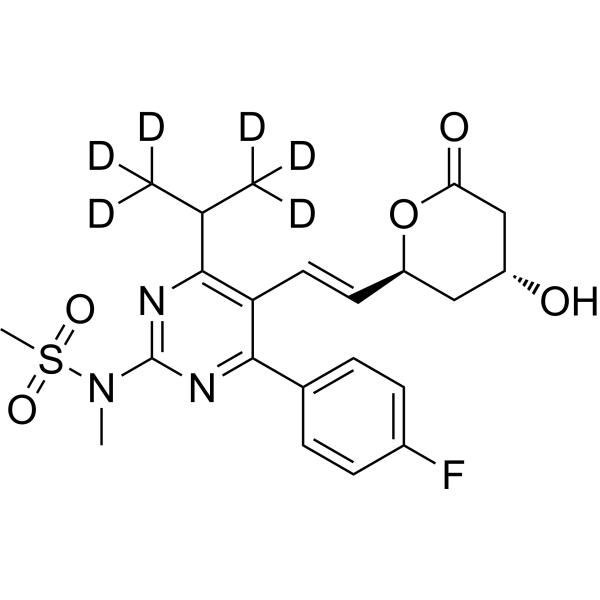
Rosuvastatin lactone-d6 is the deuterium labeled Rosuvastatin lactone. Rosuvastatin lactone is a metabolite of Rosuvastatin (HY-17504A), a statin lipid-lowering agent and HMG-CoA inhibitor. Rosuvastatin lactone exhibits endothelium-independent and HMG-CoA reductase-independent vasorelaxant activity in rat aortic rings, and its vasorelaxant effect is jointly mediated by NO produced by inducible nitric oxide synthase (iNOS) located in vascular smooth muscle and activation of potassium channels. Rosuvastatin lactone itself has no lipid-lowering effect .
loading...
    loading...
Cat. No.: HY-107939R
CAS No.: 1597-82-6
Paramethasone Acetate (Standard) is the analytical standard of Paramethasone Acetate (HY-107939). This product is intended for research and analytical applications. Paramethasone Acetate is an orally active long-acting glucocorticoid. Paramethasone Acetate directly inhibits testicular aromatase, thereby reducing the synthesis of estradiol. Paramethasone Acetate suppresses the basal and midcycle luteinizing hormone surges in female animals and blocks estrogen synthesis. Paramethasone Acetate also decreases circulating levels of dihydrotestosterone, androstenedione and estradiol in male animals. Paramethasone Acetate inhibits cartilage degeneration and alleviates joint pathological damage in osteoarthritis models. Paramethasone Acetate can be used in research related to osteoarthritis and endocrinology.
loading...
    loading...
Cat. No.: HY-138166R
CAS No.: 503610-43-3
Rosuvastatin lactone (Standard) is the analytical standard of Rosuvastatin lactone. This product is intended for research and analytical applications. Rosuvastatin lactone is a metabolite of Rosuvastatin (HY-17504A), a statin lipid-lowering agent and HMG-CoA inhibitor. Rosuvastatin lactone exhibits endothelium-independent and HMG-CoA reductase-independent vasorelaxant activity in rat aortic rings, and its vasorelaxant effect is jointly mediated by NO produced by inducible nitric oxide synthase (iNOS) located in vascular smooth muscle and activation of potassium channels. Rosuvastatin lactone itself has no lipid-lowering effect .
loading...
    loading...
Cat. No.: HY-W003969R
CAS No.: 695-34-1
Synonyms: Ascensil (Standard); 2-Amino-4-methylpyridine (Standard)
Research Areas:  

Others

Aminopicoline (Standard) is the analytical standard of Aminopicoline. Aminopicoline (Ascensil) is a potent and non-selective inhibitor of nitric oxide synthase (NOS) isoenzymes (iNOS, nNOS, eNOS). Aminopicoline competes with arginine at the substrate-binding site of nitric oxide synthase, reduces cellular nitric oxide production, inhibits the elevation of plasma nitrate, increases mean arterial pressure at high doses, and also serves as a basis for radiolabeled ligands to localize nitric oxide synthase binding sites. Aminopicoline can be used in the research of diseases associated with septic shock, joint inflammation, intestinal inflammation, and CNS inflammation 。
loading...
    loading...
Cat. No.: HY-N0723R
CAS No.: 64809-67-2
Neomangiferin (Standard) is the analytical standard of Neomangiferin. This product is intended for research and analytical applications. Neomangiferin is an orally active natural flavonoid. Neomangiferin partially ameliorates non-alcoholic fatty liver disease (NAFLD) by regulating the expression of genes related to free fatty acid uptake and lipid oxidation. Neomangiferin exerts anti-colitis effects by inhibiting Th17/Treg cell differentiation. Neomangiferin exerts anti-aging and lifespan-extending effects by targeting upregulation of bas-1, which in turn activates the autophagy, IIS and MAPK pathways. Neomangiferin has the potential to prevent aseptic loosening of prostheses after total joint arthroplasty due to its significant anti-inflammatory and osteoclastogenesis-inhibiting effects.
loading...
    loading...
Cat. No.: HY-P990214
Anti-Mouse IL-3 Antibody (MP2-8F8) is an anti-mouse IL-3 IgG1 monoclonal antibody. Anti-Mouse IL-3 Antibody (MP2-8F8) relieves joint inflammation by reducing synovial leukocyte infiltration and cytokine levels. Anti-Mouse IL-3 Antibody (MP2-8F8) can reduce the accumulation of basophils. Anti-Mouse IL-3 Antibody (MP2-8F8) can be used for researches on inflammation or infection conditions such as arthritis and parasitic infections .
loading...
    loading...
Cat. No.: HY-123382
CAS No.: 1695551-19-9
Target:  

Drug Isomer

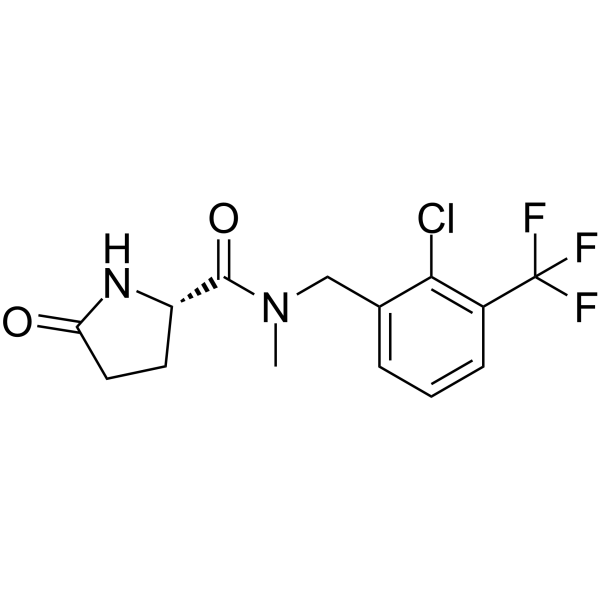
GSK-1482160 isomer is the isomer of GSK-1482160 (HY-19888). GSK-1482160 is an orally active and blood-brain barrier penetrant P2X7 receptor (P2X7R) negative allosteric modulator with pIC50s of 8.5 (human) and 6.5 (rat). GSK-1482160 reduces the efficacy of ATP at the P2X7 receptor without affecting its affinity, thereby inhibiting the release of IL-1β. GSK-1482160 is an effective radioligand and can be labeled with radioactive isotopes like 11C or 18F to image P2X7R. GSK-1482160 can be used for the studies of chronic joint pain and chronic constriction injury (CCI).
loading...
    loading...
Cat. No.: HY-FL0006
Target:  

Others

Research Areas:  

Inflammation/Immunology

BDDE-crosslinked sodium hyaluronate solution is mainly composed of BDDE (1,4‑butanediol diglycidyl ether). Its molecular weight and viscoelasticity are similar to those of normal joint synovial fluid. It can be used as a temporary substitute and supplement for joint fluid, alleviating pain in patients with knee osteoarthritis and improving the function of the knee joint.
loading...
    loading...
Cat. No.: HY-114848
CAS No.: 60414-06-4
Synonyms: SM1213 hydrochloride; Therafectin hydrochloride
Target:  

Others

Research Areas:  

Others

Amiprilose (SM1213) hydrochloride is a novel synthetic carbohydrate with anti-inflammatory and immunomodulatory properties, which can restore the number of painful and swollen joints, joint pain and swelling index, and grip strength to baseline levels.
loading...
    loading...
Cat. No.: HY-N20132
Category:  

Extract

Target:  

Others

Vitex negundo seed extract is an extract of Vitex negundo used in research on rheumatism and joint inflammation.
loading...
    loading...
Cat. No.: HY-N20206
Category:  

Extract

Target:  

Others

Rhizoma anemones raddeanae extract is an extract of Anemone raddeana Regel, used in research on joint pain and ulcer pain.
loading...
    loading...
Cat. No.: HY-N19856
CAS No.: 1032964-19-4
Millettiaspecoside A is a phenolic glycoside found in the caulis of Millettia speciosa. Millettiaspecoside A can be used in research related to joint pain .
loading...
    loading...
Cat. No.: HY-N18668
CAS No.: 84775-52-0
Category:  

Extract

Target:  

Bacterial

Curcuma longa extract is derived from the rhizome of the turmeric plant (Curcuma longa), and its active ingredient is curcumin. Curcuma longa extract can be used in research on diseases such as arthritis, joint pain, and muscle soreness.
loading...
    loading...
Cat. No.: HY-L210
2,023 compounds

Rheumatoid Arthritis (RA) is a autoimmune disease characterized by persistent joint inflammation. The pathology of RA includes immune cell infiltration, synovial lining proliferation, pannus formation, and the destruction of joint cartilage and bone, which is highly disabling. Due to long-term chronic inflammation, RA not only severely affects the quality of life of patients but can also damage multiple organs, leading to lung diseases, cardiovascular diseases, and malignant tumors. The pathogenesis of RA is complex, involving genetic, environmental, and immune factors. With the advancement of high-throughput screening technology, screening for compounds targeting JAK, CCR, MEK, MMP targets may contribute to the development of more effective drugs against Rheumatoid Arthritis (RA).

MCE has collected 2,023 small molecule compounds with definite or potential anti-rheumatoid arthritis activity. This library is of significant value for researching the anti-RA drugs.

