
107 Results for "

Solid-phase synthesis

" in MedChemExpress (MCE) Product Catalog:
Products (107)

107 Results for "Solid-phase synthesis" in MCE Product Catalog:

Cat. No.: HY-134517
CAS No.: 150281-21-3
Purity:  98.11%
Research Areas:  

Others

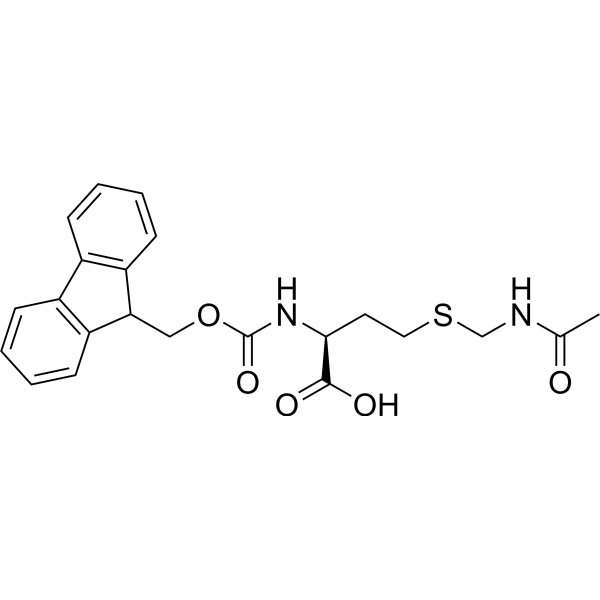
Fmoc-HoCys(ACM)-OH, a homolog of cysteine, is synthesized from L-methionine. Fmoc-HoCys(ACM)-OH also can be used for the synthesis of solid phase peptide .
loading...
    loading...
Cat. No.: HY-P2439
CAS No.: 129781-07-3
Target:  

Neurokinin Receptor

Research Areas:  

Others

MEN 10208 is a neurokinin A antagonist prepared by solid phase synthesis. The Fmoc strategy has more advantages than the Boc strategy in its preparation, and can obtain products with higher yield and purity.
loading...
    loading...
Cat. No.: HY-Y0912
CAS No.: 94790-37-1
Synonyms: N-HBTU
Research Areas:  

Inflammation/Immunology

HBTU (N-HBTU) is a guanidinium-based peptide coupling reagent and immunological sensitizer. HBTU can be used in combination with bases such as DIPEA (HY-130142) to complete coupling reactions, with HOBt and TMU as by-products. HBTU is a standard reagent in automated solid-phase peptide synthesis, particularly for the Fmoc/tBu strategy, which effectively promotes coupling steps, but it is not suitable for sterically hindered amino acids or dipeptide derivatives. HBTU can induce rhinitis, dermatitis, bronchial asthma and severe allergic reactions. HBTU can be used to study the pathogenesis of allergic reactions, occupational rhinitis, allergic contact dermatitis and bronchial asthma .
loading...
    loading...
Cat. No.: HY-142104
CAS No.: 934816-82-7
Synonyms: 2-Chlorotrityl Chloride Resin (100-200 mesh,1% DVB,0.4-3.0mmol/g)
Target:  

Drug Intermediate

Research Areas:  

Cancer

2-CTC Resin (100-200 mesh,1% DVB,0.4-3.0mmol/g) is a solid-phase synthesis carrier that has been used to study metabolic disorders in prostate cancer cells. 2-CTC Resin (100-200 mesh,1% DVB,0.4-3.0mmol/g) can be used as a reaction solution of terminal residues and adenine nucleotides to form cyclic peptides. 2-CTC Resin (100-200 mesh,1% DVB,0.4-3.0mmol/g) can prevent racemization during the incorporation of the first protected amino acid and minimized diketopiperazine formation. 2-CTC Resin (100-200 mesh,1% DVB,0.4-3.0mmol/g) is one of the most commonly used and versatile resins available for large-scale production of peptides .
loading...
    loading...
Cat. No.: HY-118161
CAS No.: 115545-59-0
Synonyms: beta-1-Adamantylaspartic acid
Research Areas:  

Others

1-Adamantylaspartate is a newly developed β-β-1-imidopropionic acid used to synthesize the C-terminal octapeptide of the β subunit of human chorionic gonadotropin (hCG) and the hexadecapeptide of the α subunit of the insulin receptor (30-55) by conventional solution methods and solid phase methods, aiming to inhibit the formation of asparagine during the synthesis of asparagyl peptides. Studies have shown that β-β-1-imidopropionic acid is an effective protector of the β-carboxyl function of aspartic acid residues.
loading...
    loading...
Cat. No.: HY-W010712S1
CAS No.: 1217696-12-2
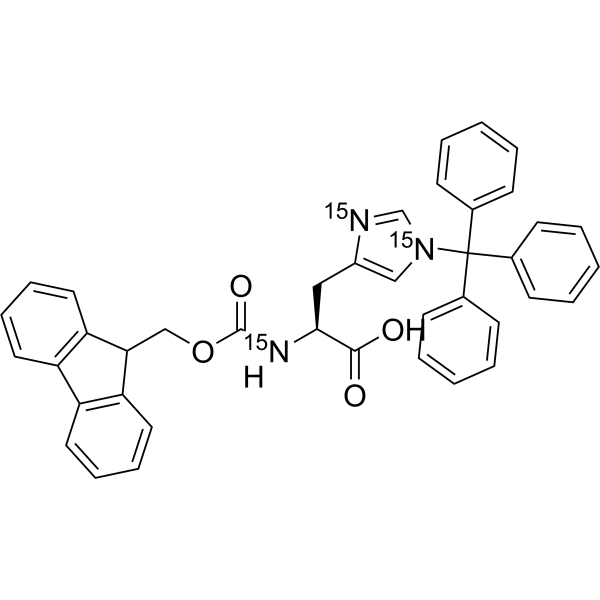
Fmoc-His(Trt)-OH- 15N3 is the 15N labeled Fmoc-His(Trt)-OH (HY-W010712). Fmoc-His (Trt)-OH is a histidine derivative. Fmoc-His(Trt)-OH has trityl (Trt) group to protect the side-chain of His. Fmoc-His(Trt)-OH has Fmoc group to protect -αNH2. Fmoc-His(Trt)-OH can be used for solid phase synthesis of peptides, providing protection against racemization and by-product formation .
loading...
    loading...
Cat. No.: HY-D2747
CAS No.: 1638784-10-7
BP Fluor 405 acid is a water-soluble, blue-fluorescent dye that is often used in multi-color applications, including flow cytometry and super-resolution microscopy using STORM. Its excitation is ideally suited for the 407 nm spectral line of the krypton laser or the 408 nm violet laser diode. BP Fluor 405 conjugates are pH-insensitive from pH 4 to pH 10. The carboxylic acid of BP Fluor 405 is a reagent of choice for the preparation of custom activated esters that often are not commercially available. Examples of such activated esters include sulfo-NHS, TFP (2,3,5,6-Tetrafluorophenol), and STP (4-Sulfo-2,3,5,6-Tetrafluorophenol, Sodium Salt). Another common application for the non-activated carboxylic acid is peptide modification during solid phase synthesis, which usually requires in-situ activation with peptide coupling regents, e.g. HATU. BP Fluor 405 acid is also often used for control experiments, and for calibration.
loading...
    loading...

