109 Results for "

cellulose

" in MedChemExpress (MCE) Product Catalog:
Products (109)

109 Results for "cellulose" in MCE Product Catalog:

Cat. No.: HY-E71305H
Target:  

Glycosidase

Research Areas:  

Others

β-Glucosidase 1A, Saccharophagus degradans (EC 3.2.1.21) is a glucosidase enzyme that acts upon β1->4 bonds linking two glucose or glucose-substituted molecules (i.e., the disaccharide cellobiose) . β-Glucosidase is one of the cellulases, enzymes involved in the decomposition of cellulose and related polysaccharides; more specifically, an exocellulase with specificity for a variety of beta-D-glycoside substrates. It catalyzes the hydrolysis of terminal non-reducing residues in beta-D-glucosides with release of glucose.
loading...
    loading...
Cat. No.: HY-E71305I
Target:  

Glycosidase

Research Areas:  

Others

β-Glucosidase 1A, Thermobifida fusca (EC 3.2.1.21) is a glucosidase enzyme that acts upon β1->4 bonds linking two glucose or glucose-substituted molecules (i.e., the disaccharide cellobiose) . β-Glucosidase is one of the cellulases, enzymes involved in the decomposition of cellulose and related polysaccharides; more specifically, an exocellulase with specificity for a variety of beta-D-glycoside substrates. It catalyzes the hydrolysis of terminal non-reducing residues in beta-D-glucosides with release of glucose.
loading...
    loading...
Cat. No.: HY-E71305J
Target:  

Glycosidase

Research Areas:  

Others

β-Glucosidase 1A, Thermotoga petrophila (EC 3.2.1.21) is a glucosidase enzyme that acts upon β1->4 bonds linking two glucose or glucose-substituted molecules (i.e., the disaccharide cellobiose) . β-Glucosidase is one of the cellulases, enzymes involved in the decomposition of cellulose and related polysaccharides; more specifically, an exocellulase with specificity for a variety of beta-D-glycoside substrates. It catalyzes the hydrolysis of terminal non-reducing residues in beta-D-glucosides with release of glucose.
loading...
    loading...
Cat. No.: HY-E71305K
Target:  

Glycosidase

Research Areas:  

Others

β-Glucosidase 1A, Thermus thermophilus (EC 3.2.1.21) is a glucosidase enzyme that acts upon β1->4 bonds linking two glucose or glucose-substituted molecules (i.e., the disaccharide cellobiose) . β-Glucosidase is one of the cellulases, enzymes involved in the decomposition of cellulose and related polysaccharides; more specifically, an exocellulase with specificity for a variety of beta-D-glycoside substrates. It catalyzes the hydrolysis of terminal non-reducing residues in beta-D-glucosides with release of glucose.
loading...
    loading...
Cat. No.: HY-E71306
Target:  

Glycosidase

Research Areas:  

Others

β-Glucosidase 3A, Bacteroides ovatus (EC 3.2.1.21) is a glucosidase enzyme that acts upon β1->4 bonds linking two glucose or glucose-substituted molecules (i.e., the disaccharide cellobiose) . β-Glucosidase is one of the cellulases, enzymes involved in the decomposition of cellulose and related polysaccharides; more specifically, an exocellulase with specificity for a variety of beta-D-glycoside substrates. It catalyzes the hydrolysis of terminal non-reducing residues in beta-D-glucosides with release of glucose.
loading...
    loading...
Cat. No.: HY-135721
CAS No.: 13304-62-6
Synonyms: Benzyl acrylamide
Research Areas:  

Others

N-Benzylacrylamide (Benzyl acrylamide) is a hydrophobic monomer. N-Benzylacrylamide can form hydrophobic microdomains that act as physical cross-linking sites to connect polymer chains to each other into a three-dimensional network; dynamically reversible hydrophobic interactions enable the spontaneous reformation of physical cross-linking sites after contact of fractured surfaces, thereby achieving autonomous self-healing. N-Benzylacrylamide can promote the synthesis of carboxymethyl cellulose-modified amphiphilic copolymers, and enhance the intermolecular association, viscoelasticity, thermal stability, as well as fire resistance/fire extinguishing performance of the resulting hydrogels .
loading...
    loading...
Cat. No.: HY-134809A
CAS No.: 392287-03-5
Synonyms: CADA hydrochloride
Target:  

HIV

Research Areas:  

Infection

Cyclotriazadisulfonamide (CADA) hydrochloride is a specific CD4-targeted HIV entry inhibitor with activity against HIV-1 replication. Cyclotriazadisulfonamide hydrochloride can specifically downregulate the expression of CD4 receptors on the cell surface, effectively inhibiting HIV transmission. Cyclotriazadisulfonamide hydrochloride can inhibit HIV-1(NL4.3) and SIV(mac251), and has a synergistic effect when used in combination with cellulose acetate (CAP). Cyclotriazadisulfonamide hydrochloride can also be used as a microbial gel formulation to maintain CD4 downregulation and antiviral activity, and is a broad-spectrum anti-HIV agent.
loading...
    loading...
Cat. No.: HY-184081
CAS No.: 5118-17-2
Target:  

Bacterial

Research Areas:  

Infection

Furazolium hydrochloride is a broad-spectrum antibacterial agent with inhibitory activity against a variety of Gram-positive and Gram-negative Bacterial strains. In a gelatin-acacia complex coacervate system, Furazolium hydrochloride exhibits protein-binding properties, where protein binding dominates at low concentrations, while micellization occurs at high concentrations. Furazolium hydrochloride does not alter the water permeability of cellulose membranes, and it can induce delayed-type hypersensitivity reactions in guinea pigs, with cross-reactivity observed in animals sensitized with aflatoxin B1. Furazolium hydrochloride can be used in studies related to bacterial infections and local wound infections .
loading...
    loading...
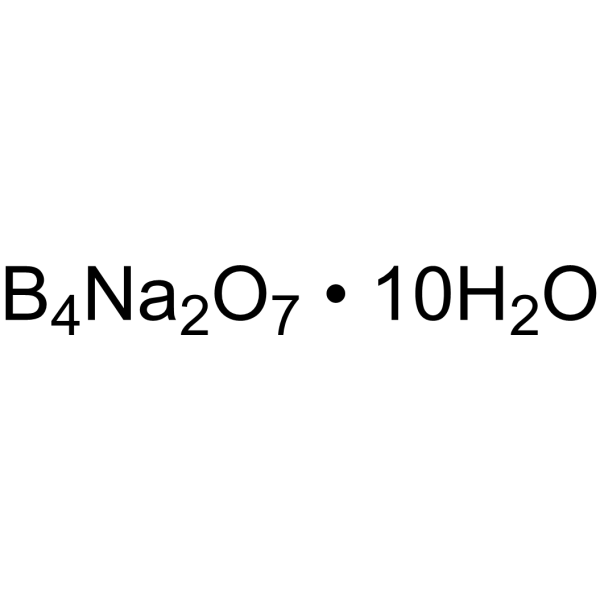
Cat. No.: HY-Y1282
CAS No.: 1303-96-4
Sodium tetraborate decahydrate is an orally active biochemical reagent and antibacterial agent. Sodium tetraborate decahydrate leads to an increase in the activity of Catalase, Superoxide dismutase. Sodium tetraborate decahydrate reduces Hydrogen sulfide and the sulfate-reducing bacteria population of swine manure. Sodium tetraborate decahydrate serves as flame suppressant for wood cellulose. Sodium tetraborate decahydrate is a triglyceride transesterification catalyst. Sodium tetraborate decahydrate suppresses the formation of chlorinated by-products in Cl −-containing water. Sodium tetraborate decahydrate has a neuroprotective effect against chromium poisoning. Sodium tetraborate decahydrate can protect the heart from chromium damage at low doses. Sodium tetraborate in a low dose with an isolated application shows an antioxidant effect .
loading...
    loading...

