107 Results for "

inner

" in MedChemExpress (MCE) Product Catalog:
Products (107)

107 Results for "inner" in MCE Product Catalog:

Cat. No.: HY-P11582
Target:  

Bacterial

Research Areas:  

Infection

CyLip-20 is a cyclic lipopeptide antimicrobial peptide that targets Gram-positive and Gram-negative bacteria. CyLip-20 exhibits low hemolytic activity and mild in vivo toxicity. CyLip-20 disrupts the integrity of bacterial outer membrane, inner membrane and cytoplasmic membrane by binding to bacterial lipopolysaccharide (LPS), triggering membrane permeabilization, depolarization and leakage of intracellular contents, and inhibits bacterial biofilm formation. In animal models, CyLip-20 reduces the bacterial load in skin wounds of mice infected with MRSA, promotes wound healing, decreases the levels of inflammatory cytokines and reduces inflammatory cell infiltration. CyLip-20 can be used in research related to MRSA skin wound infections .
loading...
    loading...
Cat. No.: HY-W017424
CAS No.: 136-95-8
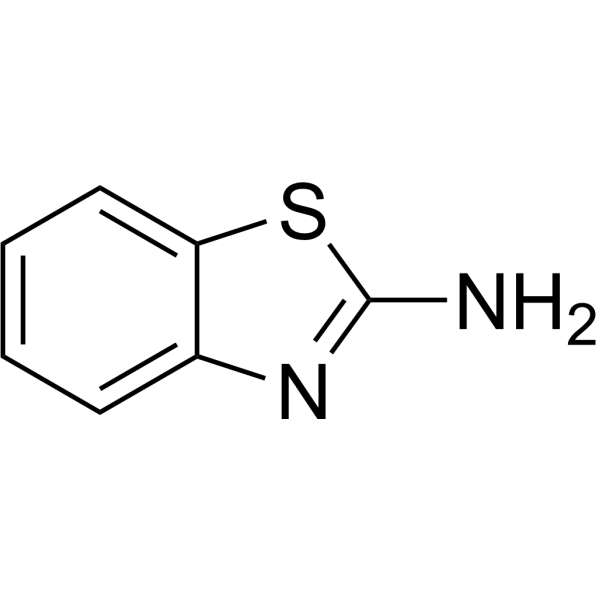
2-Aminobenzothiazole acts as a caspase 3/7 activator, an anticancer cytotoxic agent, and also exhibits neurotoxicity. 2-Aminobenzothiazole drives the apoptotic pathway by activating caspase 3/7, induces mitochondrial inner membrane depolarization, and triggers both early and late apoptosis via a caspase-dependent pathway. In zebrafish models, 2-Aminobenzothiazole induces oxidative damage in brain tissues and inhibits genes related to GABA and 5-HT synthesis pathways. Long-term exposure to 2-Aminobenzothiazole impairs motor ability, social behavior, anxiety-like state and cognitive function. 2-Aminobenzothiazole can be used in studies of human laryngeal carcinoma and related neurotoxicity .
loading...
    loading...
Cat. No.: HY-P71366
Purity:  ≥ 95%, as determined by reducing SDS-PAGE.
Synonyms: DNAJC19; DnaJ Homolog Subfamily C Member 19; DnaJ Heat Shock Protein Family (Hsp40) Member C19; DnaJ (Hsp40) Homolog, Subfamily C, Member 19, Isoform CRA_b; Mitochondrial Import inner Membrane Translocase Subunit TIM14; DnaJ-Like Protein Subfamily C Membe
Species:  
Others
Source:  
E. coli
loading...
    loading...
Cat. No.: HY-P11250
HVF18-a3-d is an antimicrobial peptide. HVF18-a3-d reduces NO production. HVF18-a3-d inhibits the production of TNF-α and IL-6, reduces ROS production, and suppresses the TLR4 signaling pathway, as well as LPS-induced phosphorylation of ERK, JNK, and p38 MAPK. HVF18-a3-d exhibits antimicrobial activity against a variety of bacteria by disrupting their outer and inner membranes. HVF18-a3-d protects mice from fatal septic shock induced by Acinetobacter baumannii resistant to Carbapenem. HVF18-a3-d shows anti-inflammatory and antioxidant effects .
loading...
    loading...
Cat. No.: HY-W017424R
CAS No.: 136-95-8
2-Aminobenzothiazole (Standard) is the analytical standard of 2-Aminobenzothiazole. This product is intended for research and analytical applications. 2-Aminobenzothiazole acts as a caspase 3/7 activator, an anticancer cytotoxic agent, and also exhibits neurotoxicity. 2-Aminobenzothiazole drives the apoptotic pathway by activating caspase 3/7, induces mitochondrial inner membrane depolarization, and triggers both early and late apoptosis via a caspase-dependent pathway. In zebrafish models, 2-Aminobenzothiazole induces oxidative damage in brain tissues and inhibits genes related to GABA and 5-HT synthesis pathways. Long-term exposure to 2-Aminobenzothiazole impairs motor ability, social behavior, anxiety-like state and cognitive function. 2-Aminobenzothiazole can be used in studies of human laryngeal carcinoma and related neurotoxicity .
loading...
    loading...
Cat. No.: HY-D3119
CAS No.: 2246946-49-4
Research Areas:  

Others

MitoAIE1 is a Fluorescent probe for mitochondrial viscosity detection. MitoAIE1 contains a pyridinium structural unit, which endows it with mitochondria-targeting specificity. The detection mechanism of this probe is based on aggregation-induced emission (AIE): in low-viscosity media such as PBS buffer, intramolecular rotation leads to non-radiative energy dissipation, resulting in only weak fluorescence; however, in high-viscosity environments such as the mitochondrial matrix or the vicinity of the inner mitochondrial membrane, such intramolecular motion is restricted, thereby significantly enhancing its fluorescent signal; in addition, this probe is not interfered by changes in microenvironment polarity and pH. Its emission wavelength is 625 nm, with absorption peaks at 325 nm and 450 nm; when transferred from low-viscosity PBS to high-viscosity 99% glycerol, its fluorescence intensity at 625 nm can be increased by 38-fold. It can be used to monitor changes in mitochondrial viscosity during processes such as Stauroporine (HY-15141)-induced apoptosis and starvation-induced mitophagy in live cells, and has good biocompatibility .
loading...
    loading...
Cat. No.: HY-W714524
CAS No.: 321863-21-2
Synonyms: 16:0-18:1 PS (POPS)
1-Palmitoyl-2-oleoyl-sn-glycero-3-PS sodium (16:0-18:1 PS (POPS)) is an anionic phosphatidylserine phospholipid with 16:0 (palmitoyl) and 18:1 (oleoyl) acyl chains. It serves as a component of biomimetic inner plasma membrane models and membrane vesicles for hemostatic response studies. 1-Palmitoyl-2-oleoyl-sn-glycero-3-PS sodium regulates membrane electrical properties by forming tethered bilayer lipid membranes. It enhances the stability of sHDL particles without altering the cholesterol efflux capacity of sHDL. 1-Palmitoyl-2-oleoyl-sn-glycero-3-PS sodium acts synergistically with phosphatidylcholine to support prothrombin activation. It serves as a component of the 4:1 POPC/POPS binary lipid bilayer model. 1-Palmitoyl-2-oleoyl-sn-glycero-3-PS sodium is applicable to research related to atherosclerosis .
loading...
    loading...

