1234 Results for "

Ac

" in MedChemExpress (MCE) Product Catalog:
Products (1234)

1234 Results for "Ac" in MCE Product Catalog:

Cat. No.: HY-P2632C
Research Areas:  

Neurological Disease

RAD16-I, free acid TFA is a derivative of RADA16 (HY-P2632), with no Ac and NH2 modifications at both ends, and it has the same function as RADA16. RAD16-I, free acid TFA is a non-directed self-assembling peptide hydrogel. Under physiological conditions, RAD16-I, free acid TFA spontaneously forms a three-dimensional nanofiber network that mimics the extracellular matrix, and possesses excellent properties such as high water content, biocompatibility and degradability. RAD16-I, free acid TFA serves as an ideal scaffold for three-dimensional cell culture. RAD16-I, free acid TFA not only maintains cell viability and induces self-organization, but also supports cell adhesion, proliferation, differentiation and insulin secretion, effectively stabilizes islet clusters and promotes directed differentiation of the cardiac lineage. RAD16-I, free acid TFA can construct a cell-friendly nano-microenvironment for research related to diseases such as myocardial infarction and diabetes .
loading...
    loading...
Cat. No.: HY-N1510
CAS No.: 22149-35-5
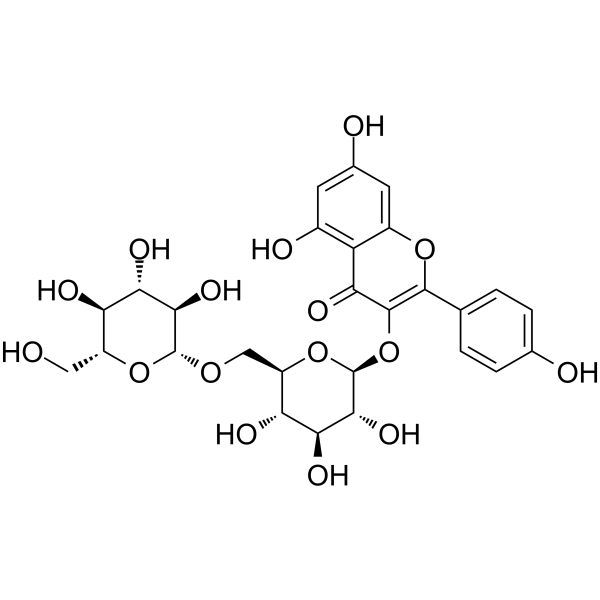
Kaempferol 3-O-gentiobioside is an orally active flavonoid, with a Ka value of 57 µM against human NOTCH1 and an IC50 value of 50 μM against α-glucosidase. Kaempferol 3-O-gentiobioside inhibits the NOTCH signaling pathway. It downregulates the expression of TLR4 and NLRP3, and suppresses the activation and nuclear translocation of NF-κB. Kaempferol 3-O-gentiobioside inhibits the expression of MUC5AC, reduces nitrite and ROS levels, and attenuates excessive mucus secretion. It exhibits antibacterial activity, reducing the formation and growth of MRSA biofilms. Kaempferol 3-O-gentiobioside blocks the TGF-β/ALK5/Smad signaling pathway and inhibits epithelial-mesenchymal transition. It suppresses the proliferation, migration, invasion and metastatic growth of tumor cells. Kaempferol 3-O-gentiobioside alleviates airway inflammation and mucus hypersecretion in mice with allergic asthma . It reduces the volume of ovarian cancer xenografts in mice. Kaempferol 3-O-gentiobioside can be used in research related to allergic asthma, diabetes, MRSA infection, breast cancer, gastric cancer and ovarian cancer .
loading...
    loading...
Cat. No.: HY-N22017
CAS No.: 2341324-20-5
(4,5-Dichloro-1H-pyrrol-2-yl)(3-hexyl-2,4-dihydroxyphenyl) methanone is an antibacterial agent discovered from Streptomyces armeniacus. (4,5-Dichloro-1H-pyrrol-2-yl)(3-hexyl-2,4-dihydroxyphenyl) methanone inhibits the growth of Gram-positive bacteria and shows no activity against the tested Gram-negative bacteria. (4,5-Dichloro-1H-pyrrol-2-yl)(3-hexyl-2,4-dihydroxyphenyl) methanone is a biosynthetic intermediate of Armeniaspirol A-C (HY-N15548) (HY-N15550) (HY-N15551). (4,5-Dichloro-1H-pyrrol-2-yl)(3-hexyl-2,4-dihydroxyphenyl) methanone can be used in studies related to infections caused by Gram-positive bacteria such as Staphylococcus aureus, Enterococcus faecalis, and Bacillus subtilis .
loading...
    loading...
Cat. No.: HY-P76382
Purity:  ≥ 95%, as determined by reducing SDS-PAGE.
Synonyms: H2Ac25; Histone H2A Type 3; Prev. HIST3H2A; H2A.W Histone; Prev. H2AW; MGC3165; Histone Cluster 3, H2a; H2A-Clustered Histone 25; Histone Cluster 3 H2A; H2A Clustered Histone 25; Histone 3, H2a
Species:  
Human
Source:  
E. coli
loading...
    loading...
Cat. No.: HY-P702861
Purity:  ≥ 90%, as determined by reducing SDS-PAGE.
Synonyms: ATP6V0D1; V-Type Proton ATPase Subunit D 1; Prev. ATP6D; 32 KDa Accessory Protein; VPATPD; V-ATPase Ac39 Subunit; P39; V-ATPase Subunit D 1; ATP6DV; ATPase, H+ Transporting, Lysosomal 38kDa, V0 Subunit D Isoform 1; VATX; H(+)-Transporting Two-Sector ATPas
Species:  
Human
Source:  
E. coli
loading...
    loading...
Cat. No.: HY-P811866
Synonyms: ABRAXAS2; Abraxas 2, BRISC Complex Subunit; KIAA0157; ABRO1; FAM175B; Family With Sequence Similarity 175 Member B; BRISC Complex Subunit Abraxas 2; Abraxas Brother Protein 1; Em:Ac068896.4; Family With Sequence Similarity 175, Member B; BRISC Complex Subunit Abro1; Abraxas Brother 1; Abraxas Brother; Protein FAM175B

Host:  

Mouse

Application:  

WB, FC

Reactivity:  

Human

loading...
    loading...
Cat. No.: HY-P811866A
Synonyms: ABRAXAS2; Abraxas 2, BRISC Complex Subunit; KIAA0157; ABRO1; FAM175B; Family With Sequence Similarity 175 Member B; BRISC Complex Subunit Abraxas 2; Abraxas Brother Protein 1; Em:Ac068896.4; Family With Sequence Similarity 175, Member B; BRISC Complex Subunit Abro1; Abraxas Brother 1; Abraxas Brother; Protein FAM175B

Host:  

Mouse

Application:  

WB, FC

Reactivity:  

Human

loading...
    loading...
Cat. No.: HY-113402AR
CAS No.: 283159-88-6
Synonyms: γ-Glu-Cys TFA (Standard)
Gamma-glutamylcysteine (TFA) (Standard) is the analytical standard of Gamma-glutamylcysteine (TFA). This product is intended for research and analytical applications. Gamma-glutamylcysteine TFA (γ-Glu-Cys TFA) is an orally active, blood-brain barrier permeable dipeptide . Gamma-glutamylcysteine TFA activates AMPK, SIRT1, IL-4/STAT6, AC/cAMP/PI3K, IGF-1R/IRS1/PI3K, and Nrf2 signaling pathways; it inhibits NF-κB, JAK1/STAT1/3, MAPKs, cadmium-induced p38 MAPK, JNK, and PI3K/Akt signaling pathways. Gamma-glutamylcysteine TFA regulates macrophage polarization, modulates the trafficking of CD36 and GLUT4, induces glutathione synthesis, improves metabolic dysfunction, reduces lipid deposition, ameliorates glucose homeostasis, inhibits apoptosis (Apoptosis), stabilizes mitochondria, suppresses lipid peroxidation, iron accumulation and ferroptosis (Ferroptosis), reduces ds-HMGB1 levels, reverses mechanical hyperalgesia, and alleviates hepatic lipid droplet formation. Gamma-glutamylcysteine TFA is applicable to research related to inflammatory bowel disease, type 2 diabetes, cadmium-induced neurotoxicity, Alzheimer's disease, cerebral ischemia/reperfusion injury, neuropathy, and alcoholic liver disease.
loading...
    loading...
Cat. No.: HY-113402B
Synonyms: γ-Glu-Cys ammonium
Gamma-glutamylcysteine ammonium (γ-Glu-Cys ammonium) is an orally active, blood-brain barrier permeable dipeptide . Gamma-glutamylcysteine ammonium activates AMPK, SIRT1, IL-4/STAT6, AC/cAMP/PI3K, IGF-1R/IRS1/PI3K, and Nrf2 signaling pathways; it inhibits NF-κB, JAK1/STAT1/3, MAPKs, cadmium-induced p38 MAPK, JNK, and PI3K/Akt signaling pathways. Gamma-glutamylcysteine ammonium regulates macrophage polarization, modulates the trafficking of CD36 and GLUT4, induces glutathione synthesis, improves metabolic dysfunction, reduces lipid deposition, ameliorates glucose homeostasis, inhibits apoptosis (Apoptosis), stabilizes mitochondria, suppresses lipid peroxidation, iron accumulation and ferroptosis (Ferroptosis), reduces ds-HMGB1 levels, reverses mechanical hyperalgesia, and alleviates hepatic lipid droplet formation. Gamma-glutamylcysteine ammonium is applicable to research related to inflammatory bowel disease, type 2 diabetes, cadmium-induced neurotoxicity, Alzheimer's disease, cerebral ischemia/reperfusion injury, neuropathy, and alcoholic liver disease .
loading...
    loading...
Cat. No.: HY-113402R
CAS No.: 636-58-8
Synonyms: γ-Glu-Cys (Standard)
Gamma-glutamylcysteine (Standard) is the analytical standard of Gamma-glutamylcysteine. This product is intended for research and analytical applications. Gamma-glutamylcysteine (γ-Glu-Cys) is an orally active, blood-brain barrier permeable dipeptide . Gamma-glutamylcysteine activates AMPK, SIRT1, IL-4/STAT6, AC/cAMP/PI3K, IGF-1R/IRS1/PI3K, and Nrf2 signaling pathways; it inhibits NF-κB, JAK1/STAT1/3, MAPKs, cadmium-induced p38 MAPK, JNK, and PI3K/Akt signaling pathways. Gamma-glutamylcysteine regulates macrophage polarization, modulates the trafficking of CD36 and GLUT4, induces glutathione synthesis, improves metabolic dysfunction, reduces lipid deposition, ameliorates glucose homeostasis, inhibits apoptosis (Apoptosis), stabilizes mitochondria, suppresses lipid peroxidation, iron accumulation and ferroptosis (Ferroptosis), reduces ds-HMGB1 levels, reverses mechanical hyperalgesia, and alleviates hepatic lipid droplet formation. Gamma-glutamylcysteine is applicable to research related to inflammatory bowel disease, type 2 diabetes, cadmium-induced neurotoxicity, Alzheimer's disease, cerebral ischemia/reperfusion injury, neuropathy, and alcoholic liver disease.
loading...
    loading...
Cat. No.: HY-P86411
Synonyms: PP2A A; PP2A alpha; PP2A B; PP2A beta; PP2A-alpha; PP2A-beta; PP2AA_HUMAN; PP2Aalpha; PP2AB_HUMAN; PP2Abeta; PP2Ac; PP2CA; PP2Calpha; PP2CB; PPP2CA; PPP2CB; Protein phosphatase 2 catalytic subunit alpha isoform; Protein phosphatase 2 catalytic subunit beta isoform; Protein phosphatase type 2A catalytic subunit; Replication protein C; RP C; RP-C; RPC; Serine/threonine protein phosphatase 2A catalytic subunit alpha isoform; Serine/threonine protein phosphatase 2A catalytic subunit beta isoform; Serine/threonine-protein phosphatase 2A catalytic subunit alpha isoform;

Host:  

Rabbit

Application:  

WB, IHC-P, ICC/IF, IP, ELISA

Reactivity:  

Human, Mouse, Rat

loading...
    loading...
Cat. No.: HY-P85483
Synonyms: Ac2-121; AL022808; E3 ubiquitin-protein ligase UHRF1; FLJ21925; Hnp95 Huhrf1; HuNp95; ICBP90; Inverted CCAAT box binding protein of 90 kDa; Inverted CCAAT box binding protein, 90-Kd; Inverted CCAAT box-binding protein of 90 kDa; Liver regeneration-related protein LRRG126; MGC138707; NP95; Nuclear phosphoprotein, 95-KD; Nuclear protein 95; Nuclear zinc finger protein Np95; RING finger protein 106; RNF106; Transcription fActor ICBP90; Ubiquitin like containing PHD and RING finger domains protein 1; Ubiquitin like PHD and RING finger domain containing protein 1; Ubiquitin-like PHD and RING finger domain-containing protein 1; Ubiquitin-like protein containing PHD and RING finger domains 1; Ubiquitin-like with PHD and ring finger domains 1; Ubiquitin-like, containing PHD and RING finger domains, 1; Ubiquitin-like-containing PHD and RING finger domains protein 1; UHRF1; UHRF1_HUMAN.

Host:  

Mouse

Application:  

WB

Reactivity:  

Human, Mouse

loading...
    loading...
Cat. No.: HY-P86144
Synonyms: HIST1H3A; H3FA; HIST1H3B; H3FL; HIST1H3C; H3FC; HIST1H3D; H3FB; HIST1H3E; H3FD; HIST1H3F; H3FI; HIST1H3G; H3FH; HIST1H3H; H3FK; HIST1H3I; H3FF; HIST1H3J; H3FJ; Histone H3.1; Histone H3/a; Histone H3/b; Histone H3/c; Histone H3/d; Histone H3/f; Histone H3/h; Histone H3/i; Histone H3/j; Histone H3/k; Histone H3/l; HIST2H3A; HIST2H3C; H3F2; H3FM; HIST2H3D; Histone H3.2; Histone H3/m; Histone H3/o; H3F3A; H3.3A; H3F3; PP781; H3F3B; H3.3B; Histone H3.3; H3k36Ac

Host:  

Rabbit

Application:  

WB, IHC-P, ICC/IF, IP, ChIP, ELISA

Reactivity:  

Human, Mouse, Rat

loading...
    loading...
Cat. No.: HY-P80181
Synonyms: H4/A, H4FA, HIST1H4A, H4C2, H4/I, H4FI, HIST1H4B, H4C3, H4/G, H4FG, HIST1H4C, H4C4, H4/B, H4FB, HIST1H4D, H4C5, H4/J, H4FJ, HIST1H4E, H4C6, H4/C, H4FC, HIST1H4F, H4C8, H4/H, H4FH, HIST1H4H, H4C9, H4/M, H4FM, HIST1H4I, H4C11, H4/E, H4FE, HIST1H4J, H4C12, H4/D, H4FD, HIST1H4K, H4C13, H4/K, H4FK, HIST1H4L, H4C14, H4/N, H4F2, H4FN, HIST2H4, HIST2H4A, H4C15, H4/O, H4FO, HIST2H4B, H4C16, H4-16, HIST4H4, H4C1, Histone H4, H4K5Ac

Host:  

Rabbit

Application:  

WB, IHC-P

Reactivity:  

Human, Mouse

loading...
    loading...

