1328 Results for "

accumulation

" in MedChemExpress (MCE) Product Catalog:
Products (1328)

1328 Results for "accumulation" in MCE Product Catalog:

Cat. No.: HY-173119
SKLB-D18 is an orally active ERK1/2/ERK5 inhibitor, with an IC50 of 38.69 nM and a Kd of 126.9 nM against human ERK1, an IC50 of 40.12 nM and a Kd of 209.8 nM against ERK2, and an IC50 of 59.72 nM and a Kd of 468.2 nM against ERK5. SKLB-D18 inhibits cancer cell proliferation, induces G0/G1 cell cycle arrest and apoptosis. SKLB-D18 reduces the levels of p-ERK5, p-RSKp90, p-c-Myc and c-Myc, and upregulates the level of p-ERK1/2, thereby inhibiting the ERK1/2/5 pathway in cells. SKLB-D18 increases LC3B-II accumulation, and decreases the levels of p62, p-mTOR and p-p70S6K. SKLB-D18 elevates the levels of ROS, lipid peroxidation and free ferrous ions, reduces the levels of NCOA4 and GPX4, and induces ferritin autophagy-dependent ferroptosis in cancer cells. SKLB-D18 exhibits antitumor activity in a triple-negative breast cancer xenograft mouse model. SKLB-D18 can be used in research related to triple-negative breast cancer .
loading...
    loading...
Cat. No.: HY-184926
PEG9MA10-PAB10-GalMA10 is a CD147 LYTAC degrader. PEG9MA10-PAB10-GalMA10 binds to the asialoglycoprotein receptor (ASGPR) via its galactose methacrylate domain, mediating its uptake by hepatoma cells. PEG9MA10-PAB10-GalMA10 induces lysosome-dependent degradation of CD147, resulting in concurrent loss of associated MCT1 and MCT4. PEG9MA10-PAB10-GalMA10 reduces extracellular lactate levels, increases intracellular lactate accumulation, inhibits glycolytic activity, and enhances mitochondrial respiratory capacity. PEG9MA10-PAB10-GalMA10 decreases the secretion of MMP-2 and MMP-9, and upregulates the expression of E-cadherin. PEG9MA10-PAB10-GalMA10 exhibits anti-tumor efficacy in hepatoma models. PEG9MA10-PAB10-GalMA10 can be used for research on liver cancer (hepatocellular carcinoma) .
loading...
    loading...
Cat. No.: HY-N0493R
CAS No.: 520-12-7
Pectolinarigenin (Standard) is the analytical standard of Pectolinarigenin. This product is intended for research and analytical applications. Pectolinarigenin is an orally active dual inhibitor of COX-2/5-LOX with anti-inflammatory, antioxidant, antitumor and neuroprotective activities. Pectolinarigenin exerts neuroprotective and anti-inflammatory effects on astrocyte inflammation via the NFκB and MAPK pathways. Pectolinarigenin inhibits LPS-induced phosphorylation of ERK1/2, N-FκB and p38MAPK, directly inhibits the enzymatic activity or binding of COX-2, 5-LOX and HIF-1α, and reduces the level of XIAP. Pectolinarigenin modifies Keap1 to promote nuclear accumulation of Nrf2, induces ARE-mediated antioxidant enzyme expression, and possesses direct free radical scavenging activity. Pectolinarigenin reduces the release of NO, proinflammatory mediators and leukotrienes, and increases the level of IL-10. Pectolinarigenin induces G2/M cell cycle arrest, apoptosis (Apoptosis) and autophagy (Autophagy) via the PI3K/AKT/mTOR signaling pathway. Pectolinarigenin reduces renal crystal deposition and inhibits melanin synthesis. Pectolinarigenin inhibits inflammation and alleviates allergy in mouse models of inflammation. Pectolinarigenin alleviates renal injury, inflammation and oxidative stress in mice by inhibiting HIF-1α activity. Pectolinarigenin can be used for the research of neurodegenerative diseases, inflammatory/allergic diseases, calcium oxalate nephrocalcinosis, gastric cancer, melasma, post-inflammatory diseases and chloasma.
loading...
    loading...
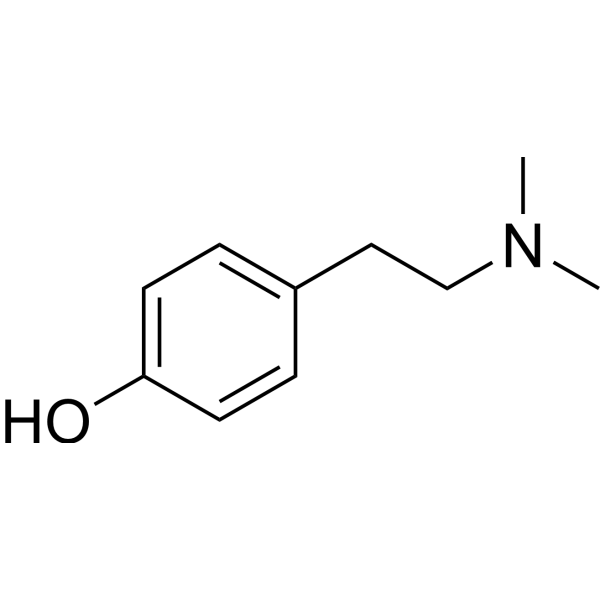
Cat. No.: HY-N0113A
CAS No.: 62493-39-4
Synonyms: Ordenina sulfate; Peyocactine sulfate
Hordenine sulfate (Ordenina sulfate; Peyocactine sulfate) is a multifunctional alkaloid with oral activity and blood-brain barrier penetration. Hordenine sulfate inhibits LPS-induced phosphorylation of p38, JNK, ERK1/2, p65, IκB, and AKT, prevents p65 nuclear translocation, and suppresses inflammatory cytokines and mediators. Hordenine sulfate promotes M2 macrophage polarization, restores blood-milk barrier integrity, alleviates oxidative stress by reducing ROS and MDA, and attenuates LPS-induced lung injury and pulmonary edema. Hordenine sulfate inhibits cAMP production, CREB phosphorylation, and MITF expression, thereby suppressing melanin synthesis in melanocytes and reconstructed epidermis. Hordenine sulfate activates the Wnt/β-catenin signaling pathway, promotes dermal papilla cell proliferation and hair shaft elongation, and accelerates hair regeneration. Hordenine sulfate activates DRD2, acts as a D3R partial agonist, α2A-AR full agonist, and 5-HT2A-R antagonist, and inhibits SERT and DAT. Hordenine sulfate inhibits α-synuclein accumulation and ameliorates motor deficits in Parkinson's disease models. Hordenine sulfate limits alcohol intake, reduces relapse drinking behavior, and modulates alcohol-induced conditioned place preference. Hordenine sulfate can be used for research on mastitis, skin pigmentation, acute lung injury, foodborne diseases, hair loss, Parkinson's disease, bacterial infections, and alcohol use disorder .
loading...
    loading...
Cat. No.: HY-N0113R
CAS No.: 539-15-1
Synonyms: Ordenina (Standard); Peyocactine (Standard)
Hordenine (Standard) (Ordenina (Standard); Peyocactine (Standard)) is the analytical standard of Hordenine (HY-N0113). This product is intended for research and analytical applications. Hordenine (Ordenina; Peyocactine) is a multifunctional alkaloid with oral activity and blood-brain barrier penetration. Hordenine inhibits LPS-induced phosphorylation of p38, JNK, ERK1/2, p65, IκB, and AKT, prevents p65 nuclear translocation, and suppresses inflammatory cytokines and mediators. Hordenine promotes M2 macrophage polarization, restores blood-milk barrier integrity, alleviates oxidative stress by reducing ROS and MDA, and attenuates LPS-induced lung injury and pulmonary edema. Hordenine inhibits cAMP production, CREB phosphorylation, and MITF expression, thereby suppressing melanin synthesis in melanocytes and reconstructed epidermis. Hordenine activates the Wnt/β-catenin signaling pathway, promotes dermal papilla cell proliferation and hair shaft elongation, and accelerates hair regeneration. Hordenine activates DRD2, acts as a D3R partial agonist, α2A-AR full agonist, and 5-HT2A-R antagonist, and inhibits SERT and DAT. Hordenine inhibits α-synuclein accumulation and ameliorates motor deficits in Parkinson's disease models. Hordenine limits alcohol intake, reduces relapse drinking behavior, and modulates alcohol-induced conditioned place preference. Hordenine can be used for research on mastitis, skin pigmentation, acute lung injury, foodborne diseases, hair loss, Parkinson's disease, bacterial infections, and alcohol use disorder .
loading...
    loading...
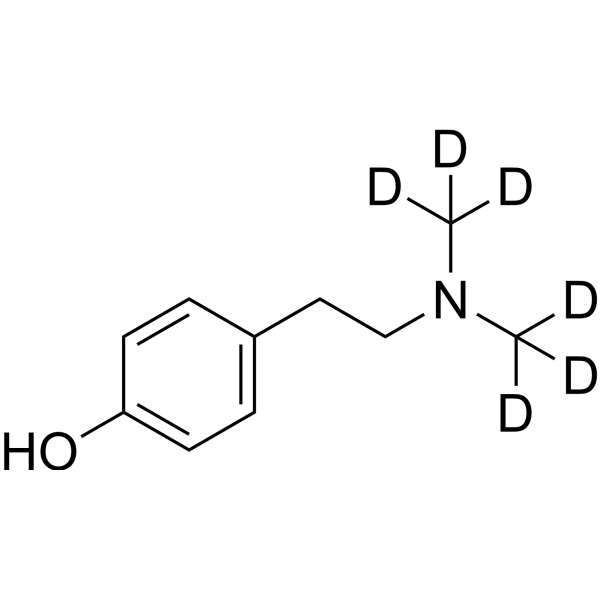
Cat. No.: HY-N0113S
CAS No.: 1346598-66-0
Synonyms: Ordenina-d6; Peyocactine-d6
Hordenine-d6 (Ordenina-d6; Peyocactine-d6) is the deuterated-labeled Hordenine (HY-N0113). Hordenine (Ordenina; Peyocactine) is a multifunctional alkaloid with oral activity and blood-brain barrier penetration. Hordenine inhibits LPS-induced phosphorylation of p38, JNK, ERK1/2, p65, IκB, and AKT, prevents p65 nuclear translocation, and suppresses inflammatory cytokines and mediators. Hordenine promotes M2 macrophage polarization, restores blood-milk barrier integrity, alleviates oxidative stress by reducing ROS and MDA, and attenuates LPS-induced lung injury and pulmonary edema. Hordenine inhibits cAMP production, CREB phosphorylation, and MITF expression, thereby suppressing melanin synthesis in melanocytes and reconstructed epidermis. Hordenine activates the Wnt/β-catenin signaling pathway, promotes dermal papilla cell proliferation and hair shaft elongation, and accelerates hair regeneration. Hordenine activates DRD2, acts as a D3R partial agonist, α2A-AR full agonist, and 5-HT2A-R antagonist, and inhibits SERT and DAT. Hordenine inhibits α-synuclein accumulation and ameliorates motor deficits in Parkinson's disease models. Hordenine limits alcohol intake, reduces relapse drinking behavior, and modulates alcohol-induced conditioned place preference. Hordenine can be used for research on mastitis, skin pigmentation, acute lung injury, foodborne diseases, hair loss, Parkinson's disease, bacterial infections, and alcohol use disorder .
loading...
    loading...
Cat. No.: HY-D3133
CAS No.: 2410296-16-9
Target:  

Fluorescent Dye

Research Areas:  

Others

HS-CyBz is a Fluorescent probe for H₂S detection, enabling ratiometric optical/photoacoustic dual-modality in/ex vivo imaging. Its detection mechanism relies on nucleophilic substitution of its benzoic ester group by HS⁻, which releases an enolic meso-hydroxyltricarboheptamethine cyanine that then undergoes keto-enol tautomerization to form Cy-ketone; this tautomerization causes distinct shifts in absorption and emission spectra, producing a ratiometric response that reduces interferences from tissue scattering, autofluorescence, and probe concentration. In its initial state, HS-CyBz has an excitation wavelength of 595 nm, with emission bands centered at 805 nm (main) and 630 nm (minor); upon reaction with H₂S, the 805 nm emission band decreases while the 630 nm band drastically increases, and its absorption spectrum shows a sharp band at 775 nm and a shoulder band at 708 nm, which decrease upon H₂S reaction with a minor increase at 850 nm and an isosbestic point at 825 nm. For in vivo optical imaging, excitation at 560 nm is used with emission channels at 620 nm and 790 nm, while in vivo photoacoustic imaging uses excitation at 775 nm and 825 nm. The detection limit of HS-CyBz for H₂S is 0.5 μM, and it shows high selectivity, with only H₂S inducing a distinct enhancement of the emission ratio F₆₃₀/F₈₀₅ and PA ratio PA₈₂₅/PA₇₇₅, while other biochemical species including cations, anions, reactive oxygen species, biothiols, and carboxylesterase trigger only minor changes and do not interfere with H₂S sensing. Tail intravenous injection of HS-CyBz leads to accumulation in the liver of mice, and it can be used to verify endogenous H₂S upregulation triggered by S-adenosyl-L-methionine via ratiometric optical/photoacoustic imaging .
loading...
    loading...
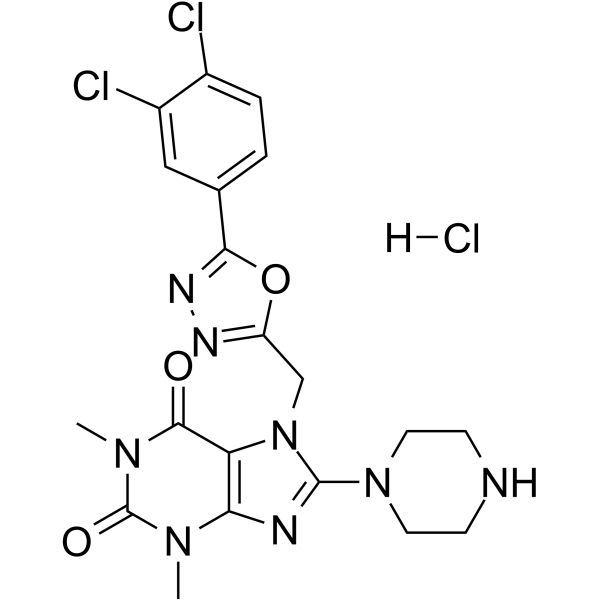
Cat. No.: HY-125209A
CAS No.: 2253744-57-7
Research Areas:  

Cancer

TH5427 hydrochloride is a NUDT5 inhibitor with a human target IC50 of 29 nM, ~690-fold selectivity over MTH1 in vitro, and selective functional inhibition over other NUDIX hydrolases including NUDT9 .TH5427 hydrochloride binds to the active site of NUDT5, blocking enzymatic activity related to ADP-ribose metabolism and PAR-derived ATP synthesis .TH5427 hydrochloride blocks progestin-dependent nuclear ATP synthesis, impairs progestin-induced chromatin remodeling, inhibits histone H1 displacement, disrupts progestin-dependent gene regulation, and abrogates progestin-dependent proliferation in breast cancer cells .TH5427 hydrochloride functions as a versatile probe to study nuclear ATP dynamics and ADP-ribose-related metabolism in cells .TH5427 hydrochloride engages NUDT5 at physiological temperatures, as demonstrated by Drug Affinity Responsive Target Stability (DARTS) assay .TH5427 hydrochloride stabilizes NUDT5 against thermal denaturation in cell lysates and intact cells, as shown by cellular thermal shift assay (CETSA) .TH5427 hydrochloride functionally inhibits NUDT5 activity, leading to downstream effects on oxidative DNA damage and DNA replication in triple-negative breast cancer (TNBC) cells .TH5427 hydrochloride suppresses proliferation of TNBC cells without inducing cell death or apoptosis, slows DNA replication in TNBC cells, promotes accumulation of oxidative DNA lesions, and triggers DNA damage response in TNBC cells .TH5427 hydrochloride suppresses growth of TNBC cells in vitro, inhibits growth of TNBC xenograft tumors in nude mice in vivo, and shows greater potency against TNBC cell lines compared to ER-positive and normal-like breast cell lines .TH5427 hydrochloride can be used for the research of breast cancer and triple-negative breast cancer .
loading...
    loading...

