133 Results for "

CD34+/CD38- subpopulation

" in MedChemExpress (MCE) Product Catalog:
Products (133)

133 Results for "CD34+/CD38- subpopulation" in MCE Product Catalog:

Cat. No.: HY-108417
CAS No.: 1332329-27-7
Target:  

STAT JAK Bcr-Abl

Research Areas:  

Cancer

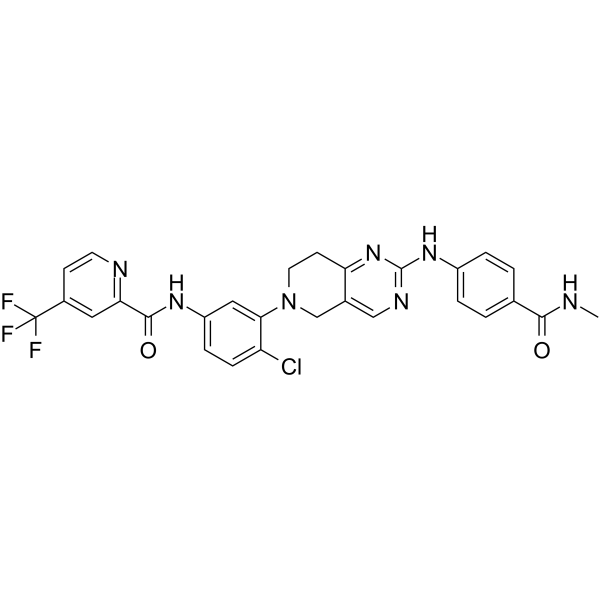
Debio 0617B, a multi-kinase inhibitor, reduces maintenance and self-renewal of primary human AML CD34 + stem/progenitor cells. Debio 0617B has a unique profile targeting key kinases upstream of STAT3/STAT5 signaling such as JAK, SRC, ABL, and class III/V receptor tyrosine kinases (TKs). Debio 0617B has documented efficacy in STAT3-driven solid tumors .
loading...
    loading...
Cat. No.: HY-124693
CAS No.: 869767-86-2
Target:  

Apoptosis

Research Areas:  

Cancer

DB1055 is a HOXA9 inhibitor that competes with HOXA9 binding to DNA (blocking its DNA interaction activity). DB1055 induces in vitro cell growth reduction, cell apoptosis, and differentiation in human acute myeloid leukemia (AML) cells. DB1055 leads to monocyte-to-macrophage differentiation and exhibits antileukemic activities in a human THP-1 AML in vivo model. DB1055 does not impact human CD34+ bone marrow cells. DB1055 can be used for the research of acute myeloid leukemia[1].
loading...
    loading...
Cat. No.: HY-19867
CAS No.: 1191448-17-5
Synonyms: TG-0054
Target:  

CXCR

Research Areas:  

Cancer

Burixafor (TG-0054) is a potent CXCR4 antagonist with a pIC50 of 7.4. Burixafor inhibits the binding of CXCL12 to CXCR4, antagonizes CXCL12-induced recruitment of Gαᵢ and β-arrestin2, and blocks the downstream Gαᵢ-mediated inhibitory effect on cAMP signal transduction. Burixafor mobilizes CD34 + hematopoietic stem/progenitor cells (HSPC) from the bone marrow to the peripheral blood. Burixafor can be used for research on autologous hematopoietic stem cell transplantation (ASCT) .
loading...
    loading...
Cat. No.: HY-110208R
CAS No.: 32703-82-5
Research Areas:  

Cancer

BRD9876 (Standard) is the analytical standard of BRD9876 (HY-110208). This product is intended for research and analytical applications. BRD9876 is the "rigor" inhibitor that locks Kinesin-5 (Eg5) in a state with enhanced microtubules (MTs) binding, leading to bundling and stabilization of MTs. BRD9876 interacts with the tyrosine 104 residue that is part of the α4-α6 allosteric binding pocket. BRD9876 specifically targets microtubule-bound Eg5 and selectively inhibits myeloma over CD34 cells. BRD9876 has the potential for multiple myeloma (MM) research .
loading...
    loading...
Cat. No.: HY-N8189
CAS No.: 119425-91-1
Loureirin D is a selective P2Y12 receptor antagonist that penetrates the blood-brain barrier. Loureirin D inhibits the MAPK/JNK/ERK/p38 signaling pathway in microglia by acting on CD38, and inhibits ADP (HY-W010918)-induced platelet aggregation, MMP2/9-mediated tight junction disruption, and ischemia-related blood-brain barrier damage. Loureirin D protects endothelial cells from OGD-induced apoptosis. Loureirin D is used in studies of ischemic stroke and thrombosis .
loading...
    loading...
Cat. No.: HY-P991800

Research Areas:  

Inflammation/Immunology

Anti-Mouse Dendritic Cells Antibody (33D1) reacts with the mouse dendritic cells. Dendritic cells (DC) are a small subpopulation of lymphoid cells with distinctive cytologic features, surface properties, and functions. Recommend Isotype Controls: Rat IgG2b kappa, Isotype Control (HY-P990682) .
loading...
    loading...
Cat. No.: HY-108161
CAS No.: 86187-86-2
Target:  

Interleukin Related

Research Areas:  

Others

LF 1695 is an immunomodulator. LF 1695 enhances the proliferative response of T cells by increasing the production of IL2 (interleukin-2) or the expression of the IL2 receptor. LF 1695 also increases CONA-induced inhibitory activity in human lymphocytes. LF 1695 can be used to study the proliferative and inhibitory activity of T cell subpopulations, as well as their role in immune regulation .
loading...
    loading...
Cat. No.: HY-N15201
CAS No.: 51068-94-1
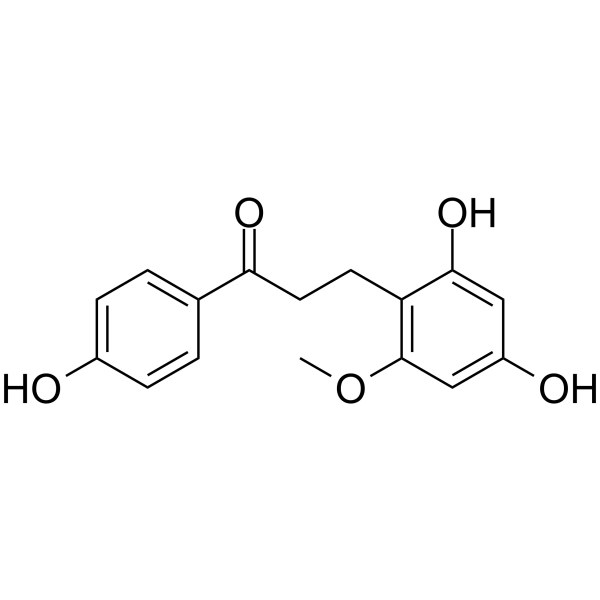
Betavulgarin is an anticancer agent. Betavulgarin can be isolated from Sugar Beet (Beta vulgaris). Betavulgarin suppresses the proliferation, migration, colony formation, and mammosphere formation of breast cancer cells, and reduces the size of the CD44 +/CD24 − subpopulation and the expression of the self-renewal- related genes C-Myc, Nanog and Oct4. Betavulgarin promotes BCSCs death through the regulation of Stat3/Sox2 signaling .
loading...
    loading...
Cat. No.: HY-134920
CAS No.: 2116519-76-5
LW106 is a selective IDO1 inhibitor with an IC50 of 1.57 μM. LW106 has no inhibitory effect on IDO2 and TDO. LW106 inhibits tumor outgrowth by limiting stroma-immune crosstalk and CSC enrichment in the tumor microenvironment. LW106 reduces subpopulation of cancer stem cells (CSCs) in xenografted tumors in which less proliferative/invasive tumor cells and more tumor cells apoptosis. LW106 can be used for the studies of lung cancer and melanoma .
loading...
    loading...
Cat. No.: HY-D3277
PE-VF594 is a high-brightness fluorescent dye used in flow cytometry, primarily for labeling antibodies or streptavidin to help identify specific cell subpopulations. PE-VF594 is a tandem dye composed of two covalently linked fluorescent groups: one is phycoerythrin (PE), responsible for absorbing laser energy; the other is the receptor molecule VF594. Energy is transferred from PE to VF594 via fluorescence resonance energy transfer (FRET) mechanism (Ex/Em = 450-500 nm/614 nm) .
loading...
    loading...
Cat. No.: HY-P99048S
15N-Labeled Sintilimab is the 15N-labeled Sintilimab (HY-P99048). Sintilimab (IBI308) is a safe and effectivel humanized IgG4 monoclonal antibody that binds to PD-1 with a Kd value of 74 pM. Sintilimab blocks the interaction of PD-1 with its ligands (PD-L1 and PL-L2), consequently helping to restore the endogenous antitumour T-cell response. Sintilimab combined with prebiotics inhibits tumor volume and regulates immune cell subpopulation balance in lung adenocarcinoma mice. Sintilimab can be used for the research of classical Hodgkin's lymphoma, non-small cell lung cancer and oesophageal cancer.
loading...
    loading...
Cat. No.: HY-P99048A
Synonyms: IBI308 (Anti-PD-1)

Target:  

PD-1/PD-L1

Research Areas:  

Inflammation/Immunology Cancer

Sintilimab (Anti-PD-1) (IBI308 (Anti-PD-1)) is a safe and effectivel humanized IgG4 monoclonal antibody that binds to PD-1 with a KD value of 74 pM. Sintilimab (Anti-PD-1) blocks the interaction of PD-1 with its ligands (PD-L1 and PL-L2), consequently helping to restore the endogenous antitumour T-cell response. Sintilimab (Anti-PD-1) combined with prebiotics inhibits tumor volume and regulates immune cell subpopulation balance in lung adenocarcinoma mice. Sintilimab (Anti-PD-1) can be used for the research of classical Hodgkin's lymphoma, non-small cell lung cancer and oesophageal cancer .
loading...
    loading...
Cat. No.: HY-L020
654 compounds

The developmental proteins Hedgehog, Notch and Wnt are key regulators of cell fate, proliferation, migration and differentiation in several tissues. Their related signaling pathways are frequently activated in tumors, and particularly in the rare subpopulation of cancer stem cells. The Wnt signaling pathway is a conserved pathway in animals. Deregulated Wnt signaling has catastrophic consequences for the developing embryo and it is now well appreciated that defective Wnt signaling is a causative factor for a number of pleiotropic human pathologies, including cancer. Hedgehog signaling pathway is linked to tumorigenesis and is aberrantly activated in a variety of cancers. The Notch signaling pathway is a highly conserved cell signaling system present in most animals. It plays an important role in cell-cell communication, and further regulates embryonic development.

MCE designs a unique collection of 654 Wnt/Hedgehog/Notch signaling pathway-related small molecules. Wnt/Hedgehog/Notch Compound Library serves as a useful tool for stem cell research and anti-cancer drug screening.

