1680 Results for "

precursor

" in MedChemExpress (MCE) Product Catalog:
Products (1680)

1680 Results for "precursor" in MCE Product Catalog:

Cat. No.: HY-W003845
CAS No.: 69205-79-4
7-Cyano-7-deazaguanine is a key purine precursor molecule in the 7-deazaguanine pathway. 7-Cyano-7-deazaguanine acts as a substrate for transglycosylases to participate in base exchange reactions, replacing native guanine in nucleic acids to generate 7-deazaguanine-modified DNA or tRNA; it can be catalyzed by QueC/ToyM to form the 7-amido-7-deazaguanine (ADG) intermediate for further involvement in subsequent biosynthesis. 7-Cyano-7-deazaguanine is applicable to studies related to translation regulation .
loading...
    loading...
Cat. No.: HY-W012922R
CAS No.: 1575-74-2
Synonyms: 2-Methylpent-4-enoic acid (Standard)
2-Methyl-4-pentenoic Acid (Standard) (2-Methylpent-4-enoic acid (Standard)) is the analytical standard of 2-Methyl-4-pentenoic Acid (HY-W012922). This product is intended for research and analytical applications. 2-Methyl-4-pentenoic Acid (2-Methylpent-4-enoic acid) is an organic acid that can be used as a precursor for synthesizing other compounds. Additionally, changes in the level of 2-Methyl-4-pentenoic Acid may be associated with the susceptibility to schizophrenia and type 2 diabetes.
loading...
    loading...
Cat. No.: HY-W014159
CAS No.: 55289-35-5
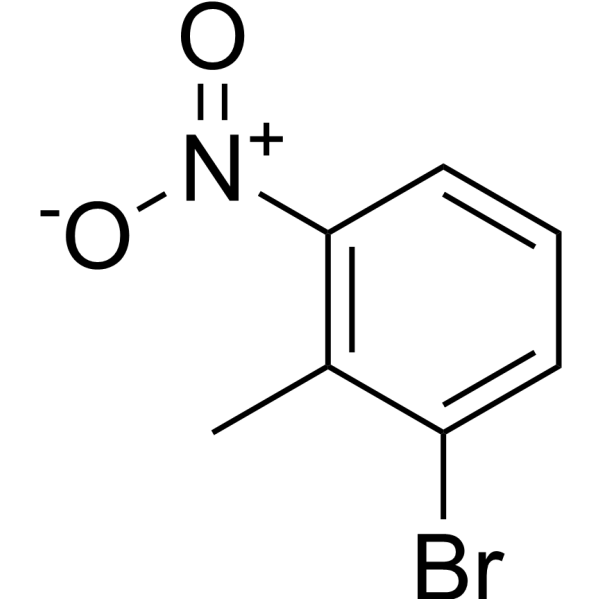
1-Bromo-2-methyl-3-nitrobenzene is an organic synthesis intermediate. 1-Bromo-2-methyl-3-nitrobenzene participates in chemical reactions such as electrophilic substitution and coupling through the bromine atom and nitro group in the molecule, and acts as a synthetic precursor. 1-Bromo-2-methyl-3-nitrobenzene can construct complex molecular structures by relying on the leaving property of bromine and the electron-withdrawing property of nitro group, and can be used in the synthesis of benzimidazole VISTA inhibitors in medicinal chemistry .
loading...
    loading...
Cat. No.: HY-W040267
CAS No.: 92220-65-0
Research Areas:  

Others

Dichlorotetrakis(2-(2-pyridinyl)phenyl)diiridium(III) is a precursor for certain OLED Iridium compounds. Dichlorotetrakis(2-(2-pyridinyl)phenyl)diiridium(III) can be used as a catalyst. Dichlorotetrakis(2-(2-pyridinyl)phenyl)diiridium(III) can also be used in the synthesis of 3,3′-([2,2′-bipyridine]-5,5′-diylbis(methylene))bis(1-ethyl-1H-imidazol-3-ium) functionalized receptor Ir-1 .
loading...
    loading...
Cat. No.: HY-W414697
CAS No.: 40289-37-0
Synonyms: D-Ribo-phytosphingosine (C17 base)
Target:  

Bacterial

Research Areas:  

Others

4-Hydroxysphinganine C17 base (D-Ribo-phytosphingosine C17 base), also known as D-ribo-phytosphingosine or PHS, is a crucial compound present in the membranes of fungi, plants, bacteria, marine organisms, and mammalian tissues. It plays a vital role in preserving the structural integrity of membranes, regulating cellular growth, and mediating the heat stress response in yeast. Additionally, PHS serves as a precursor for the synthesis of important lipid mediators such as PHS 1-phosphate, inositol phosphorylceramide, and KRN7000 (the α-anomer of galactosylceramide). Furthermore, this phospholipid promotes keratinocyte differentiation, making it a valuable active ingredient in cosmetic formulations.
loading...
    loading...
Cat. No.: HY-W587806
CAS No.: 22737-97-9
Target:  

Endogenous Metabolite

Research Areas:  

Inflammation/Immunology

9-cis Retinol is an upstream precursor of 9-cis-Retinal (HY-W009310) and 9-cis-Retinoic acid (HY-15128). 9-cis Retinol serves as a reaction substrate for cRDH, ARAT and LRAT, participates in cellular uptake and isomerization processes, and can be oxidized to form 9-cis-Retinal in the biosynthetic pathway. 9-cis Retinol inhibits the activity of 9-cis retinaldehyde dehydrogenase, thereby blocking the biosynthesis of 9-cis-Retinoic acid. 9-cis Retinol is applicable for metabolism-related research .
loading...
    loading...
Cat. No.: HY-W746100
CAS No.: 2508224-28-8
Synonyms: (S)-2-Hydroxy-4-methylpentanoic acid-d3
(S)-Leucic acid-d3 ((S)-2-Hydroxy-4-methylpentanoic acid-d3) is the deuterated-labeled (S)-Leucic acid (HY-30215). (S)-Leucic acid ((S)-2-Hydroxy-4-methylpentanoic acid) is an α-hydroxy acid found in the fermentation products of Bacillus granulobacter pectinovorum. (S)-Leucic acid is an isomer of Leucic acid (HY-30216A) and a leucine metabolite. (S)-Leucic acid acts as a D-unit subunit precursor in the biosynthesis of cryptophycins in the Nostoc cyanobacterial symbiont. (S)-Leucic acid is used in metabolism-related studies .
loading...
    loading...
Cat. No.: HY-W768934
Synonyms: L-Gulonolactone-13C6
L-Gulono-1,4-lactone- 13C6 (L-Gulonolactone- 13C6) is the 13C-labeled L-Gulono-1,4-lactone (HY-W016628). L-Gulono-1,4-lactone is a substrate of L-gulono-1,4-lactone oxidoreductase, which catalyzes the last step of the biosynthesis of L-ascorbic (Vatamin) C. In other words, L-Gulono-1,4-lactone is a direct precursor of vitamin C in animals, in plants and in some protists.
loading...
    loading...
Cat. No.: HY-Y0337AR
CAS No.: 52-89-1
L-Cysteine (hydrochloride) (Standard) is the analytical standard of L-Cysteine (hydrochloride). This product is intended for research and analytical applications. L-Cysteine hydrochloride is an orally active conditionally essential amino acid, which acts as a precursor for biologically active molecules such as hydrogen sulphide (H2S), glutathione and taurine. L-Cysteine hydrochloride suppresses ghrelin and reduces appetite in rodents. L-Cysteine hydrochloride inhibits Aspergillus flavus growth and AFB synthesis by disrupting cell structure and antioxidant system balance. L-Cysteine hydrochloride enhances relaxant responses of rat aortic rings to NO and reduces responses to endothelium-derived relaxing factor (EDRF) [4].
loading...
    loading...
Cat. No.: HY-L265
558 compounds

Cholesterol is a crucial lipid that maintains cell membrane structure, serves as a precursor for the synthesis of steroid hormones and bile acids, and plays an important role in cell signal transduction and membrane function regulation. Intracellular cholesterol levels are precisely controlled by multiple processes, including synthesis, uptake, transport, esterification, storage, and efflux. Dysregulation of cholesterol metabolism is closely associated with diseases such as atherosclerosis, fatty liver disease, metabolic syndrome, and various cancers.

The Cholesterol Metabolism Compound Library contains 558 compounds and focuses on cholesterol metabolism and homeostatic regulation. It provides an efficient tool for mechanistic studies of cholesterol metabolism and for drug discovery in metabolism‑related diseases.

Cat. No.: HY-N21613
CAS No.: 106533-40-8
Epoxyligustilide is a phthalide derivative found in the rhizomes of Ligusticum wallichii. Epoxyligustilide is the non-Z configuration of (Z)-6,7-Epoxyligustilide (HY-N17975) .
loading...
    loading...
Cat. No.: HY-P71827
Purity:  ≥ 90%, as determined by reducing SDS-PAGE.
Synonyms: ADIPOQ; Adipocyte, C1Q And Collagen Domain Containing; Prev. ACDC; Adipose Specific Collagen-Like Factor; Adiponectin; Gelatin-Binding Protein 28; ACRP30; Gelatin-Binding Protein; GBP28; Adiponectin precursor; ApM1; ADIPQTL1; Adipose Most Abundant Gene Tr
Species:  
Bovine
Source:  
P. pastoris
loading...
    loading...
Cat. No.: HY-P72489
Purity:  ≥ 95%, as determined by reducing SDS-PAGE.
Synonyms: BDNF; Abrineurin; Brain Derived Neurotrophic Factor; Brain-Derived Neurotrophic Factor Preproprotein Isoform 2; ProBDNF; Brain-Derived Neurotrophic Factor Isoform 1; Neurotrophic Factor BDNF precursor Form; ANON2; Brain-Derived Neurotrophic Factor; BULN2
Species:  
Human
Source:  
E. coli
loading...
    loading...
Cat. No.: HY-P78234
Purity:  ≥ 95%, as determined by Bis-Tris PAGE.
Synonyms: ADIPOQ; Adipocyte, C1Q And Collagen Domain Containing; Prev. ACDC; Adipose Specific Collagen-Like Factor; Adiponectin; Gelatin-Binding Protein 28; ACRP30; Gelatin-Binding Protein; GBP28; Adiponectin precursor; ApM1; ADIPQTL1; Adipose Most Abundant Gene Tr
Species:  
Mouse
Source:  
HEK293
loading...
    loading...
Cat. No.: HY-P700948
Purity:  ≥ 95%, as determined by reducing SDS-PAGE.
Synonyms: ADIPOQ; Adipocyte, C1Q And Collagen Domain Containing; Prev. ACDC; Adipose Specific Collagen-Like Factor; Adiponectin; Gelatin-Binding Protein 28; ACRP30; Gelatin-Binding Protein; GBP28; Adiponectin precursor; ApM1; ADIPQTL1; Adipose Most Abundant Gene Tr
Species:  
Cynomolgus
Source:  
HEK293
loading...
    loading...
Cat. No.: HY-P85618
Synonyms: FLJ94114; LEP; LEP_HUMAN; LEPD; Leptin; murine obesity homolog; Leptin; obesity homolog, mouse; Leptin; Leptin Murine Obesity Homolog; Leptin precursor Obesity Factor; OB; Obese Protein; Obese, mouse, homolog of; Obesity; Obesity factor; Obesity factor; Obesity homolog mouse; Obesity Murine Homolog Leptin; OBS; OTTHUMP00000212285.

Host:  

Mouse

Application:  

ELISA

Reactivity:  

Human

loading...
    loading...
Cat. No.: HY-P87321
Synonyms: 28S ribosomal protein S15 antibody; 28S ribosomal protein S15, mitochondrial [precursor] antibody; DC37 antibody; FLJ11564 antibody; mitochondrial antibody; mitochondrial ribosomal protein S15 antibody; MPR S15 antibody; MRP-S15 antibody; MRPS15 antibody; RPMS15 antibody

Host:  

Rabbit

Application:  

WB, ICC/IF, IHC-P, IP

Reactivity:  

Human

loading...
    loading...
Cat. No.: HY-P81084
Synonyms: Angiotensin Converting Enzyme 1; ACE; ACE-T; Angiotensin-converting enzyme isoform 1precursor; Dipeptidyl carboxy peptidase 1; Kininase II; ACE-1; testis-specific isoform precursor. ACE 1; ACE T; ACE1; Angiotensin converting enzyme somatic isoform; Angiotensin converting enzyme testis specific isoform; Angiotensin I converting enzyme; Angiotensin I converting enzyme 1; Angiotensin I converting enzyme peptidyl dipeptidase A 1; Carboxycathepsin; CD 143; CD143; CD143 antigen; DCP 1; DCP; DCP1; Dipeptidyl carboxypeptidase 1; MVCD3; Peptidase P; Peptidyl dipeptidase A; Testicular ECA; ACE_HUMAN.

Host:  

Rabbit

Application:  

WB, IHC-P, FC

Reactivity:  

Human, Mouse

loading...
    loading...
Cat. No.: HY-113438
CAS No.: 70981-96-3
Purity:  97.3%
15(S)-HPETE is a precursor of 15(S)-HETE (HY-113336). 15(S)-HPETE is a product of Arachidonic acid (HY-109590) in the 15-lipoxygenase pathway. 15(S)-HPETE reduces Bcl-2, Akt, and phosphorylated Akt protein levels. 15(S)-HPETE induces Apoptosis. 15(S)-HPETE antagonizes the angiogenic effects of 15(S)-HETE. 15(S)-HPETE exhibits antitumor effects against chronic myeloid leukemia. 15(S)-HPETE can be used in adipose tissue explant studies .
loading...
    loading...
Cat. No.: HY-131501
CAS No.: 523-39-7
Purity:  ≥98.0%
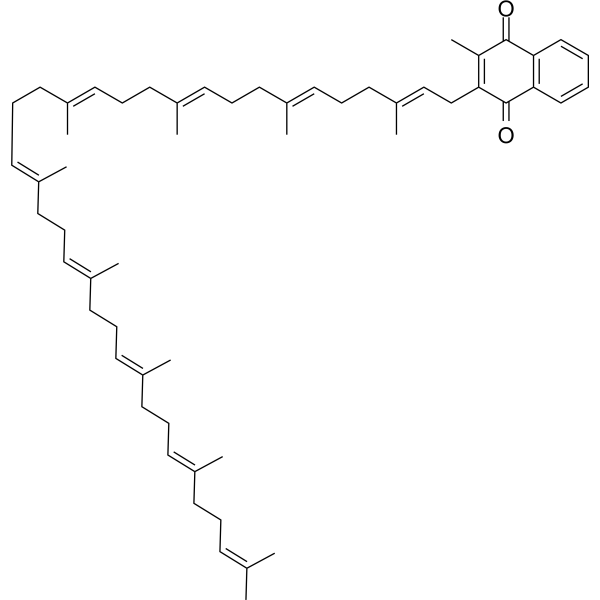
Menaquinone 9 is a naphthoquinone-type vitamin K and electron transport component produced by bacteria. Menaquinone 9 is an orally active analog of Vitamin K2 (HY-109569). Menaquinone 9 acts as an ultraviolet-sensitive, photooxidizable substrate that generates more polar photodegradation products under oxygen and ultraviolet irradiation. Menaquinone 9 binds to the αβ dimer of Escherichia coli nitrate reductase, supporting electron transport within the αβ subunit structure of the enzyme. Menaquinone 9 serves as a precursor for bone Menaquinone-4 (HY-B2156). Menaquinone 9 can be used in studies related to metabolic diseases .
loading...
    loading...

