
195 Results for "

quantify

" in MedChemExpress (MCE) Product Catalog:
Products (195)

195 Results for "quantify" in MCE Product Catalog:

Cat. No.: HY-107531R
CAS No.: 1384424-80-9
Research Areas:  

Neurological Disease Cancer

A 1070722 (Standard) is the analytical standard of A 1070722 (HY-107531). This product is intended for research and analytical applications. A 1070722 is a potent and selective glycogen synthase Kinase 3 (GSK-3) inhibitor, with a Ki of 0.6 nM for both GSK-3α and GSK-3β. A 1070722 can penetrate the blood-brain barrier (BBB) and accumulates in brain regions, thus potential for PET radiotracer for the quantification of GSK-3 in brain. A 1070722 decreases spontaneous locomotion .
loading...
    loading...
Cat. No.: HY-137672A
CAS No.: 100929-77-9
Synonyms: 2',3'-cNADP+; β-Nicotinamide adenine dinucleotide-2',3'-cyclic phosphate
2',3'-Cyclic NADP disodium (2',3'-cNADP+; β-Nicotinamide adenine dinucleotide-2',3'-cyclic phosphate) is a substrate for 2',3'-cyclic nucleotide 3'-phosphodiesterase (CNP), an enzyme abundant in myelin. It has been used in a coupled enzyme assay to quantify CNP activity. 2',3'-Cyclic NADP disodium (5 μM) increases calcium overload-induced calcium release and prevents calcium-induced swelling in rat brain mitochondria.
loading...
    loading...
Cat. No.: HY-137878
CAS No.: 26112-88-9
Synonyms: PNP-α-NeuNAc
2-O-(p-Nitrophenyl)-α-D-N-acetylneuraminic acid (PNP-α-NeuNAc) is a classic chromogenic substrate for neuraminidase. 2-O-(p-Nitrophenyl)-α-D-N-acetylneuraminic acid releases p-nitrophenol upon enzymatic hydrolysis, allowing quantification of enzyme activity and inhibitory effects via spectrophotometry. 2-O-(p-Nitrophenyl)-α-D-N-acetylneuraminic acid (PNP-α-NeuNAc) acts as a sialyl donor in the process of enzyme-catalyzed trans-sialylation .
loading...
    loading...
Cat. No.: HY-148979
CAS No.: 61216-62-4
Synonyms: SAPE
1-Stearoyl-2-arachidonoyl-sn-glycero-3-phosphorylethanolamine (SAPE) is a fluorescent reporter that specifically binds biotin. 1-Stearoyl-2-arachidonoyl-sn-glycero-3-phosphorylethanolamine produces a detectable fluorescent signal to quantify target factors. 1-Stearoyl-2-arachidonoyl-sn-glycero-3-phosphorylethanolamine can be used for the research of primary liver cancer, cervical cancer .
loading...
    loading...
Cat. No.: HY-D1603
CAS No.: 209541-26-4
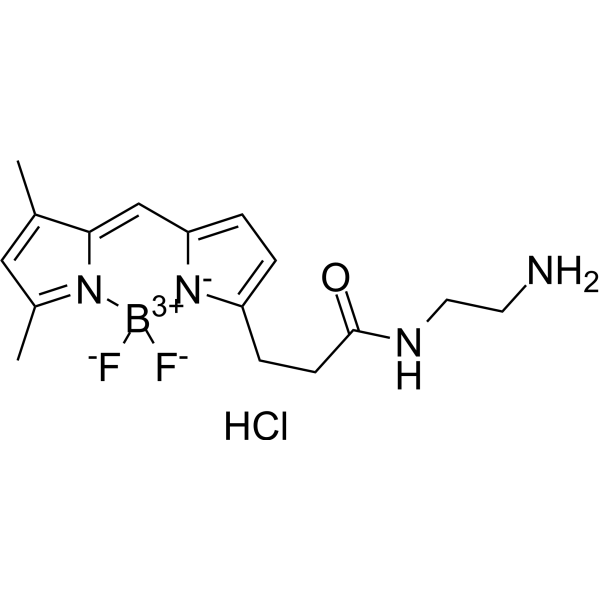
BODIPY FL-EDA is a widely used fluorescent dye for quantitative analysis of nucleotides. BODIPY FL-EDA is an aliphatic amine analog that can react with aldehydes and ketones. BODIPY FL-EDA can be used to detect both modified and unmodified deoxynucleotides and to determine DNA damage and genomic DNA methylation through capillary electrophoresis with laser-induced fluorescence (CE-LIF). Additionally, it can be used for quantifying intracellular ATP levels. The excitation wavelength is 500 nm, and the emission wavelength is 510 nm .
loading...
    loading...
Cat. No.: HY-D2817
Target:  

Fluorescent Dye

Research Areas:  

Others

FITC-PLL is a fluorescently labeled polycationic polypeptide probe composed of polylysine (PLL) and FITC (HY-66019), with a typical Ex/Em of 495/520 nm. The fluorescence intensity and lifetime of FITC-PLL are sensitive to pH and FITC density. FITC-PLL can be used for quantifying hapten receptor binding and endocytosis kinetics in macrophages, as a patternable substrate for neuron guidance, for negatively charged phospholipid membrane binding and transmembrane transport, and for live-cell imaging of starch nanoparticle conjugates and lysosome labeling .
loading...
    loading...
Cat. No.: HY-P0248F1
Research Areas:  

Others

Kemptide-FITC is a fluorescently labeled Kemptide (HY-P0248). Kemptide is a synthetic heptapeptide that acts as a specific substrate for cAMP-dependent protein kinase (PKA). Kemptide-FITC enables the quantification of PKA activity and can also indirectly determine cAMP concentrations through the activation of PKA in sperm insoluble fractions. Kemptide-FITC is applicable for kinase mobility shift assay (KiMSA), and its fluorescent signal shows a linear response with increasing peptide amount within a specific range on agarose gels .
loading...
    loading...
Cat. No.: HY-120512
CAS No.: 13159-16-5
5-Phenyl-4E-pentenol is a product of the peroxidase-catalyzed reduction of PPHP. 5-Phenyl-4E-pentenol can be rapidly isolated by solid phase extraction and quantified by isocratic reversed-phase high performance liquid chromatography (HPLC) with UV detection. 5-Phenyl-4E-pentenol is a fluorescent dye that can be used to determine the kinetic properties of heme-containing and non-heme peroxidases and to evaluate the ability of oxidative compounds to serve as substrates for peroxidase reduction. .
loading...
    loading...
Cat. No.: HY-123023
CAS No.: 84807-90-9
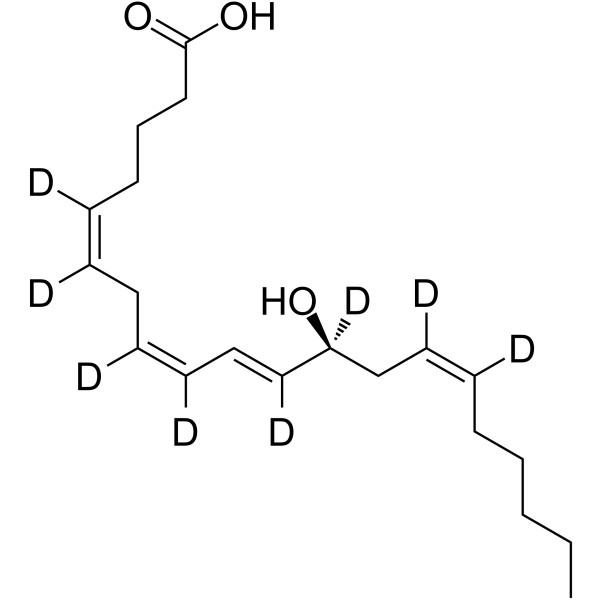
12(S)-HETE-d8 contains eight deuterium atoms at the 5, 6, 8, 9, 11, 12, 14 and 15 positions. 12(S)-HETE-d8 is intended for use as an internal standard for the quantification of 12(S)-HETE by GC- or LC-mass spectrometry (MS). 12(S)-HETE-d8 is the predominant lipoxygenase product of mammalian platelets. It enhances tumor cell adhesion to endothelial cells, fibronectin, and the subendothelial matrix at 0.1 µM.
loading...
    loading...
Cat. No.: HY-182626
CAS No.: 1246526-29-3
CS1P1 is a brain-penetrant and selective S1PR1 antagonist and PET radiotracer, with human S1PR1 IC50 values of 2.1 nM. CS1P1 binds specifically to S1PR1 to enable in vivo receptor expression quantification. CS1P1 can be used as PET radiotracer when labelled with 11C. CS1P1 can be used for the research of multiple sclerosis, neointimal hyperplasia, vascular inflammation .
loading...
    loading...
Cat. No.: HY-D2758
CAS No.: 1911598-65-6
TAMRA DBCO, 5-isomer is a derivative of TAMRA fluorescent isomer with a DBCO functional group. TAMRA DBCO, 5-isomer undergoes strain-promoted azide-alkyne cycloaddition (SPAAC) under copper-free catalytic conditions. TAMRA DBCO, 5-isomer serves as a FRET acceptor for FAM fluorophores. TAMRA DBCO, 5-isomer can label proteins, peptides, nucleic acids and all azide-modified biomolecules, and is suitable for fluorescence imaging and flow cytometry to quantify intracellular SPAAC reactions .
loading...
    loading...
Cat. No.: HY-D2902
CAS No.: 2080332-70-1
SNOTRAP (SNO trapping by triaryl phosphine) is a chemical probe used for detecting S-nitrosylated (SNO) proteins. SNOTRAP selectively converts S-nitrosylated cysteines in proteins into stable disulfide-iminophosphorane intermediates, which are then enriched with streptavidin and detected by nanoLC-MS/MS. SNOTRAP enables global enrichment and label-free quantification of SNO proteins and their modification sites in complex biological samples such as mouse brain tissues. SNOTRAP can be applied to studies related to nitrosative stress-associated diseases, including neurodegenerative diseases, cancer, and multiple sclerosis .
loading...
    loading...
Cat. No.: HY-P2893A
CAS No.: 37340-58-2
Synonyms: Creatine amidinohydrolase
Target:  

Endogenous Metabolite

Research Areas:  

Metabolic Disease

Creatinase (Recombinant) is a hydrolase responsible for catalyzing the hydrolysis of creatine (HY-W010388) into sarcosine (HY-101037) and urea (HY-Y0271). Creatinase (Recombinant) can be used in conjunction with creatinine deiminase (HY-P2838) and sarcosine oxidase (HY-P2861) in an enzyme cascade reaction to measure creatinine (HY-B0504) levels in blood and urine. Creatinase (Recombinant) is the rate-limiting enzyme in this enzymatic cascade, and the enzymatic quantification of creatinine is an important method for evaluating kidney function .
loading...
    loading...
Cat. No.: HY-W706672R
CAS No.: 86850-72-8
Synonyms: Glycerol Tritricosanoate (Standard); TG(23:0/23:0/23:0) (Standard); Tritricosanoin (Standard)
Propane-1,2,3-triyl tritricosanoate (Standard) is the analytical standard of Propane-1,2,3-triyl tritricosanoate. This product is intended for research and analytical applications. 1,2,3-Tritricosanoyl glycerol is a triacylglycerol that contains tricosanoic acid (HY-W009081) at the sn-1, sn-2, and sn-3 positions. It has been used as an internal standard for the quantification of fatty acids in the triglyceride component of human aortic endothelial cells (HAECs) grown in media supplemented with stearic and/or oleic acid.
loading...
    loading...
Cat. No.: HY-W710512
Synonyms: Glycerol Tritricosanoate-d5; TG(23:0/23:0/23:0)-d5; Tritricosanoin-d5
Propane-1,2,3-triyl tritricosanoate-d5 (Glycerol Tritricosanoate-d5) is deuterium labeled Propane-1,2,3-triyl tritricosanoate. 1,2,3-Tritricosanoyl glycerol is a triacylglycerol that contains tricosanoic acid (HY-W009081) at the sn-1, sn-2, and sn-3 positions. It has been used as an internal standard for the quantification of fatty acids in the triglyceride component of human aortic endothelial cells (HAECs) grown in media supplemented with stearic and/or oleic acid.
loading...
    loading...
Cat. No.: HY-W750595
CAS No.: 13392-24-0
Target:  

Drug Derivative

Research Areas:  

Cancer

6-(L-1,2,3-Trihydroxybutyl)-pterin is a derivative of L-biopterin (HY-102015) and is the oxidized form of tetrahydro-L-biopterin (BH4) as well as D-biopterin. Co-ingestion of 6-(L-1,2,3-Trihydroxybutyl)-pterin (0.5%) with the carcinogen 4-dimethylaminoazobenzene reduces the incidence of 4-dimethylaminoazobenzene-induced liver tumors in rats. 6-(L-1,2,3-Trihydroxybutyl)-pterin has been used as an internal standard for the LC-MS quantification of biopterin and neopterin in rat plasma.
loading...
    loading...
Cat. No.: HY-180306
CAS No.: 84693-92-5
Fluoroestradiol is an Estrogen receptor PET imaging tracer precursor. Fluoroestradiol, when radiolabeled with 18F, can be used as an Estrogen receptor PET imaging tracer. 18F-Fluoroestradiol exhibits the highest uptake selectivity and target-to-background ratio among
several 18F-labeled estrogens. 18F-Fluoroestradiol has demonstrated Estrogen receptor expression in normal brain tissues and in meningiomas. 18F-Fluoroestradiol can quantify regional Estrogen receptor expression in breast cancer. 18F-Fluoroestradiol has potential applications in assessing and monitoring heterogeneity in ovarian cancer .
loading...
    loading...
Cat. No.: HY-DY2037
Target:  

Fluorescent Dye

Research Areas:  

Others

Lignin Staining Solution (Safranin Method) is a histochemical staining solution for lignin with Safranin O as the active component. Lignin Staining Solution (Safranin Method) enables lignified cell walls to appear red to deep red (pinkish in regions with low lignification) via the high affinity of the dye for lignin. Lignin Staining Solution (Safranin Method) can be used to visualize lignin distribution in ex vivo thick sections of annual shoots from woody plants and vibratome sections of stems from herbaceous plants (such as Arabidopsis and flax), as well as for in situ quantification of cell wall substructural regions (cell corners, intercellular layers, secondary walls) based on Safranin O ratiometric fluorescence .
loading...
    loading...
Cat. No.: HY-184777
CAS No.: 94367-34-7
Target:  

Aminopeptidase

Research Areas:  

Others

Met-AMC is a fluorescent substrate used to detect the activity of methionine aminopeptidase (MetAP). Hydrolysis of the substrate releases the fluorophore AMC, with detection performed at an excitation wavelength of 360 nm and an emission wavelength of 460 nm. Met-AMC can distinguish the effects of different metal cofactors on the substrate preference of MetAP1: Zn (II)-MetAP1 barely hydrolyzes Met-AMC, while Co (II)-, Mn (II)-, and Ni (II)-MetAP1 can stably cleave this substrate. Met-AMC can be used to establish an intracellular MetAP activity cell-based assay system, which quantifies the intracellular MetAP inhibition level by monitoring the fluorescence signal from substrate hydrolysis in living cells .
loading...
    loading...
Cat. No.: HY-DY1089
CAS No.: 797785-10-5
Di-4-ANEPPDHQ (solution) is a polarity-sensitive membrane probe with a doubly positive charge that can be used to visualize membrane microdomains in living Arabidopsis cells. Di-4-ANEPPDHQ produces a fluorescence spectrum shift by changing the polarity of the lipid environment after embedding into the cell membrane, thereby quantifying the degree of lipid accumulation. The excitation wavelength of Di-4-ANEPPDHQ is 488 nm, and the emission wavelengths are 560 nm and 650 nm in the liquid ordered and disordered phases, respectively. Di-4-ANEPPDHQ is often used for fluorescence imaging studies of membrane microstructure, lipid order, and membrane tension response in living cells[1][2][3].
Solvent and concentration: DMSO: 5 mM
loading...
    loading...

